Q4 Sales Seasonality: Which Industries Gain and Which Lose? 2026 Trend Analysis

8min.

Comments:0

24 November 2026

Q4 Sales Seasonality: Which Industries Gain and Which Lose? 2026 Trend Analysis
The last quarter of the year is the most important period for e-commerce businesses, but not every industry benefits from it to the same extent. According to Shoper, an e-commerce platform for online stores in Poland, 17 of the 20 industries analyzed increase their revenue year over year in Q4, and for toys, as much as 44% of annual sales falls in the last three months of the year. In this article, we analyze the trends based on sales data and suggest how to use the insights when planning your marketing strategy for this period.

8min.

Comments:0

24 November 2026

Key Takeaways

    • Q4 accounts for about 30% of Polish e-commerce’s annual turnover, but not every industry benefits from the seasonal sales boost to the same degree.
    • September 2026 brought strong sales growth in construction (+28.3%) and furniture (+22.7%), while electronics stagnated.
    • Google Trends data from 2023 to 2026 shows that interest in products grows at different times, from October for winter tires to November and December for gifts.
    • An effective SEO and Google Ads strategy for Q4 requires early preparation and budgets matched to the seasonality of each product category.
    • More orders don’t always mean more profit, so besides revenue, you need to monitor margins, ad costs and promotion profitability.

    How Important Is Q4 for Online Sales in Poland?

    Q4 is the season of getting ready for winter, Black Week (or even a whole Black Month), St. Nicholas Day (a gift-giving occasion in Poland on December 6) and, finally, holiday shopping. Although these occasions fall close together, they don’t mean the same level of demand for every industry at the same time.

    According to “How Do Poles Shop in Q4?”, a report by the Polish e-commerce platform Shoper based on data from more than 10,000 online stores:

    • Q4 accounted for 9 of the 10 strongest sales days in 2025,
    • 17 of the 20 industries analyzed improved their results year over year in this period,
    • in the toy category, as much as 44% of annual sales was generated in Q4,
    • 61.4% of December sales value came from new customers.

    The same trend is confirmed by broader, market-wide estimates from the Polish Chamber of Commerce (KIG), based on data from Statistics Poland (GUS). They show that e-commerce turnover in Poland from October to December 2025 reached PLN 27.4 billion, about 30% of the total for 2025.

    Keep in mind, however, that a market-wide average can be misleading. An online toy store should prepare for Q4 differently than a store selling electronics, tires or patio furniture.

    Why Doesn’t Q4 Mean Growth for Everyone?

    Seasonal sales depend on many factors, such as consumer needs, the weather and the nature of the products. For toy sellers, the holiday season will be key, while for winter tires, the biggest trigger for sales growth will be changes in temperature.

    That’s why planning your Q4 marketing budget should start with seasonality data for a specific category, not with the general belief that sales always grow in Q4. The quarter lasts three months, and each industry’s period of strongest demand growth may come at a different time.

    How Much Momentum Did Polish E-commerce Have Entering Q4 2026?

    The latest available data covers the period just before Q4 began, September 2026. According to the Shoper Trends report, sales in the stores analyzed grew by 13.1% year over year that month, the highest growth rate of any month in 2026. The number of orders, the number of buyers and the average order value all increased.

    Data from Statistics Poland points in a similar direction: according to KIG estimates, e-commerce turnover in September 2026 was 18.7% higher than a year earlier.

    This growth is driven mainly by a larger number of buyers, not by more expensive baskets. For stores, that’s an important signal: more orders don’t have to mean better profitability, especially if discounts and ad budgets are growing at the same time.

    Which Industries Are Gaining and Which Are Losing Before Q4 2026? Sales Data

    Na podstawie wspomnianego raportu Shoper Trends:
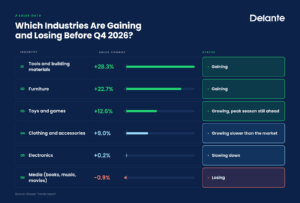
    Chart: year-over-year sales change by industry in Polish online stores in September 2026, based on Shoper Trends

    Market-wide data from Statistics Poland adds two more groups that saw sales grow in September 2026: pharmaceuticals, cosmetics and orthopedic equipment (+45.2%) and furniture, consumer electronics and home appliances (+40.7%). Below, we’ve prepared a detailed analysis for each industry.

    September’s results show the condition of each industry going into Q4, but they don’t determine the results for the whole quarter, which are shaped by Black Friday, holiday shopping and seasonal shifts in demand, among other things.

    Construction and Furniture: A Strong Start to the Fall

    Sales of tools and building materials rose by 28.3% year over year, and furniture sales by 22.7%. September’s data shows that you shouldn’t automatically assume interest in these categories drops as summer ends. In the furniture industry, customer acquisition matters most: according to Shoper, as much as 79% of furniture sales come from new customers. This is a category where you win by being present while potential customers are doing their research.

    Electronics: More Orders Don’t Have to Mean Higher Sales

    The value of electronics sales grew by only 0.2% year over year in September, even though there were 10.9% more orders. According to Shoper, this may mean that shoppers are buying more inexpensive accessories instead of pricier devices. However, it doesn’t signal a weak Black Friday. Quite the opposite: some shoppers may be deliberately putting off their purchases until the promotions start.

    See also: Will Your Product Make the ChatGPT Shortlist Before Black Friday? How AI Narrows Down Product Choices

    The takeaway? A growing number of orders looks good in a report, but it doesn’t always mean higher revenue. Consumer electronics and home appliance stores should monitor the number of transactions, sales value and margins separately.

    Sports: The End of Summer Doesn’t Mean the Whole Industry Is Declining

    Sales of sporting goods were 13.9% higher year over year in September, but they fell by 9.5% compared with August. So an industry can grow year over year and lose momentum after the summer season at the same time.

    In Q4, demand shifts toward winter sports, indoor training and gifts, so sporting goods stores should move their ad budgets to these categories.

    Books, Music and Movies: A Weaker September Despite the Upcoming Gift Season

    Books, music and movies was the only category in Shoper’s ranking with a year-over-year drop in sales (-0.9%). Of course, this doesn’t determine the result for the whole quarter, but it shows that not every category enters Q4 with similar momentum. It’s worth analyzing new releases, gift products and the rest of the range separately.

    Seasonality in Google Trends: Comparing 2023 to 2026

    Sales data shows which industries are actually growing in terms of revenue, while Google Trends lets you check when users start searching for products in a given category and whether these moments of demand stay the same or change over the years. We analyzed keyword popularity from 2023 to 2026, using US data and English search terms.

    Google Trends shows relative interest on a scale of 0 to 100, not the exact number of searches. That’s why we treat it as a signal of when demand is rising, not as a measure of an industry’s actual results in a given period.

    Gift Products: Toys, Perfume and Smartwatches

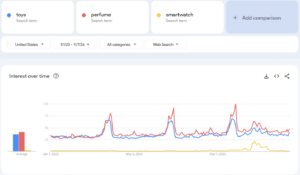
    The chart below shows keyword popularity data for gift categories:

    Google Trends chart: US search interest in toys, perfume and smartwatch, January 2023 to November 2026

    Source: Google Trends

    After analyzing the trends from January 2023 to November 2026, we can draw the following conclusions:

    • Perfume: interest starts climbing in early November, jumps in the week of Black Friday and peaks in the week before Christmas. In 2025, this was the highest point of the whole period.
    • Toys: there’s a clear rise from early November, and the term is most popular from late November to mid-December, which points to growing interest as the holidays approach.
    • Smartwatch: in the US, the generic term gets very few searches compared with toys and perfume, and it shows no holiday peak. The only clear rise came in spring 2026.

    Categories With Different Seasonality: Winter Tires, Patio Furniture and BBQ Grills

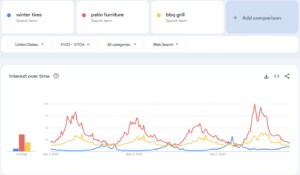
    For comparison, we also checked search terms for industries that are seasonal at different times of the year by nature. The Google Trends results confirm this:

    Google Trends chart: US search interest in winter tires, patio furniture and bbq grill, January 2023 to November 2026

    Source: Google Trends

    • BBQ grill: the term peaks at about the same time every year, in early summer, between Memorial Day and the Fourth of July.
    • Patio furniture: interest is highest in April and May, before the summer season. In the fall, it’s two to four times lower.
    • Winter tires: interest grows from October and, depending on the year, peaks in late October, late November or early December. This suggests that the weather is an important factor in when demand peaks in this industry.

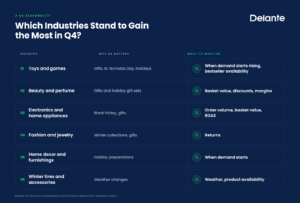
    Which Industries Stand to Gain the Most in Q4?

    Based on historical seasonality and financial results from previous years, we can identify several industries that should prepare especially carefully for Q4 and monitor their results on an ongoing basis.

    Table: industries that stand to gain the most in Q4, why Q4 matters for them and what to monitor

    In some categories, users start their research much earlier but only complete the purchase during promotions, so the greatest potential doesn’t always fall in November or December alone.

    Which Industries May Lose Out in Q4?

    For weather-dependent products, a drop in interest in the fall is natural. Google Trends confirms this for, among others:

    • garden products, including patio furniture and grilling equipment: in the fall, interest in these products is several times lower than at their spring and early summer peak,
    • air conditioning: searches for “air conditioner” peak only in summer, during heat waves,
    • summer sports and outdoor gear: according to Shoper’s report, sales of sporting goods fell by 9.5% in September compared with August, and Google Trends also confirms lower interest in these categories in winter.

    These forecasts refer to seasonal declines and don’t mean year-over-year declines in this period.

    Does Lower Demand Mean You Should Cut Your Marketing Budget?

    Not always. A period of lower demand is a good time for SEO and AISO work that will build your website’s visibility for the coming seasons. For example, a patio furniture store can already work on the categories and products that will start performing in spring. In ad campaigns, on the other hand, it’s worth checking whether lower competition off-season lets you acquire traffic more cheaply, but you shouldn’t assume that CPC always falls along with demand.

    When Exactly Does the Q4 Shopping Season Start?

    One of the biggest mistakes is treating the whole of Q4 as a single, uniform shopping period. Data from 2023 to 2026 shows that industries reach their seasonal peak at different times. Below, we’ve put together a calendar for the different stages of the quarter:

    Period What’s happening? What should you plan?
    September and October Demand grows for winter tires and seasonal products SEO, content, preparing offers
    Late October and early November Toys and gifts take off Gift campaigns, product feed
    November Black Week, high demand for perfume Sales campaigns, margin control
    First half of December Gift searches peak Logistics, delivery deadlines
    Late December Gift demand drops Retention, remarketing, Q1 plan

    How Does Q4 Sales Seasonality Affect SEO and Google Ads?

    In Google Ads, growing interest means more searches and clicks from campaigns, but often also more competition. This won’t always mean a higher CPC, and sometimes even much more expensive clicks during Black Friday will still be profitable if the conversion rate and order value grow enough.

    In SEO, preparing seasonal content, category pages and product pages early will be key. Optimizing when demand is already peaking is usually too late and won’t deliver results quickly enough.

    What Data Should You Analyze Before Increasing Your Budget?

    Metric What does it show?
    Google Trends When interest grows
    Search volume The scale of demand
    CPC Cost per click
    Conversion rate Willingness to buy
    ROAS Revenue relative to ad costs
    Margin The real profitability of promotions

    Simply assessing whether an industry’s seasonality grows in Q4 won’t be enough to make strategic decisions. You also need to check whether the company can take advantage of this growth profitably. Promotions with overly steep discounts and competing at any cost can mean that, in the end, profits fall short of a satisfactory level.

    Delante’s Decision Matrix: How Should You Adapt Your Strategy to Your Industry’s Situation?

    Situation What should the business owner do?
    The industry has a strong sales peak in Q4 Prepare SEO, campaigns and inventory before demand grows
    Interest grows earlier than sales Develop content and brand awareness activities
    Sales are growing, but margins are falling Review discounts, ad costs and profitability
    The industry is seasonally losing interest Shift some activities to preparing for the next season
    The number of orders is growing faster than their value Analyze basket composition and profitability
    Results vary widely across categories Split the budget at the level of products and product groups

    For e-commerce, another important part of the strategy will be analyzing the seasonality of every product category separately. In a sporting goods store, interest in outdoor activity products may drop in Q4 while winter sports gear grows at the same time.

    Q4 2026 Sales Seasonality: Key Takeaways for Business Owners

    Q4 accounts for almost 30% of the Polish e-commerce sector’s annual turnover, and September 2026 showed that the market is entering this period with strong momentum. However, September’s data shows very different results across industries, from strong growth in construction and furniture to stagnation in electronics and a decline in media. Google Trends, in turn, shows that the start of the season for each industry is very consistent from year to year.

    The key takeaway? There’s no single Q4 seasonality calendar that works for every store. When interest starts to grow, when sales peak and how profitable promotions are all need to be analyzed separately for each category.

    At Delante, we help combine data analysis with SEO and Google Ads campaigns so you can make better use of seasonal shifts in demand and plan sales for the coming quarters.

    Let's Talk About Your Google Ads Campaign!

    Learn More
    Tomek Gniecki
    Tomek Gniecki SEM & Analytics Specialist

    Sources:

    • https://www.shoper.pl/learn/ebooki-ecommerce/raport-2026
    • https://www.shoper.pl/learn/artykul/shoper-trends-wrzesien-2026
    • https://kig.pl/wp-content/uploads/2026/10/Miesiecznik-e-handlu_2026-10-23.pdf
    • https://kig.pl/wp-content/uploads/2026/01/Miesiecznik-e-handlu_2026-01-27.pdf
    • https://trends.google.com/trends/
    Author
    Mateusz Calik - CEO
    Author
    Matt Calik

    CEO

    CEO, has been building Delante since 2014. Responsible for international SEARCH strategies. He has a strong analytical approach to online marketing backed by more than 12 years of experience. Previously associated with the IT industry, as well as the automotive, tobacco, and financial markets. Has experience in creating scaled processes based on agile methodologies.

    Author
    Mateusz Calik - CEO
    Author
    Matt Calik

    CEO

    CEO, has been building Delante since 2014. Responsible for international SEARCH strategies. He has a strong analytical approach to online marketing backed by more than 12 years of experience. Previously associated with the IT industry, as well as the automotive, tobacco, and financial markets. Has experience in creating scaled processes based on agile methodologies.

    FAQ

    Which E-commerce Industries Could Gain the Most in Q4 2026?

    The greatest seasonal potential lies mainly with toys and games, perfume and cosmetics, electronics, fashion and gift products. Historical data shows that for toys, as much as 44% of annual sales falls in Q4. You can also expect growing interest in winter tires and seasonal accessories, although the timing of peak demand depends on factors such as the weather.

    Which Industries Lose Interest in the Last Quarter of the Year?

    In Q4, interest seasonally drops mainly for garden products, patio furniture, grills, air conditioners and summer sports gear. However, this doesn’t automatically mean a year-over-year drop in sales. It’s worth analyzing individual product categories, because even within one industry, some products may lose popularity while others gain it.

    When Is the Best Time to Start Preparing SEO and Google Ads for Q4?

    It’s best to start SEO work before seasonal interest grows, because optimizing content and product categories takes time. Google Ads campaigns, on the other hand, should be planned around when demand grows in a specific industry. For example, interest in winter tires grows in the fall, interest in toys around the turn of October and November, and interest in gift products often peaks in November and December.