How Do Customers Search for Cosmetics in Google and AI? From Skin Concern to Product Choice

6min.

Comments:0

08 October 2026

How Do Customers Search for Cosmetics in Google and AI? From Skin Concern to Product Choice
People used to go to a drugstore to buy cosmetics. Today, the path to purchase looks very different. Potential customers check recommendations, compare products or ask AI to put together a skincare routine. In this article, you'll learn how beauty consumers use search engines and artificial intelligence.

6min.

Comments:0

08 October 2026

Key Takeaways

  • Customers look for solutions: today’s beauty purchase journey starts with a description of a skin concern.
  • AI is taking on the role of a virtual advisor: tools such as ChatGPT or Google AI Overviews can seamlessly combine multiple criteria (skin type, budget, required ingredients) and turn them into ready-made, personalized skincare routines.
  • Comprehensive content fuels the algorithms: for AI to recommend your cosmetics, you have to give it data. Your e-commerce store needs, among other things, ingredient databases (INCI), routine guides and articles that cover different skin concerns.
  • A holistic strategy wins: effective marketing requires consistently combining technical SEO, building authority (E-E-A-T), GEO (visibility in Google’s AI) and AISO (external LLMs).

Problems, Not Products: How Does the Beauty Purchase Journey Begin?

Your potential customer rarely starts their purchase journey by typing in a specific brand name. Instead, they look for a solution. They type their problem into Google, e.g., “what to use for dry skin”, the result they expect, e.g., “serum for hyperpigmentation”, ingredient requirements or limitations, such as a budget: “routine under $50”.

What Does the Cosmetics Search Journey Look Like?

The process can be divided into seven stages.

StageWhat does the user want to find out?Example query
Recognizing the needWhat’s happening to my skin or hair?“why does my skin feel tight after washing”
Naming the goalWhat result do I want to achieve?“how to improve skin hydration”
Learning about solutionsWhich products or ingredients can help?“ceramides or hyaluronic acid”
Choosing a categoryWhat kind of product do I need?“ceramide serum or cream”
ComparisonWhich product best meets my criteria?“comparison of creams for sensitive skin”
VerificationIs the product trustworthy and right for me?“product X reviews”, “product X ingredients”
PurchaseWhere can I buy the product at a good price?“product X price”, “product X availability”

Scattered Research: Where Do Your Customers Check Cosmetics Before Buying?

It’s hard not to notice that research in the beauty industry is highly scattered. A survey of 1,300 UK skincare consumers illustrates this well. It found that 83% of respondents had bought skincare products after first searching online, including on Google, social media and AI.

However, each of these touchpoints plays a different role in the purchase journey:

On Google, users mainly look for verification and want to complete the purchase. They’re interested in:

  • answers to their questions
  • specific products and their variants
  • current prices
  • reviews
  • photos
  • trustworthy sellers

TikTok, Instagram and YouTube are channels of inspiration that provide:

  • demonstrations of how a product behaves on the skin
  • ready-made skincare routines
  • social proof

AI takes on the role of an advisor. In a split second, it can combine several conditions in a single query, taking into account, among other things:

  • skin type and specific concerns
  • a set budget
  • desired ingredients
  • the products the customer has used so far
To close sales effectively, your store has to provide hard data for Google, educational and well-structured content for AI and the social proof customers have already seen on social media.

How Exactly Does Searching on Google Differ from Asking AI?

ElementGoogleAI systems
Query formatUsually shorter and keyword-basedUsually longer and conversational
AnswerA list of results, products, images and other contentA synthesized answer or recommendation
User’s roleOpens and compares sources on their ownProvides criteria and expects them to be combined
PersonalizationDepends on the query, location and historyCan take into account a lot of information shared in the conversation
Typical useResearch, verification, price and purchaseExplanation, comparison and building a routine
Main riskToo many similar resultsIncorrect or outdated information
Importance of product dataBardzo wysokieVery high
Importance of external sourcesWysokieVery high
Position in the sales funnelMainly the middle and bottom of the funnelMainly the top and middle of the funnel

What If We Ask Google and AI the Same Thing?

Google searches are often based on short phrases, while LLM queries tend to be longer and more detailed. Thanks to Google AI Overviews, however, that line is blurring. The search engine is learning to handle complex queries so it can keep users on its own pages. Let’s see how both tools handle the challenge today when we give them a full, complex description of a skin concern in a single sentence.

We prepared a sample query:

“I have very dry, sensitive skin. Put together a simple 3-step evening routine for me for under PLN 150. I want ceramides and no fragrance.”

Google Search:

At the very top of the results, a generated “AI Overview” appears. Google immediately gives a direct answer, a so-called Direct & Immediate Answer. It reassures the user that the routine will fit within a budget of PLN 105 to 130 and recommends specific fragrance-free products.
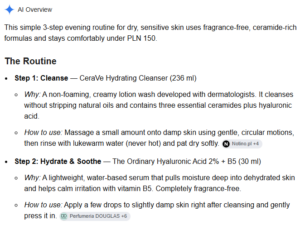
Google AI Overviews answer to a query about a 3-step evening routine

Source: Google AI Overviews answer in Google Search

Next, AI breaks the routine down into a 3-step skincare plan, giving specific prices, sizes and how the ingredients work.
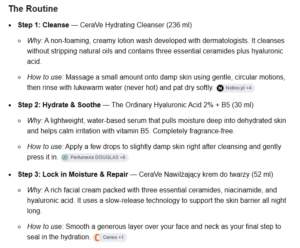
Google AI Overview answer, 3-step evening skincare routine

Source: Google AI Overviews answer in Google Search

The most important part, however, happens on the right side of the panel and below it. Google bases its recommendations on external sources. In the box to the right of the answer, AI suggests links to the blog articles Google took its information from. And below the AI answer, the organic results feature YouTube and TikTok videos that show ready-made evening skincare routines for sensitive skin.
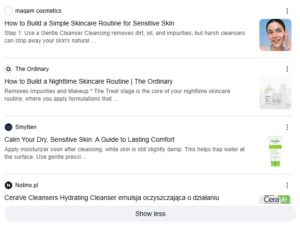
Skincare and skin health blogs and guides, sources cited by Google AI Overviews

Source: Sources cited by Google AI Overviews in Google Search
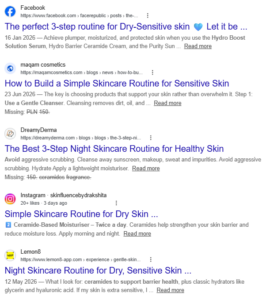
Search results, skincare routines on social media

Source: Google Search

ChatGPT:

If we enter the same prompt into ChatGPT, we’ll see that the LLM approaches the task very similarly to Google AI Overviews.

The language model also has no trouble breaking the routine down into 3 specific steps. What’s more, like the search engine, it recommends specific products, states what they’re for and gives estimated prices, making sure everything fits within the set budget.
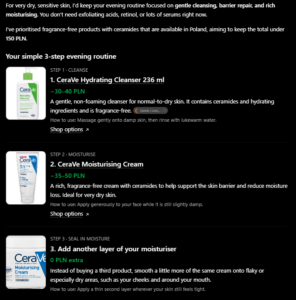
 

ChatGPT answer, 3-step evening skincare routine

Source: ChatGPT answer

There is one difference, though. At the very end, ChatGPT takes on the role of a cautious cosmetologist. The model adds important educational value that was missing from Google’s overview. It warns against introducing acids or retinoids for reactive skin and clearly recommends a patch test before applying new cosmetics.

Source: ChatGPT answer

The lines between the search engine and language models are blurring significantly. Both tools can recommend specific products from your store. Although users still type short phrases more often in classic search, Google AI Overviews and the new AI Mode were created precisely to give accurate answers to complex, long-tail queries. This short experiment shows that Google, too, may become a place where users increasingly ask more personalized questions.

If you want your store to appear at the very top of AI-generated results and in Google AI Overviews answers, you should invest in a combination of solid technical SEO, expert guides that build E-E-A-T authority and modern GEO and AISO activities, all at the same time. This comprehensive content architecture will help you become visible at every stage of your customer’s purchase journey.

What Do Customers Pay Attention to When Choosing Cosmetics?

Potential customers pay particular attention to the quality of information. Users want to know who a product is for, how to use it, how to combine ingredients, what to expect and when to be careful. That’s why it’s so important that the cosmetics sold in your store have clearly described effects, for both the product and its ingredients.

The scale of this need is well illustrated by the COSMILE Europe database (rel=”nofollow”, as in the original), which provides scientifically verified information on nearly 30,000 cosmetic ingredients. It’s a clear signal that explaining INCI lists transparently is no longer optional and has become a market standard.

When creating product descriptions and guides, you have to comply with EU regulations. They require every claim about what a cosmetic does to be backed by hard evidence. In practice, this means you can’t automatically attribute the properties of a single ingredient to the entire finished formula. Also make sure your communication doesn’t suggest treating diseases if the product doesn’t have the appropriate status and medical documentation.

What Content Should a Beauty Brand Prepare?

The content architecture of your store should capture users at every stage of the purchase funnel. Focus on the variety and quality of your content to effectively win traffic from search engines and AI answers.

Pay attention to 5 content formats that should be on your website:

  • Problem-focused content that responds to the customer’s first concerns, e.g., “how to recognize a weakened hydrolipid barrier?”
  • Ingredient databases that explain the functions and purpose of specific substances and the rules for combining them.
  • Routine guides that provide ready-made skincare plans categorized by skin type, concern, time of day or budget.
  • Product comparisons that make the final choice easier by highlighting real differences.
  • Product pages that include a clear intended use, the full ingredient list, directions for use, contraindications, price, availability and reviews.

Want to learn how to implement these formats step by step to give algorithms the ideal data? Read our detailed guide: How to Create Cosmetics Content That Builds Google Visibility and AI Recommendations.

Summary: How Do You Win the Race for the Beauty Customer in the AI Era?
 

A customer looking for a cosmetic goes through a multi-step journey, from noticing a problem to learning about possible solutions, ingredients, categories and specific products. To answer their questions, a cosmetics brand has to provide expert content that explains how products work and how to use them, while the e-commerce store itself should make it easy to choose based on need, skin type, budget and availability.

The biggest advantage will go to companies that combine expert knowledge with complete product data and a simple path to purchase. That way, they’ll be visible both at the start of the research and at the decisive moment of choosing a specific product.

Wondering what this looks like in practice for a beauty brand? See how we combine SEO and AI search for beauty companies in our beauty SEO and AI search case study.

Sources:

Author
Michał Grzyb - Junior SEO Specialist
Author
Michał Grzyb

SEO & AI Specialist

Graduate of Management at the Cracow University of Economics. His interest in internet marketing and SEO began during his studies and led him to start working at Delante in August 2022. Expert in building visibility in traditional search engines and AI models. Privately a lover of physical activity in any form and good food.

Author
Author
Martyna Zemła

Junior SEO Specialist

Author
Michał Grzyb - Junior SEO Specialist
Author
Michał Grzyb

SEO & AI Specialist

Graduate of Management at the Cracow University of Economics. His interest in internet marketing and SEO began during his studies and led him to start working at Delante in August 2022. Expert in building visibility in traditional search engines and AI models. Privately a lover of physical activity in any form and good food.

Author
Author
Martyna Zemła

Junior SEO Specialist