AI Search Optimization vs. AI Ads: What’s the Difference?

10min.

Comments:0

19 November 2026

AI Search Optimization vs. AI Ads: What’s the Difference?
AI search optimization (AISO) increases the chances of your brand appearing organically in AI answers and recommendations, while AI ads also let you reach users with paid messages. The two channels can complement each other, just as SEO and SEM have worked together in Google for years. However, they differ in how they work, how much control they give you over visibility, how long they take to deliver results and how their effectiveness is measured.

10min.

Comments:0

19 November 2026

Key Takeaways

    • AISO builds a brand’s organic visibility in AI answers, while ChatGPT Ads makes it possible to reach potential customers through paid placements.
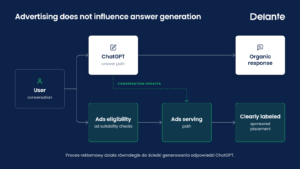
    • Ads in ChatGPT don’t affect organic AI recommendations, because the two mechanisms work independently.
    • AISO and AI ads can complement each other by drawing on shared data, content and knowledge of customer needs.
    • Delante’s first ChatGPT Ads tests delivered more than 690,000 impressions, 13,300 clicks and 430 reported conversions, but results vary between campaigns.
    • The choice between AISO and ChatGPT Ads should depend on your company’s goals and budget, and the effectiveness of both should be judged by their real impact on the business.

    AI Search Optimization vs. AI Ads: The 7 Key Differences

    Although AISO and AI ads, such as ChatGPT Ads, share the same business goal, acquiring customers, they work according to separate mechanisms. We’ve summarized the key differences in the table below:

    Criterion AI search optimization (AISO) AI ads
    Goal Building organic brand visibility in answers and recommendations Reaching users through paid placements
    Mechanism Optimizing on-site content, brand information and the brand’s presence in external sources Matching and serving sponsored messages as part of ad campaigns
    Where it appears AI answers, recommendations, mentions and citations Dedicated ad placements
    Control No guarantee of appearing in an answer Campaigns can be managed, with no guarantee of specific ad delivery
    Cost model Investment in strategy, content, optimization and monitoring Media budget plus campaign management
    Timing and durability Visibility built gradually, potentially long-term Traffic can be acquired while ads are running
    Measurement AI Search Presence, Share of Voice, Citation Share, traffic and conversions from AI channels Impressions, CTR, CPC, CPA, conversions and ROAS

    The most important difference comes down to what the company is actually paying for.

    With AISO, the investment aims to increase the chances that the brand will be included in AI tools’ organic answers. Users trust organic recommendations more, which in turn means a better chance of winning a customer. However, you can’t buy an organic recommendation in ChatGPT, and running ads on the platform doesn’t influence it either.

    OpenAI states plainly in its documentation that the ad system works separately from the answer generation mechanisms. So ads won’t affect whether an LLM cites or mentions a brand more often.

    openai aiso a chatgpt ads

    What Do These Differences Mean for Business Owners?

    AISO can build a brand’s presence at the stage when users are looking for information, comparing providers and asking AI for a recommendation. Ads, on the other hand, can provide an additional touchpoint with users, including when the brand doesn’t appear in the organic answer.

    This means a company doesn’t have to limit itself to one strategy. It should, however, know what result it wants to achieve, how it will measure it and whether the additional channel delivers real business value.

    What Do AI Search Optimization and AI Ads Mean for E-commerce?

    The growth of AI Search is changing the way consumers make purchasing decisions. Instead of browsing stores and comparing products themselves, they can save time by handing these tasks over to an AI assistant, which will present specific recommendations based on their needs.

    For e-commerce, this means that besides rankings in Google, a presence in AI-generated answers and recommendations is becoming increasingly important.

    Why Can a Spot on a Short List of Recommendations Matter So Much?

    McKinsey’s study “Who wins when AI does the shopping?”, published in October 2026, shows how AI is affecting customers’ purchasing processes. The analysis covered 21,000 consumers from 11 markets. Among the AI shoppers surveyed:

    • 81% said AI helps them narrow down their product choices,
    • 80% appreciated having to scroll and browse through fewer pages,
    • 79% reported significant time savings.

    The results of this study point to important trends in consumer behavior. From the perspective of shopping psychology, AI tools can reduce choice overload. When a user has a dozen or more pages of products to browse in a category, an AI assistant can help them quickly narrow down the options they’re considering.

    For an e-commerce brand, this means a new area of competition. If a product doesn’t appear in AI recommendations, the consumer may leave it out of further consideration.

    How Can AISO Support an Online Store?

    AISO can increase the visibility of a store and its products in AI-generated answers. For e-commerce, this means:

    • A better chance of being recommended by AI: through optimized product pages and descriptions.
    • Reaching customers at the purchase decision stage: by creating comparison content and rankings and describing products in detail.
    • Building brand credibility: through a presence in valuable external sources.
    • Getting ready for Agentic Commerce: by organizing product data and preparing integrations that make it easier for AI agents to use the online store’s information when making purchases.

    Learn more: SEO in the Era of Agentic Commerce. How to Prepare Your E-commerce for AI Customers and Agents

    What Role Can AI Ads Play?

    AI ads can complement AISO by letting online stores reach potential customers with paid messages. For e-commerce, this means:

    • Reaching customers with purchase intent: through ads tailored to their needs and queries.
    • Increasing product visibility: thanks to paid exposure alongside organic AI recommendations.
    • Supporting sales: by directing users to specific products and offers.
    • Testing new customer acquisition channels: by analyzing the traffic, conversions and additional sales generated by ads.

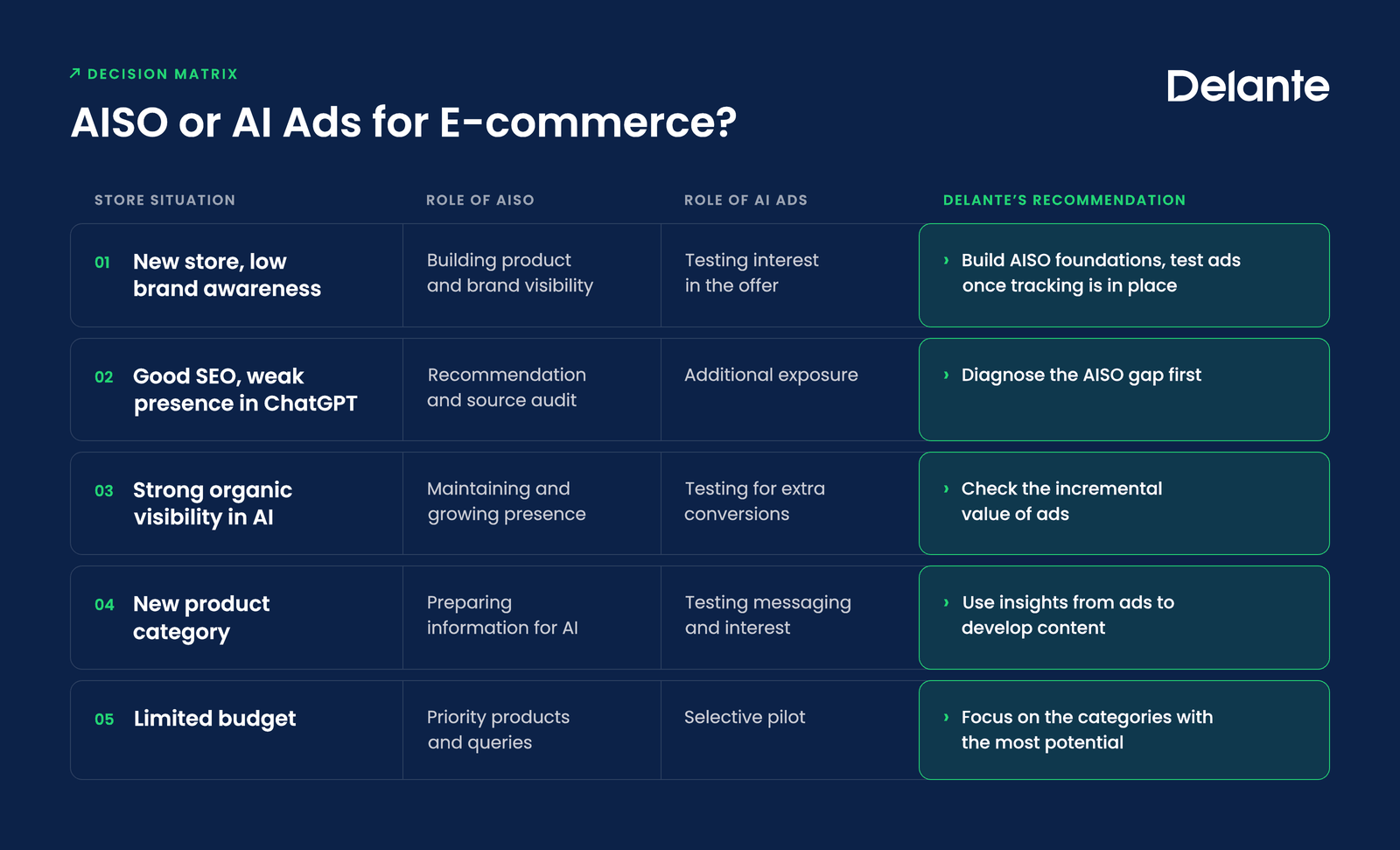
    AISO or AI Ads for E-commerce?

    Below, we’ve put together a decision matrix for e-commerce businesses to help you decide which strategy is right depending on your brand’s situation:

    What Do the Differences Between AISO and AI Ads Mean for B2B and Service Companies?

    In B2B, the buying process is usually much longer and more complex than in e-commerce. Customers compare service providers and analyze their expertise and experience, and AI can support this process at various stages, from identifying the problem to choosing potential business partners.

    AISO helps companies build visibility in the recommendations and lists of providers generated by AI tools, while ads offer paid reach to users who are actively looking for specific solutions and services.

    What Can SEO and SEM in Google Teach Us About AISO and AI Ads?

    In some ways, the growth of AI ads resembles a situation we know well from Google. For years, SEO and SEM have let companies acquire customers in different ways, and planning them together makes the strategy more effective, because the synergy between the two channels brings the best results. When a website has weak organic visibility for important queries, Google Ads can help it reach customers even before it achieves high SEO rankings.

    On the other hand, when a brand already has strong organic rankings, you can check whether additional ads actually increase the number of customers acquired or partly take over traffic the company would have received even without the campaign.

    The same logic can be useful when planning AISO and ChatGPT Ads.

    ChatGPT Ads Is a New Channel. Why Should You Start Testing It?

    AISO and ChatGPT Ads can complement each other, but as we mentioned, according to official information from OpenAI, organic answers and ads are generated by separate mechanisms.

    However, both can draw on the same resources, such as:

    • Valuable content and product data that make it easier to present the offer and match it to customer needs.
    • Well-prepared landing pages that support the user experience and conversion.
    • Consistent brand communication that ensures a uniform message across different customer touchpoints.

    What’s more, AI visibility monitoring data from the AISO process can show in which shopping contexts the brand is present and where competitors are winning. Analyzing ad campaigns, in turn, makes it possible to assess which messages and offers generate valuable traffic and conversions.

    So the synergy between AISO and ChatGPT Ads lies mainly in sharing data, content and customer knowledge, not in organic visibility directly affecting the ad system, or the other way around.

    Why Can Early Testing Be Valuable for a Business?

    A new ad channel requires testing and building experience. Companies need to check which messages and products attract users’ attention and how this translates into traffic and conversions.

    Early advertisers’ advantage may lie above all in their own data and experience, gained before the channel matures. However, this doesn’t guarantee lower costs or better results. That’s why it’s worth starting with a controlled pilot with a set budget and measurable goals.

    Do ChatGPT Ads Already Drive Sales? First Data From Delante

    At Delante, we’re testing ChatGPT Ads across different markets and many industries, analyzing both the scale of traffic and user behavior.

    By the end of September 2026, the campaigns covered by the first pilot summary had generated:

    Metric Delante result
    Impressions more than 690,000
    Clicks more than 13,300
    Average CTR about 1.93%
    Reported conversions 430
    Total media budget about PLN 32,600

    The data covers different industries, markets and campaign durations.

    We describe our first insights from advertising in ChatGPT in the article: How ChatGPT Ads Work: First Insights and Takeaways on Advertising in ChatGPT

    Our first tests show that ChatGPT Ads can generate traffic on a noticeable scale. In some projects, we’re also seeing conversions, but their quality and impact on sales need to be verified case by case.

    The key takeaway? At this stage, it’s hard to point to a single industry that will always achieve the best results. What will matter most is how well the ad message matches the user’s intent and needs.

    Case Study: A Sports Store With Established SEO and SEM Tests ChatGPT Ads

    Should a company that has been investing in SEO and Google Ads campaigns for years test ChatGPT ads? One example of this approach is a long-standing Delante client: an online sports store that sells sports watches and accessories for active people, among other things.

    The brand has been growing its visibility in Google with Delante for a long time, achieving good results in SEO and SEM.

    The next step was to launch a ChatGPT Ads pilot to see whether the new channel could become an additional source of valuable traffic.

    What Results Did the Campaign Achieve?

    In the period analyzed, from week 38 to the partial week 44 of 2026, the campaign generated:

    Metric Result
    Clicks 948
    Impressions about 78,700
    Weighted average CPC PLN 4.26
    Ad spend about PLN 4,036

    Source: Delante’s own data, ChatGPT Ads reports, ISO weeks W38 to W44 of 2026. Week W44 was incomplete, and the number of impressions has been rounded.

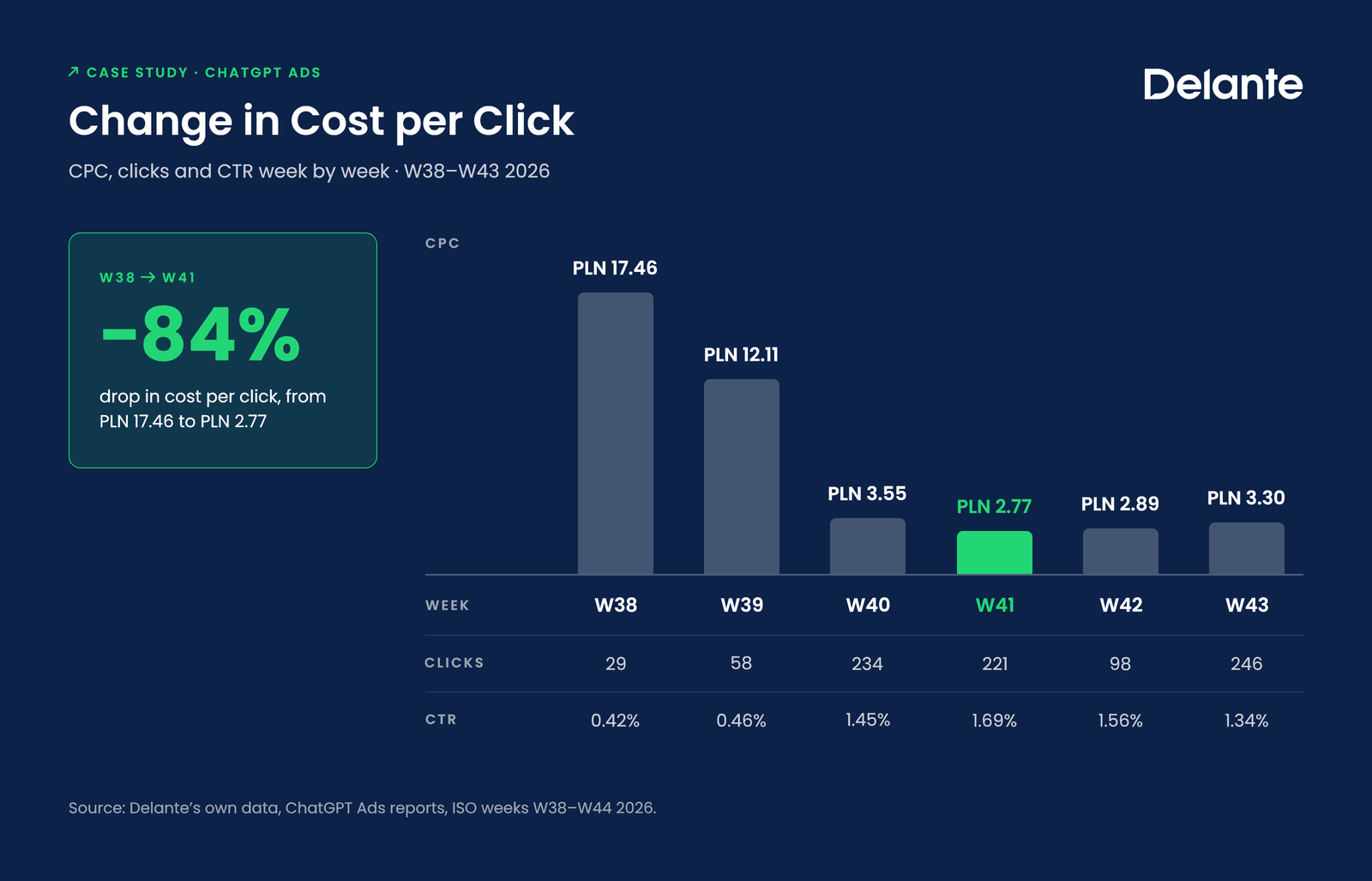
    The change in cost per click is particularly interesting:

    In the first week of the campaign, the CPC was PLN 17.46. By W41, it had fallen to PLN 2.77, a drop in cost per click of about 84%. Over the next two full weeks, it stayed between PLN 2.89 and PLN 3.30.

    It’s an interesting result, but it should be interpreted with caution. We don’t yet know whether the improvement came from campaign optimization, changes in the ad auction, ad inventory availability or other factors.

    What it does show is how much campaign efficiency in a new channel can change from one week to the next.

    What About Conversions?

    In the completed weeks W38 to W43, the campaign showed no recorded direct conversions in the report presented. This means that despite several hundred clicks, we don’t yet have confirmation that this particular pilot generates direct sales results.

    This doesn’t automatically mean the traffic has no value. It does, however, call for checking its quality, the tracking setup, user behavior on the site and any later conversions.

    ChatGPT Ads can already deliver traffic and let you test interest in your offer, but not every campaign will generate sales from the start.

    “ChatGPT Ads is a channel we’re still learning today. In some campaigns, we’re already seeing significant traffic, improved CTR and falling costs per click, but this doesn’t always translate into conversions right away. That’s why it’s especially important to analyze user quality and compare data from Ads Manager, analytics and sales systems. For us, the greatest value of the pilot is the chance to see in which situations this channel actually helps acquire customers and when it needs further optimization.”

    How Can AISO and AI Ads Work Together?

    Running AISO and ChatGPT Ads together can help a company make better use of different ways of reaching customers. For a brand with a weak organic presence in AI, ads can provide additional exposure while AISO is being developed. If the brand is already recommended regularly, ad campaigns can be used to check whether additional paid reach brings new conversions.

    What matters most, however, is analyzing the data together while measuring the two areas separately.

    How Should You Measure Results?

    Area Key metrics What do they show?
    AISO visibility AI Search Presence, Share of Voice How often the brand appears in AI answers
    AISO quality Citations, mentions, recommendations, context of presence How the brand is presented
    AI traffic Sessions, sources, engagement based on GA4 Whether users click through to the website
    ChatGPT Ads CTR, CPC, impressions, clicks How efficiently ads are served and bring in traffic
    Business results Qualified leads, sales, CPA, ROAS Whether the activities bring value to the company

    In AISO, it’s not enough to measure the number of brand mentions alone. What matters more is the contexts in which the brand appears and whether those queries are tied to real purchasing decisions. A brand can be cited often in informational answers but rarely recommended to people looking for a provider or a specific product. This kind of data helps us set AISO priorities and point to areas where additional advertising is worth considering.

    Michał Grzyb
    Michał Grzyb SEO & AI Specialist

    What Should You Invest in First: AISO or ChatGPT Ads?

    The decision should depend on factors such as the company’s starting point, customer behavior and its ability to measure results. If the brand doesn’t appear in organic AI answers for important queries, the first step may be an AISO audit.

    If the company already has a strong organic presence and wants to test another source of traffic, an ad pilot may be a sensible move.

    With a limited budget, it’s worth setting priorities based on business potential and readiness to measure conversions.

    In the table below, we’ve suggested priorities depending on the company’s situation:

    Company situation Priority Role of the second channel
    The brand has low visibility in ChatGPT AISO audit and development Ads can provide additional exposure
    The brand has good SEO, but its AI visibility is unknown Analysis of AISO and recommendations Ads pilot with an adequate budget
    The brand is well recommended organically Maintaining presence and analyzing its quality Testing for additional conversions
    An e-commerce store is launching new products Preparing content and information for AI Testing messaging and interest
    A B2B company has a long buying process Presence in comparisons and recommendations Testing the acquisition of quality leads
    The company has a limited budget Prioritizing by potential A small test only if results can be measured
    The company already invests in AISO and ads Joint analysis of results Optimizing the budget by business value

    Not every company needs to invest in both AISO and AI ads. The key is to match your activities to your business goals and assess their real impact on customer acquisition and sales. With paid campaigns, it’s worth checking not only the number of conversions but also whether the ads generate additional value that couldn’t have been achieved without them.

    Learn more: ROAS vs. ROI. Why Is Optimizing for the Ad Platform Dashboard a Hidden Risk to Your Budget?

    Just as with SEO and SEM, the greatest potential lies in combining organic visibility, paid activities and analysis of their results. Testing new solutions like ChatGPT Ads early can also help companies gain the experience and data they need to prepare better for the growth of AI Search.

    At Delante, we combine AI search optimization (AISO) with ChatGPT Ads campaigns, drawing on our experience in SEO and SEM and from our own ad pilots.

    Sources:

    • https://openai.com/index/building-chatgpt-ad-stack/
    • https://www.mckinsey.com/capabilities/growth-marketing-and-sales/our-insights/who-wins-when-ai-does-the-shopping-new-evidence-on-agentic-commerce

    ChatGPT Ads Campaigns

    Reach customers in a new channel with our help!

    See Our Offer
    Tomek Gniecki
    Tomek Gniecki SEM & Analytics Specialist
    Author
    Michał Grzyb - Junior SEO Specialist
    Author
    Michał Grzyb

    SEO & AI Specialist

    Graduate of Management at the Cracow University of Economics. His interest in internet marketing and SEO began during his studies and led him to start working at Delante in August 2022. Expert in building visibility in traditional search engines and AI models. Privately a lover of physical activity in any form and good food.

    Author
    Tomek Gniecki - SEM & Analytics Specialist
    Author
    Tomek Gniecki

    SEM & Analytics Specialist

    Graduate of Marketing and Market Communication at Cracow University of Economics. At Delante he is involved in running Google Ads campaigns and the implementation and configuration of Google Analytics. He also conducts training in web analytics. Privately a guitarist, a lover of heavy music and good football.

    Author
    Michał Grzyb - Junior SEO Specialist
    Author
    Michał Grzyb

    SEO & AI Specialist

    Graduate of Management at the Cracow University of Economics. His interest in internet marketing and SEO began during his studies and led him to start working at Delante in August 2022. Expert in building visibility in traditional search engines and AI models. Privately a lover of physical activity in any form and good food.

    Author
    Tomek Gniecki - SEM & Analytics Specialist
    Author
    Tomek Gniecki

    SEM & Analytics Specialist

    Graduate of Marketing and Market Communication at Cracow University of Economics. At Delante he is involved in running Google Ads campaigns and the implementation and configuration of Google Analytics. He also conducts training in web analytics. Privately a guitarist, a lover of heavy music and good football.

    FAQ

    How Is AI Search Optimization (AISO) Different From ChatGPT Ads?

    AISO focuses on increasing a brand’s organic visibility in AI-generated answers, recommendations and citations. ChatGPT Ads, on the other hand, are paid ad messages that let you reach users. The main difference lies in how visibility is achieved: AISO develops it by optimizing content and building brand authority, and ads do it through paid placements.

    Does Buying Ads in ChatGPT Improve a Brand's Organic Visibility?

    No. OpenAI says its ad system works independently of the answer generation mechanism. Running ChatGPT Ads campaigns therefore doesn’t directly increase a brand’s chances of organic recommendations or citations. Both channels can, however, draw on the same content, product data and knowledge about users.

    Do ChatGPT Ads Generate Sales?

    ChatGPT Ads can generate valuable traffic and conversions, but not every campaign translates into sales right away. Delante’s first tests recorded 430 reported conversions, but in some projects, the traffic hasn’t yet produced confirmed sales results. That’s why, in addition to clicks and CTR, you need to analyze traffic quality, conversions and the campaign’s real business value.