How to Increase Your Share of Voice in AI Search Engines?

5min.

Comments:0

23 June 2026

How to Increase Your Share of Voice in AI Search Engines?d-tags
In 2026, reporting keyword positions and organic traffic is no longer enough. Marketing managers now also have to measure brand exposure in a new customer-acquisition channel, LLMs and AI Overviews, meaning AI-based tools. The only reliable metric for gauging your share of the conversational market is Share of Voice. What does the metric involve, how do you report it to the board, and how do you actually improve it?

5min.

Comments:0

23 June 2026

What Is Share of Voice?

Share of Voice is a metric that shows your brand’s percentage presence in AI-generated answers, within a given industry or product and service category, benchmarked against the competition. It counts how many citations and mentions feature your brand in tools like ChatGPT, and it gauges the sentiment of those answers, meaning whether the model recommends your brand and speaks about it positively, or does the reverse.

When a user puts a complex business question to an LLM, the model returns a long-form answer that, instead of the traditional list of links you know from Google, usually names just two to four brands. As a result, your chance of appearing in an AI-generated answer is lower than your visibility in Google, which is exactly why monitoring brand visibility and benchmarking against rivals with the Share of Voice metric matters so much.

For marketing directors, losing Share of Voice in AI is a quiet risk of losing digital market share. That makes tracking this metric critical, because a signal that competitors are pulling ahead in AI tools calls for a quick decision to act and roll out an AISO strategy. Once competitors have built strong authority in the eyes of AI, the fight to appear in LLM answers becomes far harder.

How Do AI Systems Choose Their Sources?

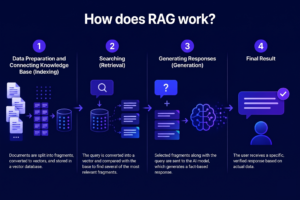
To compete effectively for presence in AI tools, you first need to understand how language models pull in the knowledge they use to build answers. The mechanism behind it is RAG architecture, or Retrieval-Augmented Generation. It works by retrieving data from external web indexes and then synthesizing it.

The prompt a user types is converted into a vector and compared against a database of content held in the index, in order to find matching fragments. The query and the selected data fragments are then passed to the AI model, which generates an answer based on them. The user receives a response grounded in real facts, along with information on which pages were cited and used as sources.

For a CMO, this means one thing: if your brand’s content does not match the AI model’s mathematical vector, the brand will be left out of the recommendation entirely.

RAG Architecture

Source: Translated image from https://www.senuto.com/pl/blog/co-to-jest-rag/

The Correlation Between SEO and Visibility in AI Tools

Google’s search algorithms are among the most advanced information-quality systems in the world, so the analytics built into them directly support RAG mechanisms. If criteria that strict deem a domain trustworthy and authoritative, AI systems are far more willing to pick it as a credible source for their recommendations.

An analysis by ZipTie.dev found that brands ranking first in Google search results have a 25% chance of being cited for the same queries in AI tools. The further down the ranking, the lower the chance. (3) The conclusions from that study point directly to the important role of solid SEO foundations in building Share of Voice.

How to Increase SoV in AI?

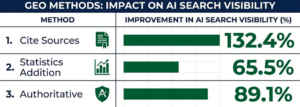
Academic research conducted at Princeton University identified which content-modification techniques had the strongest effect on page visibility in generative AI answers within the Google ecosystem (AI OverviewsAI Mode).

The most effective methods were:

  • Citing sources, the study added trusted sources to the text to back up specific claims. This simple move increased visibility in generative answers by as much as 132.4%.
  • Including statistics and hard data, adding numerical data in place of purely descriptive paragraphs raised visibility by 65.5%.
  • An authoritative tone, the third of the most effective tactics shifted the tone to something more confident and persuasive, drawing on the author’s expertise and command of the topic. This change translated into an 89.1% increase.
jak zwiększyć ai search of voice

The research shows that everything signaling strong substantive preparation in a text (citing sources that back up your claims) and everything that sets your content apart from what is already out there (original perspectives, commentary, reports, and statistics) ranks among the most effective ways to increase Share of Voice.

What else helps improve Share of Voice?

Building authority with AI Authority Link Building. LLM algorithms verify a page’s reputation based on trusted sources. That is why one element of any Share-of-Voice strategy should be AI Authority Link Building, meaning earning mentions and links that point to your site with the specific aim of building authority in the eyes of AI. The work involves selectively choosing trusted industry sources, so the brand gains valuable mentions and links that reinforce its authority.

Digital PR and shaping positive brand sentiment. LLMs are happy to cite sources like Reddit and check a brand’s presence on social media. Monitor brand opinions across forums and social platforms, since a high volume of negative voices can erode AI tools’ trust in the brand. Encourage customers to leave positive reviews, because positive user-generated content has a favorable effect on AI visibility. Also focus on earning positive mentions in industry sources as part of Digital PR, for example in roundups of the top X companies in sector Y and similar rankings.

Identifying and filling content gaps. Test the prompts that matter most to your business in LLMs. Check queries from different stages of the buying funnel, and do not skip the important research stage. If you notice competitors showing up in citations while your site is absent, check whether you cover the topic thoroughly enough. You may uncover gaps that, once filled with new content, will improve your presence in AI answers.

How Share of Voice Translates Into Share of Market?

For a CFO, Share of Voice will not be as important a metric as Share of Market, the brand’s real share of the market and sales volume. In practice, the two are closely linked.

In marketing, we talk about the ESOV model, or Excess Share of Voice. When a brand meets this model, meaning it holds a higher Share of Voice than its market share, it has a surplus that fuels natural growth and rising revenue. When the trend reverses and SoV falls, that is a clear warning sign that Share of Market will start to decline in the near future too.

Users who type purchase-intent prompts into LLMs are looking for concrete recommendations and expect to be pointed to suggested providers. If your brand does not appear in those recommendations and posts a low SoV against the competition, it translates directly into:

  • A drop in branded queries in Google search
  • A drying up of the top and middle of the sales funnel, because potential customers never learn about the brand at the research stage
  • And finally, Share of Market starting to shrink in favor of competitors that AI treats as the industry leaders

Fighting for Share of Voice in AI is, at the same time, work that protects and ultimately grows Share of Market. LLMs are becoming purchase advisors for users, so visibility in this customer-acquisition channel should be an important part of your digital strategy.

How to Measure Share of Voice?

At Delante, we monitor our clients’ Share of Voice using our proprietary tool, Cerber AI. Among other things, we track:

  • Direct mentions, meaning how often AI names the client as a leader and a recommended company for business-critical queries.
  • Citations, meaning how often AI tools point to the domain as a source for generating an answer.
  • LLM sentiment analysis, meaning the context in which AI mentions the brand, whether it is a positive recommendation or a warning and a negative comment.

We set all of these parameters against competitor results, and on that basis we arrive at a percentage Share of Voice figure.

The most popular SEO tools, such as Ahrefs and Semrush, also offer Share of Voice monitoring.

Why Presence in AI Is a Strategic Priority?

Share of Voice is one of the key metrics for measuring a brand’s effectiveness in AI tools. It has a direct impact on Share of Market, which makes monitoring it a valuable signal for protecting revenue. A brand’s absence from language models means losing presence at every stage of the buying funnel and quietly handing potential customers to the competition.

Allocating budget to AISO protects the competitive advantages you have built and secures revenue for the quarters ahead. Once LLM algorithms have built authority around your competitors, the cost of closing that gap will be many times higher than the cost of earning and holding the leader’s position now.

Sources:

  1. Aggarwal, P., Murahari, V., Rajpurohit, T., Kalyan, A., Narasimhan, K., & Deshpande, A. (2024). GEO: Generative Engine Optimization. Proceedings of the 30th ACM SIGKDD Conference on Knowledge Discovery and Data Mining, Barcelona, Spain. https://doi.org/10.1145/3637528.3671900
  2. https://www.semrush.com/blog/share-of-voice-how-to-increase/
  3. https://ziptie.dev/blog/seo-still-matters-for-ai-search-engines/

AISO, Visibility in AI Search Tools

Build visibility where your potential customers are already searching.

Check out our service!
Michał Grzyb
Michał Grzyb SEO & AI Specialist

Author
Michał Grzyb - Junior SEO Specialist
Author
Michał Grzyb

SEO & AI Specialist

Graduate of Management at the Cracow University of Economics. His interest in internet marketing and SEO began during his studies and led him to start working at Delante in August 2022. Expert in building visibility in traditional search engines and AI models. Privately a lover of physical activity in any form and good food.

Author
Michał Grzyb - Junior SEO Specialist
Author
Michał Grzyb

SEO & AI Specialist

Graduate of Management at the Cracow University of Economics. His interest in internet marketing and SEO began during his studies and led him to start working at Delante in August 2022. Expert in building visibility in traditional search engines and AI models. Privately a lover of physical activity in any form and good food.

FAQ

How does Share of Voice (SoV) affect Share of Market (SoM)?

A low share of AI-generated answers translates directly into a smaller market share for the brand. The lower your visibility, the lower your chance of turning it into revenue. LLMs present data in a direct-to-buy format, preparing ready-made suggestions of two or three companies with described offers and often purchase links. If your brand is not there, competitors automatically pick up potential customers from the top of the sales funnel.

How does traditional SEO affect a brand's visibility in ChatGPT or Gemini?

Good practices carried out as part of traditional SEO form the foundation for AI visibility. Market research shows that companies ranking high in organic results have a far greater chance of being cited by AI tools than brands absent from traditional SERPs. A lack of visibility in Google usually signals low domain authority and technical gaps on the site, which feeds through to AI visibility too.

Which techniques help increase Share of Voice in AI?

Citation optimization, meaning adding quotes from your in-house experts to the content, using hard data and statistics, ideally from your own studies and reports, and working on digital authority by building brand mentions on external industry sites. Positive external signals strongly influence whether a given LLM’s algorithms treat the domain as trusted and worth citing.