SEO in Slovakia: How to increase visibility in Slovak search results?
d-tags
d-tags
Before diving into SEO and e-commerce, it’s worth looking more broadly at Slovakia itself. This Central European country, with just over 5.4 million inhabitants and an area of around 49,000 km², borders as many as five countries: Poland, the Czech Republic, Austria, Hungary, and Ukraine. Thanks to this, it serves as a bridge connecting various markets and represents a stable and business-friendly environment. The capital is Bratislava, where much of business and e-commerce is concentrated, but other important hubs include Košice, Nitra, and Prešov.
The only official language in Slovakia is Slovak, spoken by the vast majority of citizens. Since 2004, Slovakia has been a member of the European Union, and in 2009 the euro became the official currency, replacing the Slovak koruna.
The foundation of every e-commerce market is internet access, and in Slovakia this foundation is rock solid. At the beginning of 2025, internet penetration exceeded 94%. This means that more than 5.1 million Slovaks are online.
Slovakia is a smaller market than Poland, but it is characterized by growing purchasing power, fast e-commerce development, and relatively low saturation in many online sectors. For you, this means a real chance to enter and build a leading position faster than, for example, in Germany or the Czech Republic, where competition is much stronger.
In 2025, the sector’s value already reached 2.56 billion USD, and forecasts point to dynamic growth to 4.32 billion USD by 2030 – a CAGR of 10.98%. Here’s the revenue distribution of the entire market:
This distribution clearly differs from many European markets, where fashion usually takes first place. However, it is a very important insight showing the specific preferences of Slovak consumers or still untapped opportunities in the fashion segment.

Source: Paymentwall
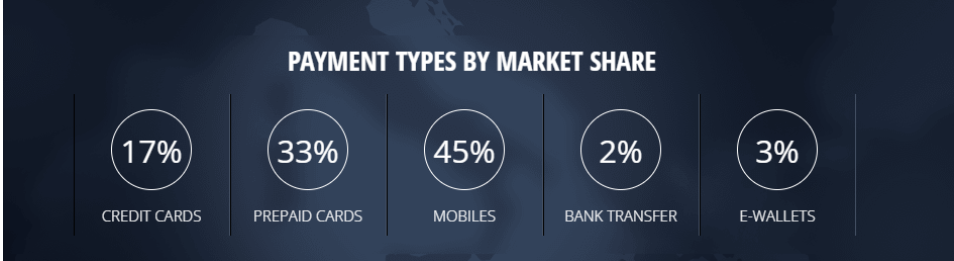
The most popular payment methods in Slovakia in 2025:
Although in the age of digitization it might seem that cash would be a thing of the past, in Slovakia many people still prefer to pay the “good old” way, especially on delivery. This is a sign of trust and attachment to traditional forms. However, the rapidly growing use of payment cards and mobile payments proves that technology is not only entering Slovaks’ daily lives for good but also shaping online shopping habits.
Interestingly, the Polish BLIK system has recently become available in Slovakia. For example, Tatra Banka clients can now use fast, simple, and secure payment methods that integrate seamlessly into their daily lives.
Read also: What are the most popular online payment methods in Poland?

Source: Digital Report 2025
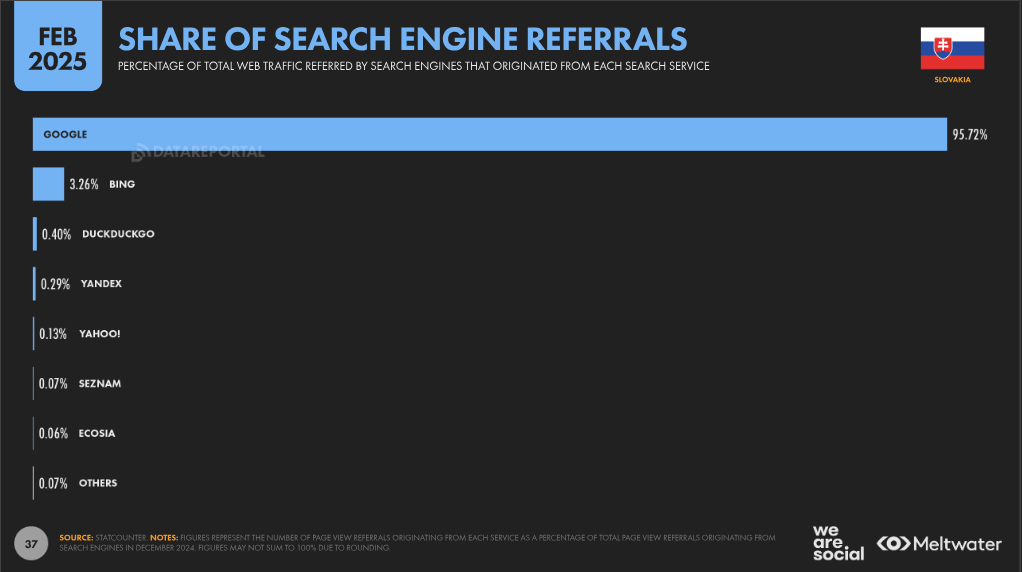
Google in Slovakia is not just a leader – it’s practically a monopolist. With a market share of as much as 95.72% in February 2025, all other search engines have marginal importance. Bing is second with just 3.26%, DuckDuckGo has 0.40%, and the remaining players share the crumbs.

Source: Digital Report 2025
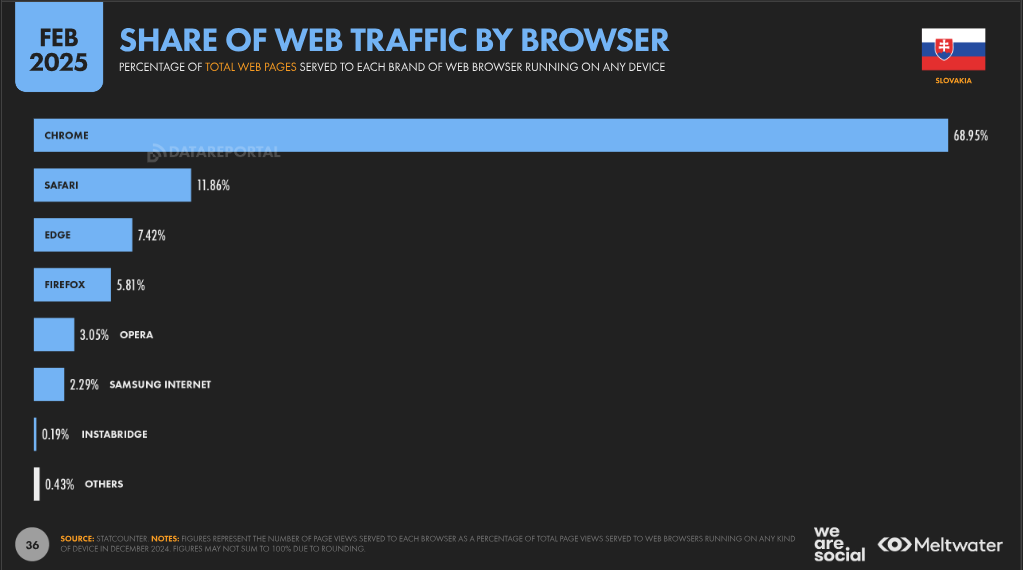
This dominance is reinforced by browser data. Chrome, with a market share of 68.95%, is the first-choice tool for most Slovaks. This Google dominance significantly simplifies your SEO strategy. You don’t need to worry about optimizing for multiple algorithms – you just need to focus on one, but do it perfectly.
To effectively reach Slovak customers, you need to understand their key trait: they are above all pragmatic and conscious consumers.

Source: Digital Report 2025
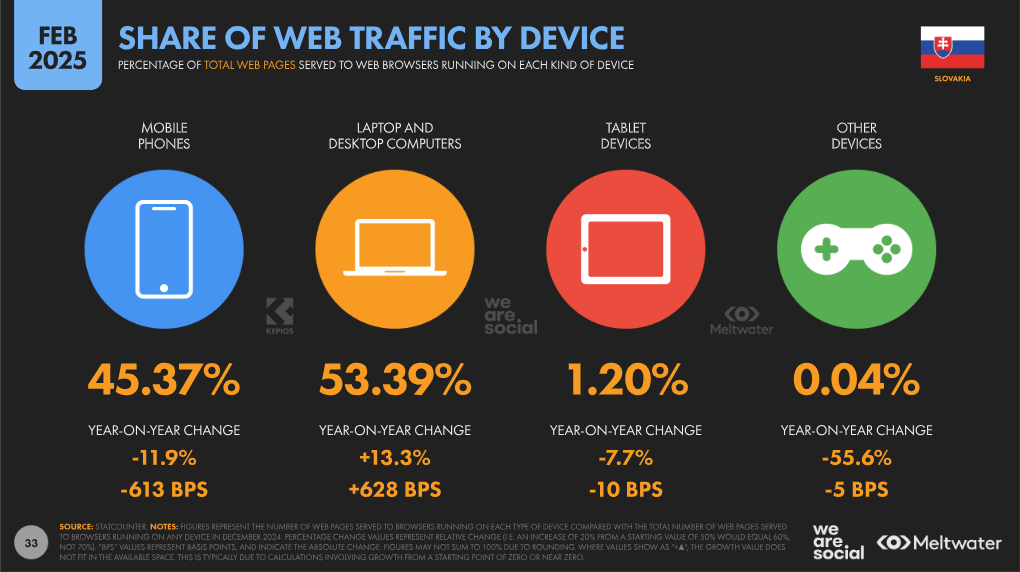
This conscious control is perfectly reflected in how Slovaks use the internet. Contrary to the global “mobile-only” trend, it’s desktops and laptops that generate the majority of traffic (53.39%). Smartphones (accounting for 45.37% of traffic) are often a first-touch tool – used for quick research, browsing offers, and comparing prices. However, when it comes to the final purchase decision, many users prefer to sit in front of a large screen, which provides greater clarity and comfort during the checkout process.
The same analytical approach applies directly to finances. Slovak consumers are fully digitalized – as many as 93% have made an online payment – but they do it on their own terms. The most important data point here is the huge gap between debit card ownership (89%) and credit card ownership (just 31%). This is a clear signal that Slovaks prefer spending money they actually own, avoiding living on credit.
SEO on the Slovak market requires above all a deep respect for local specifics, and its heart is the language. You must understand one fundamental rule: Slovak is not a dialect of Czech. Although the two languages are similar, they have unique features, different grammar, and vocabulary that must be strictly respected across all your content. Also, check out our service for SEO in the Czech Republic!
That’s why your strategy must be based on professional localization, not simple translation. Localization is a much deeper process – it’s the adaptation of the entire message to the cultural context, including idioms, ways of expressing thoughts, and the tone of communication. This applies to everything: from product and category descriptions, blog articles, and advertising campaigns to button labels and system messages.
For Slovak users, price comparison websites play a bigger role than in Poland. Platforms like Heureka.sk or Pricemania.sk are the places where most users begin their shopping journey. It’s there that customers compare prices, check store reviews, and decide where to finalize the transaction. For an online store, the lack of presence on these platforms means losing enormous sales potential.
Keep in mind that Slovak users are often guided not only by price, but also by store reputation – ratings and reviews on Heureka.sk can determine the purchase decision. That’s why, apart from integrating with the comparison site, you should also take care of competitive pricing, product availability, and actively collecting positive reviews.
One of the most important elements of success in e-commerce is customer service in Slovak. Even the best SEO or attractive prices may not be enough if the customer cannot contact the store’s support team in their native language. Slovak consumers attach great importance to easy and seamless communication with a company.
The ability to talk over the phone with a consultant or exchange emails in Slovak makes the customer feel more secure and more likely to complete the purchase. This is particularly important when it comes to more expensive products or services that require additional clarification.
A thoughtful approach to SEO in Slovakia will allow you not only to appear in Google but also to truly compete for visibility and customers. Now let’s walk you step by step through the SEO process, focusing on what really works in the Slovak market.
Check how Google indexes your website, whether your URLs are properly structured, whether the robots.txt file doesn’t block important subpages, and whether the site operates in a mobile-first model, which has been the standard for years. As you already know, in Slovakia Google has over 95% market share, which means that even small technical errors may result in your offer being practically invisible to most potential customers.
When entering the Slovak market, the audit must include verification of the correct implementation of hreflang tags, as they inform Google which version of your site should be displayed in which country. A technical audit is tedious work, but without it, even the best content has no chance in search results.
Logical and well-thought-out site structure is the foundation for both SEO and usability. Make sure your URLs are short, user-friendly, and contain Slovak words, which improves navigation.
It’s also worth implementing topical content grouping (silos), where the main category page (e.g., running shoes) is internally linked with related subcategories and blog posts. An essential element of good architecture is breadcrumb navigation, which shows users their exact location on the site and makes it easier to return to higher levels.
You need to conduct keyword research for the Slovak market from scratch, using professional tools. Start with broad queries, then dive into long-tail keywords, which often come with higher conversion rates. You must understand how Slovak users enter queries, what their shopping habits are, and what they look for in online stores.
Analyzing locally searched keywords will allow you to design categories, subpages, and menus in a way that is intuitive both for users and for Google’s algorithms.
Your content marketing strategy should focus on building expert authority and providing useful information. Instead of creating generic texts, focus on materials that genuinely help your audience make decisions. Every piece of content should be polished in terms of both substance and language, thus building trust and the authority of your brand (so-called E-E-A-T: Experience, Expertise, Authoritativeness, Trust).
The profile of inbound links is one of the strongest ranking signals for Google. In the context of Slovakia, the absolute priority is acquiring links from valuable Slovak domains (.sk). However, don’t give up on international links – they also matter, especially if your store operates in multiple countries. Still, keep in mind that Google values geographic relevance – which means that local links will have the biggest impact on your visibility in Slovakia. The more your brand is visible in the local online space, the faster you will build user trust.
If your business has physical locations in Slovakia, such as stores, offices, or pickup points, make sure to set up and optimize your Google Business Profile in Slovak. Fill in your exact address, opening hours, local phone number, photos, and business description. Actively encourage customers to leave reviews and respond to them regularly. Also ensure consistency of your business details (NAP – Name, Address, Phone) across all important local directories and online services.
Expansion into the Slovak market is an opportunity worth seizing now, before your competitors do. However, executing such a comprehensive, multi-stage strategy requires not only advanced knowledge but also significant commitment, time, and resources. It’s a full-time task that can overwhelm even the most determined entrepreneurs, pulling them away from what they do best – growing their business.
If you want to be sure your efforts deliver results, choose an experienced partner. Delante has been supporting companies in international expansion for years and successfully positions websites in demanding markets.
Entrust us with SEO in Slovakia, and we will take care of everything – from analysis and strategy, through technical optimization, to the long-term growth of your brand’s visibility. This way, you will gain a stable flow of customers and an advantage over your competitors.