How to Use ‘People Also Ask’ in an SEO Strategy?

4min.

Comments:0

11 March 2025

SEO
How to Use ‘People Also Ask’ in an SEO Strategy?d-tags
Google offers us multiple features in search engine results pages apart from a standard list of websites. One of them, People Also Ask or PAA, can be a great asset to your digital marketing strategy. If used properly, it can help you drive more traffic to your website, increase brand recognition or even... prepare better-tailored content plans. So, how do you use People Also Ask for SEO?
4min.

Comments:0

11 March 2025

For starters, you can use People Also Ask (PAA) as a source of inspiration for your content plans—it can provide you with excellent ideas on new blog topics! What’s more, it can also show you a better direction in your web content design and layout. Plus, it may (but doesn’t have to!) increase your organic traffic directly. Do you want to learn more about the role of PAA in SEO and learn how to optimize your website to get featured snippets in the People Also Ask box? Great! All you have to do is read this article. 😉

3 Methods of Using ‘People Also Ask’ to Win the SERP Race

Let’s start with the essence of this article: How to use People Also Ask in SEO? There are three main ways to turn this SERP feature into an advantage and… not all involve you appearing in it! So, how can you extract value out of PAA?

Inspiration for Your Content

People Also Ask is a great source of inspiration—you can type any general keyword in and look for broader questions that other people search for. This way, you can expand your topic clusters and find ideas for new blog entries. But that’s not all!

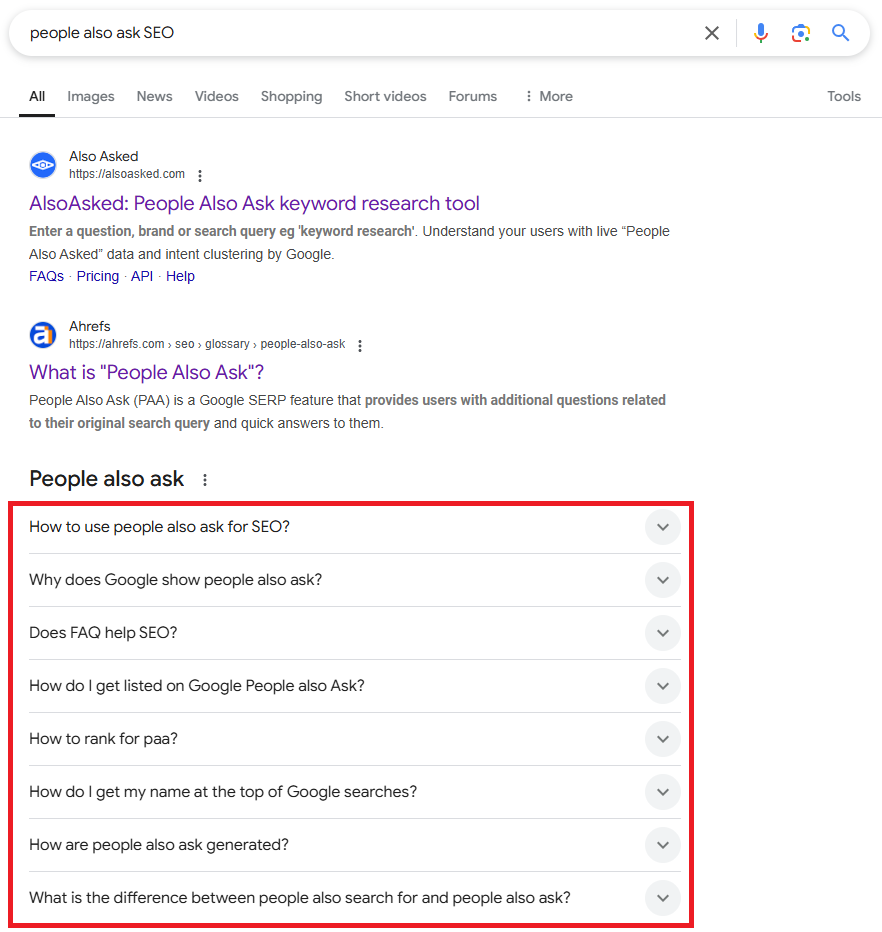
You can also use PAA to define user intent. How does that work? Here’s an example.⤵️

What do we learn from it?

  • Most searches involve using PAA for SEO or generally ranking up in Google, hence our article about PAA should focus on that.
  • Some queries touch upon the way PAA works ➡️it might be good to add some informative sections as well or write a separate article/definition explaining this feature.
  • We get some ideas for blog article topics that don’t contain our initial keyword at all, but are important for the users, like ‘Does FAQ help SEO’- we should involve more detailed post on such topics.

All this information comes from a single search—just think what you can achieve over the course of several hours spent on preparing a content plan!

Remember that although People Also Ask appears frequently, it doesn’t have to pop up for your specific keywords. Google likes to test it frequently with the feature disappearing and reappearing in SERPs as time flies by, so… don’t rely purely on PAA!

Developing Content on Your Website

You might also use PAA to improve your content layout, hence optimize your more sales-oriented texts for SEO. Though, in this case, you won’t be using People Also Ask, but rather: People Also Search For (we explain the differences later in the article).

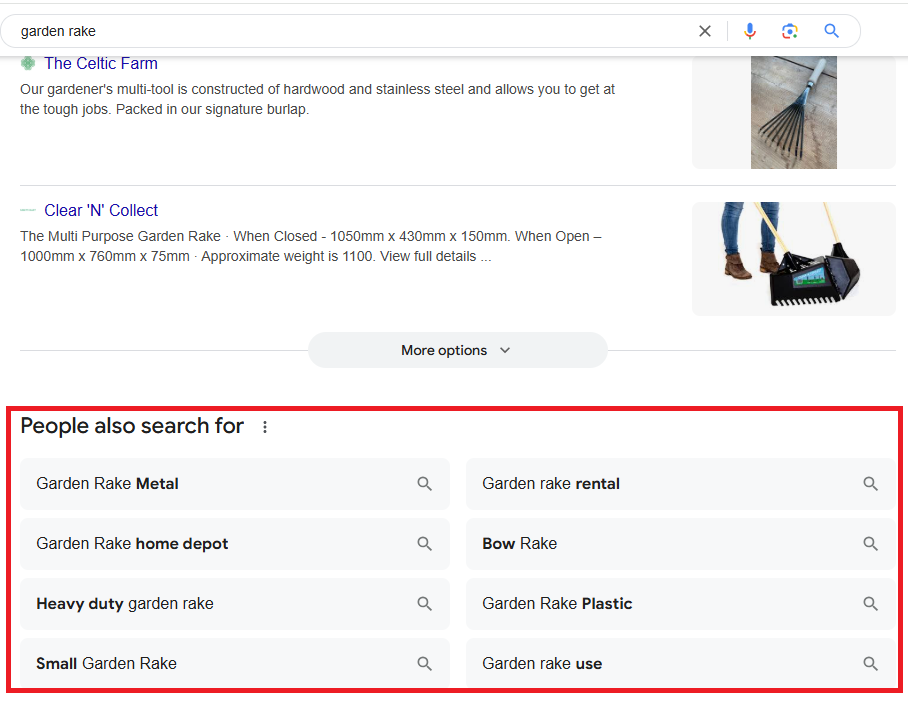
Imagine you sell garden rakes. You’ve organized them in your store by brand. But, will it work? Let’s type “garden rake” into Google and verify it. 🔎

People also search for: example

What do we see here? It might be worthwhile to create categories by rake size or material, as this is how users search for such information.

Although this is just a single example, you can apply this method to different industries and businesses, including yours. People Also Ask and People Also Search For give you information about the real user behavior in the search engine, so they’re an invaluable source of directions and insights into the way you organize your content and develop your website.

Attracting Organic Traffic

Finally, you can use PAA to attract organic traffic. These questions appear above most (if not all) organic results in SERPs, which puts them in a sort of rank 0. Why 0 not 1 or 2?

On the one hand, you may show up higher in SERPs, which increases the number of impressions. On the other hand, PAA is designed to provide an immediate answer to the question—not every user that sees an excerpt of your content will enter your site. Here’s a good example.⤵️

PAA used for SEO: attracting organic traffic

If you look at the above snippet, the case gets quite straightforward:

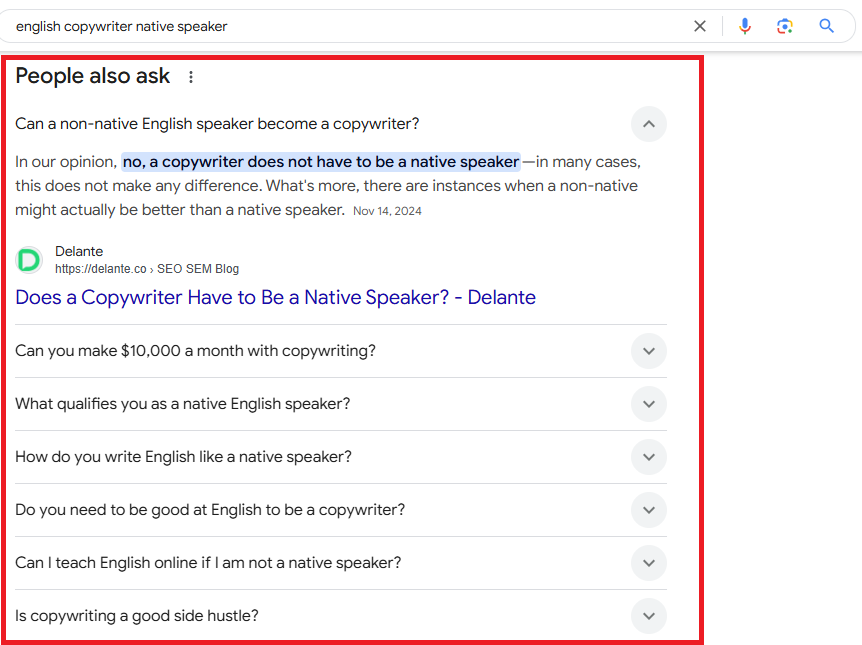
  • the user will enter the site if they are interested in the reasons why a copywriter doesn’t have to be a native speaker,
  • the user will not enter the website if they just seek a yes or no answer, since they get it right away.

Nevertheless, in both cases our site is shown to the users—we’re building brand image. The same goes for your website—even if you won’t lure visitors with your PAA snippets, you’ll build visibility and brand awareness, which will pay off in the long run.

People Also Ask vs. People Also Search For

We’ve promised to explain the difference between People Also Ask and People Also Search For, so here we go. In a nutshell:

  • People Also Ask shows questions related to the search,
  • People Also Search For show keywords input by users in follow-up searches.

In practice, you’ll also see a difference when interacting with each of these SERP features:

  • People Also Ask shows a snippet with the answer to the question if you click on it,
  • People Also Search For starts a new search for the chosen keyword if you click on it.

Finally, there’s a difference in their location in the SERPs:

  • People Also Ask appears much higher in SERPs, with just 2-3 organic/paid results above it,
  • People Also Search For appears at the bottom of the search results for desktops and after a while of scrolling on mobile devices.

How to Optimize Your Website for ‘People Also Ask’?

So, what can you do to rank in PAA? In principle, you should embrace user-oriented SEO. This involves:

  • Make clear, concise and quality content that matches user intention.
  • Extract the questions related to your keywords—there are quite a few tools that will help you automate this process.😉
  • Answer the questions clearly. Ideally, you should write down the question as a heading (don’t worry—it can be a H3!) and provide immediate, clear and to-the-point answers below it.
  • Add a FAQ. You can input the questions there and come up with answers in a nutshell, ideal for the PAA section. But, if you want this to be effective, you need to mark the FAQ in the schema.

FAQ Schema Generator

Create FAQ schema markups with ease: discover our free generator!

Generate Now

While the above will increase your chances of ranking up in People Also Ask, you mustn’t forget about general content optimization techniques and strategies—all the SEO rules still apply!

The Takeaway

People Also Ask & People Also Search For are both helpful when designing your SEO content strategy. What’s more, the former can help you boost your visibility in the search engine results pages. Do you need help optimizing for PAA or PASF? Discover our SEO services—let our experts win the SERP race for you!

Author
Joanna Nicpoń - SEO specialist
Author
Joanna Nicpoń

Senior SEO Specialist

Senior SEO Specialist. At Delante since August 2017. She specializes in SEO strategies for E-commerce, IT, and YMYL sectors (including PL, US, UK, and DACH markets). By combining technical optimization with a business-driven Customer Success approach, she builds profitable, long-term client relationships. An expert in content strategies and website migrations. Project Manager and author of the case study nominated for the Global Search Awards 2024. After hours: cinema, traveling, and Heroes III.

Author
Joanna Nicpoń - SEO specialist
Author
Joanna Nicpoń

Senior SEO Specialist

Senior SEO Specialist. At Delante since August 2017. She specializes in SEO strategies for E-commerce, IT, and YMYL sectors (including PL, US, UK, and DACH markets). By combining technical optimization with a business-driven Customer Success approach, she builds profitable, long-term client relationships. An expert in content strategies and website migrations. Project Manager and author of the case study nominated for the Global Search Awards 2024. After hours: cinema, traveling, and Heroes III.

FAQ

How to Use Google People Also Ask?

You can use PAA to attract more visitors to your website, boost brand awareness & recognition, find inspiration for new blogposts and adjust content distribution & layout across your site.

How to Rank for PAA?

The best strategies that will help you rank for People Also Ask include:

  • using questions in your content and following up immediately with clear, concise answers,
  • creating a FAQ, filling it up with PAA questions and generating a FAQ schema markup,
  • writing user-content that matches the reader’s intention.

What Does 'People Also Ask' Mean?

People Also Ask is a Google SERP feature that provides users with questions related to their search and answers. It appears in the top side of SERPs, though it might be preceded by some paid or organic results and/or a featured snippet.