
Why Your Business Needs Authority, Not Just Links, in the AI Era?

6min.

Comments:0

05 May 2026

Why Your Business Needs Authority, Not Just Links, in the AI Era?d-tags
In 2026, LLMs (ChatGPT, Gemini, Perplexity) do not evaluate a website's trustworthiness solely through the raw volume of backlinks. They use links to verify entities and topical relevance. A high DR (Domain Rating), once the holy grail of traditional Link Building, is no longer enough on its own. To win in AI search engines today, a brand must pivot from traditional link building to building digital authority, becoming a highly credible source in the "eyes" of algorithms. Understanding the mechanics of AI Authority is the only way to secure your Share of Voice across generative channels.

6min.

Comments:0

05 May 2026

The Layers of AI Authority: Building a Bulletproof Strategy

AI Authority is the level of trust LLMs place in a specific website and brand. It is the foundational element of building visibility within AI tools. If a brand wants to appear in answers generated by LLMs, it must first establish undisputed authority with its algorithms. How do you build a strategy that effectively drives AI Authority?

Based on our extensive experience and data analysis, we recommend a strategy structured across three core layers:

  1. The Stable Layer (Core Authority): This is your structural foundation, focusing exclusively on acquiring links from domains with massive, undeniable authority. Links from powerhouse domains build the long-term trust that both AI models and traditional organic algorithms place a heavy weight on during domain evaluation.
  2. The Dynamic Layer (Pulse Authority): This layer consists of short-term citations, mentions in industry reports, and expert commentary. Its purpose is to signal to algorithms that the brand is highly active and continuously supplying fresh data. These citations provide a “Pulse,” proving the brand is alive, operating, and reacting to market changes.
  3. The Contextual Layer (Intent Authority): The final element involves content precisely aligned with user queries to reinforce your brand’s topical associations. This layer allows AI and Google to deeply understand the specific intents and the needs your website fulfills, magnifying your brand’s semantic visibility within the industry.

How Do You Measure the Impact of Links on AI Authority?

To evaluate how acquired links actually build AI Authority, we must rely on hard data. At Delante, we utilize two critical metrics that clearly illustrate the relationship between traditional Referring Domains (RD) and brand visibility in tools like ChatGPT, Gemini, and Perplexity.

The Pearson Correlation: Mathematical Proof That AI Analyzes Link Profiles

The Pearson correlation coefficient (r) is a statistical measure of the strength and direction of a linear relationship between two quantitative variables. Ranging from -1 to 1, it indicates how two values relate to each other (-1 indicates a negative correlation, 0 indicates no correlation, and 1 indicates a perfect positive correlation).

Our proprietary analysis reveals that the correlation between the number of referring domains and the total number of AI citations is exactly 0.89. This is irrefutable proof of a very strong positive correlation between these two values.

What does this mean in practice? Every high-authority referring domain (RD) you add directly and predictably increases your brand’s citations across AI models. It is a clear signal that premium link building is the exact fuel powering your visibility in AI tools.

The “Ratio” Metric: Calculating Your Return on Link

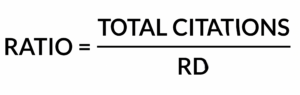
While the correlation proves that the relationship exists, effectively measuring strategy performance requires a more granular approach. We created a proprietary metric at Delante called the RatioIt calculates your “Return on Link,” telling us exactly how many AI citations a single acquired referring domain generates on average.

The formula is straightforward:

click-through rate

*RD – Referring Domains

How to interpret your Ratio:

  • Close to 1.0: The baseline for stable AI visibility. It means that every 1 link you acquire roughly translates to 1 real citation in LLM-generated answers.
  • High Ratio (e.g., closer to 1.5): A strong signal that your links represent Premium quality. Your link-building process relies on sources that AI considers highly authoritative. As a result, one acquired link generates nearly two brand citations.
  • Low Ratio (close to 0.5 or lower): A massive red flag. This indicates that AI algorithms are simply ignoring the links you are acquiring during the authority verification process.
Brands investing today in premium, LLM-optimized link building are effectively training AI knowledge bases for years to come. This creates a compounding competitive advantage that will be incredibly difficult for rivals to overcome.

A Link is Just a Digital Footnote; Authority is the Verdict

You can have thousands of links from relatively strong domains, and Perplexity or ChatGPT will still ignore you when answering a potential client’s core question. Why? Because AI can instantly detect when your links lack topical authority. Even if you burn a massive budget acquiring placements on generally trusted sites, a lack of topical relevance means those links contribute exactly zero to your AI Authority.

In my off-site campaigns in 2026, I don’t look for ‘high-DR placements.’ I look for topical neighborhoods. If an AI is going to recognize a client’s company as a SaaS systems expert, its website must be cited exactly where AI models already scrape their technology data. A link in the AI era is not a vote in a popularity contest; it is a witness testimony in court. If the witness is unreliable, the link loses all value.

Kasia Śliwa
Kasia Śliwa Senior Off-site SEO Specialist

From Link Building to Entity Building

Chasing the highest possible number of links from high-DR websites is rapidly becoming obsolete, as it is being replaced by an approach centered on Entity Resolution. In practice, this means AI algorithms are constantly trying to determine whether all mentions of your company across the internet (on your site, in industry articles, on social media) point to a single, cohesive entity. If they do, the AI builds a portrait of your brand as a credible expert. If they don’t, the AI treats the information as fragmented noise.

Today, it isn’t about the sheer volume of links; it’s about whether those links form a logical, cohesive web of connections that clearly defines who you are and what you specialize in. This consistency is the sole deciding factor in whether an AI deems your brand a trustworthy source worth recommending.

1. Building a Digital Brand Portrait

Based on the entity resolution mechanism, LLMs paint their own map of your brand. An AI Authority link-building strategy must actively sharpen and unify this portrait.

What NOT to do:Do not acquire links from general-topic, catch-all portals, even if they boast massive traffic or high DR metrics.

What TO do:Focus exclusively on links from industry reports, specialized expert media, and websites strictly dedicated to your company’s exact niche.

2. Links as Semantic Bridges

In 2026, links act as bridges connecting your website to established authorities. If a universally trusted industry leader, like PubMed or The Lancet in the medical sector, links to you, the AI receives a clear signal: “If this absolute authority trusts them, I can confidently cite them too.” Your link-building strategy must aim to map out a network of trust, not just a spreadsheet of links.

Learn more: Link Building in the AI Era: Why It’s No Longer About Links, but Brand Credibility.

The New Currency: Information Density

Information Density is a metric that measures the concentration of hard data within your content (statistics, certificates, technical parameters, numerical figures). To an LLM, emotional marketing copy, “fluff,” and flowery adjectives are utterly worthless.

Modern Link Building must point to content that is deeply saturated with unique, trustworthy data (First-Party Data). Off-site publications should feature proprietary statistics from your company’s systems or concrete case studies with measurable results. This ensures LLMs are highly incentivized to extract your data to generate their answers.

How Do We Monitor AI Authority at Delante?

Our Arsenal of Tools

  • Cerber AI: We built a proprietary tool to verify whether our external publications are actually being ingested into language models’ memory.
  • Chatbeat: We use this tool to monitor brand mentions and track exactly how AI models classify our clients in generative rankings.
  • Server Log Analysis: We analyze server logs to determine whether bots spike on a client’s site following an external opinion leader’s publication. If they do, we know our authority engineering is working.

Our KPIs

When reporting on Link Building and AI/LLM visibility, we focus on KPIs specifically adapted to these new strategies:

  • Ratio: The metric calculating “return on link,” showing the degree to which acquired links translate into fresh AI citations.
  • Share of Voice: We measure your brand’s footprint in AI answers and organic results compared directly against your industry competitors.
  • Bot Hits: We monitor whether LLM bots and Google crawlers are actively visiting and analyzing the client’s content.
  • Conversions & Revenue Impact: The ultimate business metric, we track the hard impact our strategies have on your bottom-line revenue, not just clicks and raw traffic.

The Dual-Track Strategy: Dominating Every Touchpoint

The modern customer journey is more fragmented than ever. Data shows that over 70% of users verify at least two brand touchpoints before making a purchasing decision (e.g., getting a recommendation from ChatGPT, then pivoting to Google to check brand reviews). Therefore, your strategy must run on two parallel tracks:

  • Sustaining the Foundation in Traditional SERPs: Maintaining top rankings for conversion-driving queries is essential.
  • Building AI Authority: Actively securing mentions in AI-generated answers guarantees you control that critical secondary touchpoint. AI is rapidly dominating as the premier acquisition channel, especially in the B2B sector.

In 2026, ignoring AI visibility is an enormous operational risk, but so is abandoning your foundational SEO efforts in Google.

Your brand must be cohesively present everywhere, in both AI answers and Google results. If AI recommends your brand but the user can’t find you on Google for industry queries, you lose trust. If you dominate Google but are a ghost in AI answers, you lose visibility.

At Delante, we will secure your visibility exactly where purchasing decisions are made today and help you architect an unbreakable AI Authority.

AI Authority Link Building

We will help you forge unbreakable website authority in the eyes of AI models.

Let's talk strategy!
Kasia Śliwa
Kasia Śliwa Senior Off-site SEO Specialist
Author
Kasia Śliwa - Senior
Author
Kasia Śliwa

Senior Off-site SEO Specialist

Off-site SEO specialist, link building expert. At Delante since December 2018, she took her first professional steps in organizing large events. Student of journalism and social communication. Passionate about dance, music and good cinema. Loves listening to people and discussing with people with opposing views.

FAQ

Does this mean my "old" links are now worthless?

Abandoning your historical link profile, provided those publications were on trusted portals, is a terrible idea. Those links are the bedrock of your Google rankings. However, Entity Authority and Entity Building are the definitive future of AI visibility. This new approach is an evolution, not a reset. We do not discard what works in traditional search; we simply pivot the ongoing focus toward topical quality that perfectly aligns with LLM algorithms.

Is a brand mention without a hyperlink actually valuable?

In 2026, it is incredibly valuable. AI models extract entities from the content they scan, not just the hard HTML outbound links. If an authoritative source writes that “Brand X is the undisputed expert in Industry Y,” the AI absorbs and remembers that fact, even if there isn’t a clickable link to your homepage.

How quickly will I see the results of building AI Authority?

Authority in the eyes of AI builds more slowly than traditional SEO, but it is infinitely more resilient. Once AI tools process your citations and acquired links and officially deem your site trustworthy, your business becomes highly insulated against future algorithm updates.