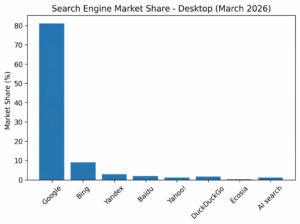
The vast majority of online stores exclude Bing from their advertising budgets, citing its lower market share as the primary reason. You likely do this as well, and that decision is a major strategic misstep in e-commerce. From a business psychology perspective, rejecting this channel is a textbook example of the cognitive traps that ensnare marketing managers.
Your competitors are mindlessly pumping their entire budgets into Google Shopping Ads, so you feel compelled to allocate 100% of your budget there, too. This is the classic bandwagon effect: you follow the herd, burn your budget on inflated CPC bids, and ultimately skyrocket your cost per conversion. Does this mean you should abandon Google Shopping Ads? Absolutely not, but sometimes the smartest alternative to a costly bidding war is to diversify channels.
- The Illusion of the Google Monopoly
Google is often treated as synonymous with “search,” creating an illusion of an absolute monopoly. Managers assume it is the only place customers shop, overlooking that the modern purchasing funnel is much broader. Today, customers search for products on social media, ask AI models for brand recommendations, and check specific items on search engines, but not just on Google. By completely ignoring Bing in your ad budget allocation, you are leaving low-cost, high-intent conversions on the table.
“We’ve already invested so much work into optimizing Google Merchant Center that we simply don’t have the time to build everything from scratch for another search engine.” This objection is a massive blocker, and it is entirely based on a myth. Launching a campaign in Microsoft Ads does not require rebuilding your infrastructure, which we will explain shortly.
The true measures of profitability in advertising campaigns are your Return on Ad Spend (
ROAS) and your Customer Acquisition Cost (
CAC). By ignoring the Microsoft ecosystem, you are simply leaving the most highly qualified leads and high-margin sales to your competitors, inevitably resulting in a lower ROAS and a higher CAC for your brand.








 Tomek Gniecki