Author


Since June 2025, ChatGPT had been adding the utm_source=chatgpt.com parameter to links in its answers. This let GA4 identify the source of a visit even when the browser didn’t pass on the referrer. Since May 2026, these sessions have been assigned to a separate AI Assistant channel in GA4.
GPT-6 started rolling out on October 7. According to Cédric Huesler of Adobe, the new version opens links with the noopener and noreferrer attributes and no longer adds the UTM parameter. As a result, the visit arrives without any signal about its source, and GA4 attributes it to Direct. Search Engine Roundtable covered this on October 14.
The problem doesn’t affect all links equally. According to Ethan Smith, links in the sources panel and in shopping results still carry UTMs, while links embedded directly in the answer text lose them. Traffic from the mobile app is the most exposed: the referrer was a signal mainly in the desktop browser version, while in the app, attribution relied almost entirely on UTMs.
Several independent sources have described the same change on different samples:
| Source | Sample | Observation |
|---|---|---|
| Cédric Huesler (Adobe) | approx. 500 pages where ChatGPT drove at least 5% of visits; Oct 9–13 vs the previous week | ChatGPT: approx. −31K visits a day, Direct: approx. +26K a day; Direct grew on 2 of 3 pages that lost ChatGPT traffic |
| LLM Pulse | websites monitored by the tool; Oct 9–11 vs the same days in the two previous weeks | ChatGPT sessions approx. −46%; traffic from Perplexity and Claude, as well as total traffic, unchanged |
| Ethan Smith | several websites with significant AI traffic | sessions attributed to ChatGPT from −22% to −57% (estimated at approx. −45%); Google and Direct stable or growing |
| Profound (Josh Blyskal) | ChatGPT answers collected by Profound | answers with at least one tagged link: 98% (Oct 8), 75% (Oct 9), 66% (Oct 14); Intelligent UI share: 2% → approx. 35% |
| Peec AI (Tomek Rudzki) | the same 1M prompts; Oct 2–7 vs Oct 9–13 | a direct link to the website in 42% of answers (previously 8–10%); 54% of those links lead to the homepage |
Huesler also checked how new users behave in the Direct channel. On mobile, the share of visits in which the consent banner appears (that is, visits from new people) rose in Direct from 36% to 44%. For ChatGPT traffic, this rate is 55%. He notes himself that these are preliminary, sampled data from four days.
Two changes overlap here. According to Profound, ChatGPT more and more often answers in the new format, in which links carry no UTMs. At the same time, as Tomek Rudzki of Peec AI showed, it links directly within the answer text much more often, mostly to homepages. Some of the traffic that used to reach a specific subpage from a citation may now land on the homepage and look like a direct visit. Ethan Smith described a website where Direct traffic to the homepage grew by 17% while Google traffic stayed flat, all of it from new users.
Not everything can be explained by attribution, though. Sébastien Billard recorded a drop since October 9 not only in human traffic from ChatGPT but also in visits from the ChatGPT-User bot, while OAI-SearchBot activity has been rising since October 7. So it’s possible that how often ChatGPT fetches pages during a conversation has changed too. This needs further observation.
I checked the data from a sample of projects we manage: 5 online stores and 7 service websites.
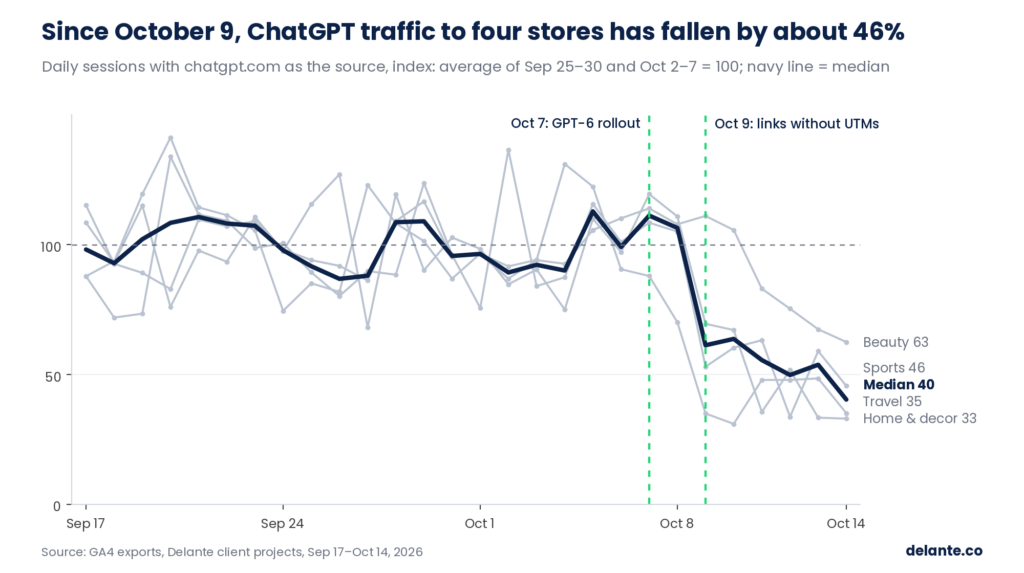
In three of the four largest stores, the drop started exactly on October 9: ChatGPT sessions fell by roughly half overnight. In the beauty store, traffic was still at its usual level on October 9 and 10, and the decline built up from October 11. From October 12 to 14 (Monday to Wednesday), the store had 37% fewer sessions than on the same weekdays before the change. This matches Profound’s observation that the share of answers in the new format grew gradually.
The scale is the average number of ChatGPT sessions per day before the change:
| Project | ChatGPT traffic scale | Change Oct 9–14 |
|---|---|---|
| Store, beauty | large | −16% |
| Store, travel | large | −59% |
| Store, sports | large | −48% |
| Store, home & decor | large | −52% |
| Services, travel | medium | −18% |
| Services, adult industry | medium | −40% |
| Services, automotive | small | −7% |
| Services, logistics | small | −62% |
| Store, furniture | small | −74% |
| Services, IT | small | −39% |
| Services, hospitality | small | 0% |
| Services, nationwide B2B | small | −35% |
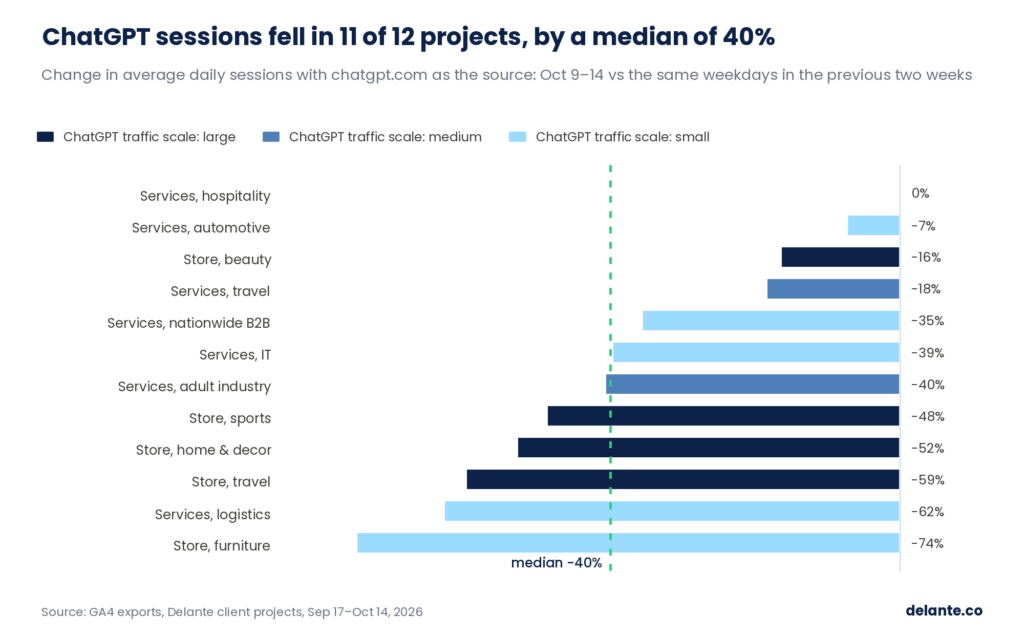
The drop occurred in 11 of 12 projects, and the median change is −40%. Service websites get anywhere from a few to a few dozen ChatGPT sessions a day, so individual results there aren’t very stable, but the direction is the same. Revenue attributed to ChatGPT in the five stores fell by a combined 26% over this period, which immediately shows up in reports on the value of the AI channel.
The only project without a drop is a local business in the hospitality (HoReCa) industry. What’s interesting there is the chatgpt.com source with the gmb medium: these are visits through the website address in the Google Business Profile, which ChatGPT shows in place cards. So it looks like links in local place cards still carry UTMs, just like links in the sources panel and in shopping results, according to Ethan Smith.
In my view, this makes GA4 data an increasingly weak measure of how a brand is doing in ChatGPT. Prompt monitoring, that is, checking whether and how a brand appears in answers, is a more reliable reference point today. Ideally, combine it with server log data on how often AI bots visit.
The reports concern links in ChatGPT’s organic answers. Ads in ChatGPT lead to URLs to which advertisers add UTM parameters themselves, and according to Ethan Smith, these clicks should be measured as before. I wouldn’t automatically apply conclusions from organic traffic to campaigns. Just compare clicks in OpenAI Ads Manager with sessions carrying your campaign UTMs in GA4 and check whether the ratio changed after October 7.
Our data confirms this. In projects with regular ChatGPT Ads campaigns that have their own UTMs, paid traffic hasn’t changed.
OpenAI hasn’t addressed the change or announced a fix. This is an inconsistency that OpenAI will probably fix, since links in parts of the interface still carry UTMs. And it’s in OpenAI’s interest for us to see a growing share of this channel in GA4, because that will encourage investment in it. Even if that happens, though, data from the period without tagging can’t be recovered.