
Author


The fall 2026 edition of BrightonSEO showed that the industry has moved on from asking “Will AI change SEO?” to asking “How do we measure it, automate it and sell it?” On October 8 and 9, two of our specialists, Przemysław and I (Wojciech), attended Europe’s biggest SEO conference in Brighton, UK. For me, it was already my fifth time at Brighton.
Two days, six rooms running parallel tracks, 190 speakers and around 4,500 attendees from more than 70 countries: that’s the event in numbers.
The fall edition of BrightonSEO focused on how brands earn visibility in AI-powered search, and on how to measure that visibility. Compared with October 2025, the conversation shifted from general strategies to specifics: which sources models cite, how citation patterns have changed since December 2025, what AI “infers” about a brand and how to influence it. GEO & AEO, Understanding AI Search and AI and Brand Citations each got their own track, and Digital PR was largely presented through the lens of earning AI citations. While speakers used terms such as GEO and AEO, at Delante we address these challenges through our broader AISO (AI Search Optimization) approach, combining SEO foundations, content, technical optimization, brand authority and AI visibility analysis.
The second clear theme was practical automation. There were talks on Claude Code in a search marketer’s work, on when MCP servers make sense, on automating technical SEO and on vibe coding. Agentic commerce also made an appearance: shopping in ChatGPT, product feeds for agents and the first data on ads in ChatGPT.
There was also a strong focus on data and on talking to the business. Speakers covered data warehouses (mainly BigQuery), server-side tracking, and reporting and communicating data to the board. A lot of time went to attribution, with the conclusion that siloed, channel-by-channel marketing is dying, and to ways of building performance forecasts and estimates and calculating the ROI of SEO.
Beyond that, the agenda covered the classic areas: technical SEO (schema in the AI era, crawl bloat, log files), e-commerce SEO (filters, Shopify, product pages), migrations, local SEO, organic social (Reddit, TikTok, LinkedIn) and E-E-A-T. The conference closed with a keynote by Ross Simmonds on building a brand’s presence in the “memory” of language models.
Our main takeaways from this year’s Brighton:
Below is a list of the talks we found particularly valuable. Not every speaker shared their slides. The organizers make recordings of all the talks available to attendees in a video bundle about two weeks after the event, and they usually appear on the BrightonSEO YouTube channel a few months later.
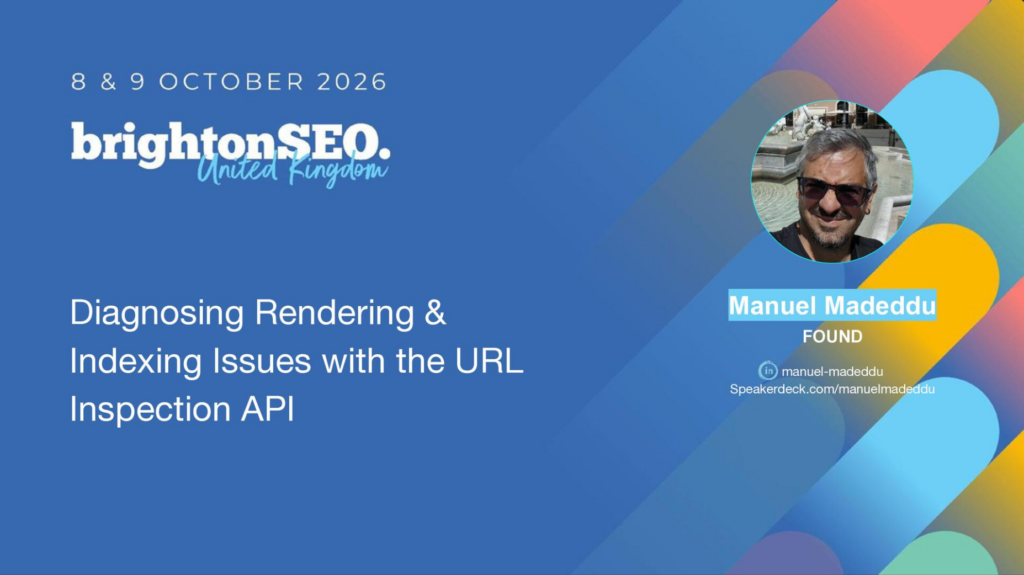
Manuel Madeddu showed that SEO problems most often appear where three things diverge: the code sent by the server, the rendered DOM and what actually makes it into the index. All it takes is a canonical that changes after rendering, or content that only becomes available once JavaScript runs, for a page to drop out of the index. And in the era of AI search, the impact is twofold: content that can’t be read disappears both from search results and from AI-generated answers.
Alongside organic AI visibility, paid placements in ChatGPT are emerging as another way for brands to reach potential customers. As in traditional search, paid and organic visibility serve different purposes and can complement each other rather than act as substitutes. According to Joss, ChatGPT ads went from a closed pilot to a full-fledged ad platform in under 200 days, and their annual revenue run rate reached around $1 billion in August 2026. In the UK alone, Adthena recorded 4,764 unique advertisers in September, and more than 15,000 in the US. What does his data show so far?
As Frank pointed out, everyone does keyword research with the same tools on the same data, so content plans end up looking alike. On top of that, AI Overviews are eating into clicks. Frank suggests also looking for topics in sources competitors don’t use: Reddit threads (with velocity rather than volume as the criterion, meaning a focus on terms that are starting to come up more and more often), customer call transcripts or AI-generated query fan-outs. In his view, once a phrase already shows search volume in the tools, it may be too late to get ahead of competitors. Traditional keyword research remains essential, but early-stage content opportunities may emerge sooner in customer conversations, communities and AI-driven search behavior, before they become visible in conventional keyword tools.
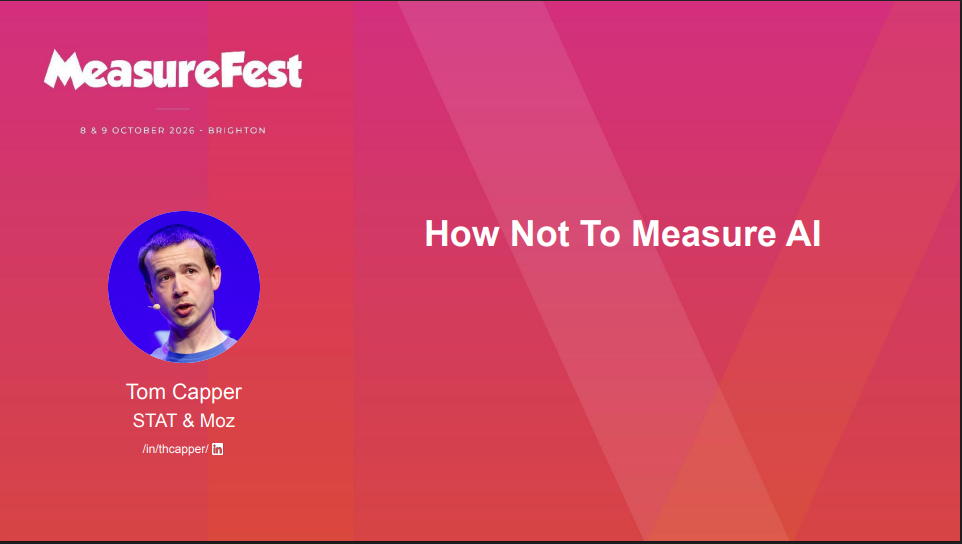
Tom challenged the most popular metric in AI visibility monitoring: the simple fact that a brand appears in an answer. His team tested how language models choose between brands when what the sources say about them changes. It turned out that models follow a hidden hierarchy of arguments. Some signals outweigh a high user rating, others barely change anything, and a single risk signal can sink a brand despite its many strengths. In his tests on SaaS tools, security certifications and regulatory compliance sat at the top of the hierarchy. In every industry, though, the hierarchy will look different, and it also varies between AI engines. So beyond counting mentions, you need to find out which arguments drive recommendations in a given category and build your brand messaging around them.
You’ve probably heard of llms.txt, a file we review as part of our AI search audit, since it gives AI systems a clear overview of a site’s most important content. Dixon presented another, newer standard, developed with the involvement of R. V. Guha, the creator of schema.org. The concept is https://entitymap.org/, which I won’t describe here, as the documentation on the site explains quite clearly how it works. It’s worth noting, though, that in Dixon’s own tests, implementing the file translated into more brand citations in LLMs. These early findings are worth watching, but broader and independent testing is needed before treating this approach as an established AI visibility tactic.
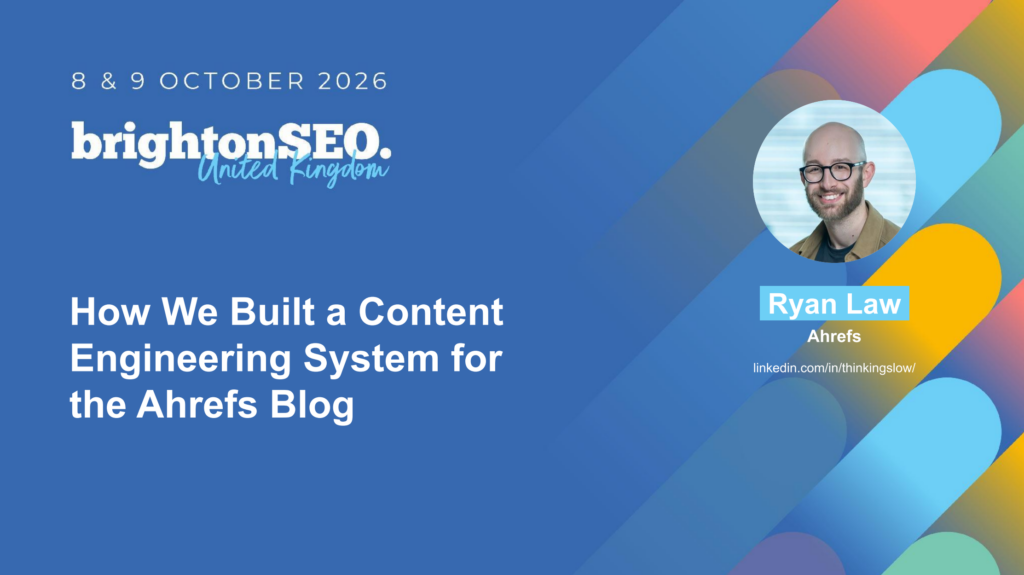
Ryan Law, Director of Content Marketing at Ahrefs, showed how his team approaches creating SEO content with AI. He argues that thanks to agents, skills and MCP servers with access to SEO data, it’s now possible to produce good-quality articles, and the cost per article has dropped significantly. Ryan cautions, however, that this approach works mainly for informational content. The key is “content engineering”: breaking your own editorial process down into specific steps and turning them into interconnected skills. A human should bring opinion, context and direction at the very beginning, instead of fixing a finished text at the end. Add to that SERP data, which makes it possible to add something beyond what’s already in the results, a custom style guide built on examples of favorite articles and a product knowledge base.
The punchline of the talk, borrowing from Patrick Stox, is that since everyone will have the same automation tools, the advantage will go to whoever has the better strategist on the human side.
And last but not least, the closing keynote:
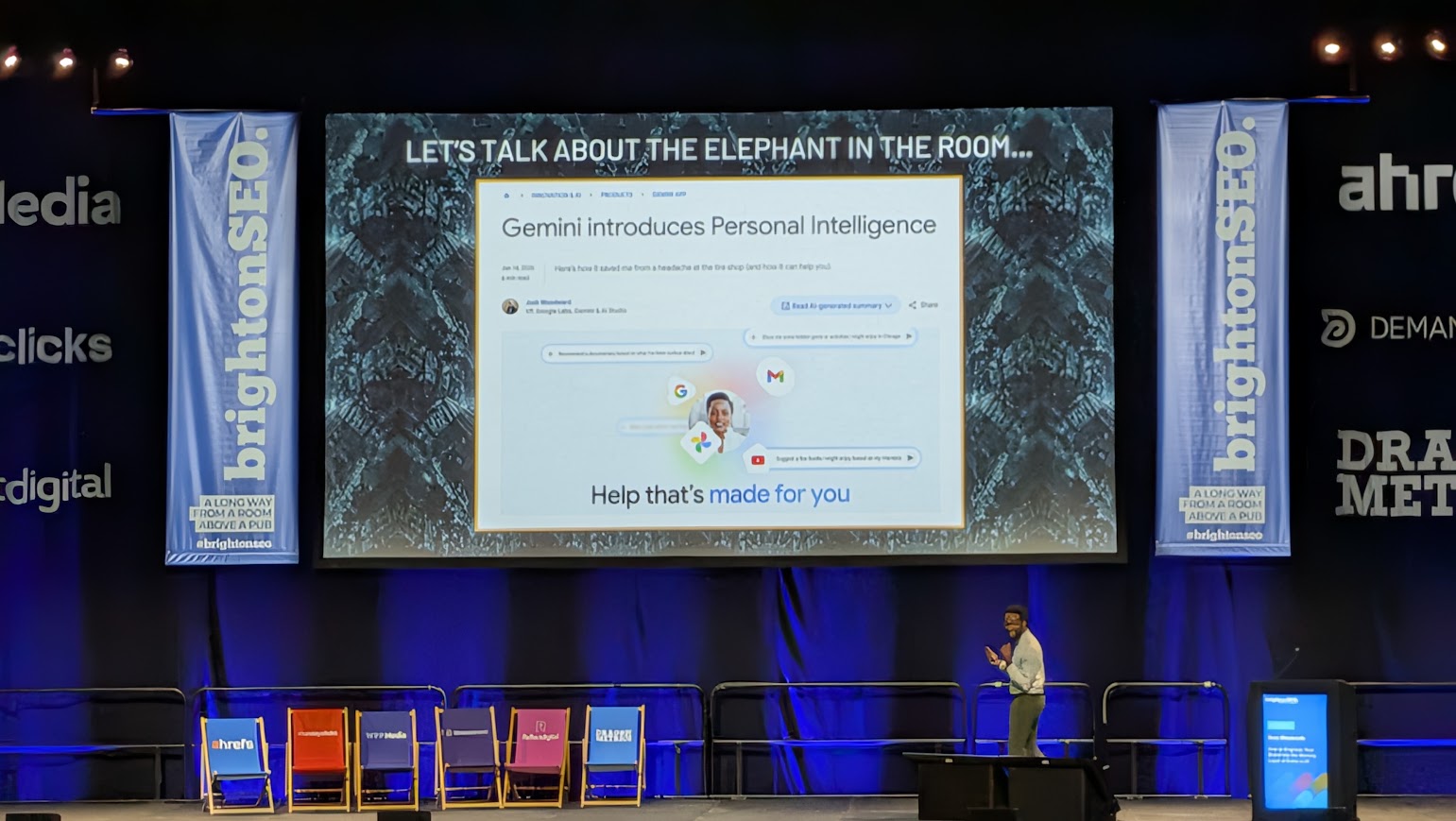
Ross, founder of the Foundation agency and the Distribution.ai platform, closed the conference on the main stage. His topic tied the whole edition together nicely: since more and more purchasing decisions start in a conversation with a model, a brand has to be present in the sources the model draws its knowledge from. Every customer conversation with ChatGPT, Claude or Gemini shapes what AI believes, recommends and remembers. The premise? The winners won’t be those who only optimize for the algorithm, but those who can design experiences so powerful that audiences themselves “upload” the brand into the memory of the AI they use.
Ross refers to the film Inception: the most powerful thing isn’t handing over information, but planting an idea so deeply that the audience believes it’s their own. In practice, it’s about creating “inception moments,” the moments in which your audience becomes the key to your brand’s success in the LLM era.
What does this mean for our approach at Delante? The conversations at BrightonSEO reinforce an important direction: AI search requires more than chasing individual mentions. Through AISO, we connect strong SEO foundations with technical R&D, content quality, brand authority and AI visibility analysis. The aim is to help brands become credible, relevant choices across the customer journey, while measuring progress with appropriate context and acknowledging what the data cannot yet tell us.
This edition showed that the industry is moving past general discussions about AI search and getting down to specifics. We’re increasingly asking how AI describes a brand, not just whether it mentions it. We read individual prompts in the context of entire conversations, and we build automation on clear quality criteria. At the same time, classic SEO hasn’t gone anywhere. Rendering, indexing, migrations and e-commerce filters still determine whether content reaches search engines and language models at all.
We attend BrightonSEO regularly. If you’re curious how the SEO industry has evolved, see what we wrote in our recaps of previous editions:
Planning your next conference trips? We’ve rounded up the key events around the world in our calendar of SEO, PPC and marketing conferences for 2026.
![Top SEO, PPC, and Marketing Conferences in 2026: The Ultimate Guide to Global Events [Calendar]](https://delante.co/wp-content/uploads/2026/01/2026-marketing-seo-conference-calendar.jpg)