Gaps can have different causes, so the problems you identify can be grouped into several areas:
1. Topic Gap
A Topic Gap is when an entire topic area is missing from the website. For example, a competitor has plenty of material (articles, case studies) on international SEO for e-commerce, while another agency doesn’t cover the topic at all, even though it offers these services.
This is an example of a situation where creating new content really is justified. In other cases, it’s better to spend your time optimizing existing content or supporting it with link building.
2. Intent Gap
An Intent Gap appears when a topic is covered on the website but lacks the context that answers the user’s intent. For example, an agency has an article titled “What Is International SEO?”, but a potential customer typing a prompt into ChatGPT is looking for information about the agency’s experience with international SEO. The answer to that intent would be case studies, which the website doesn’t have in this case.
3. Evidence Gap
For LLMs, one of the key factors in deciding whether a brand is worth citing is evidence of its expertise and experience. Simply saying you have experience won’t be enough: you need specific data.
For example:
- The agency operates in 18 markets.
- Over a 5-year partnership with brand X, it delivered +300% growth in organic revenue.
- As part of the partnership, it implemented work in areas X and Y.
The more material there is to justify recommending a brand as a good provider of a solution or product, the greater the chance that AI will decide to recommend it. In other words, the website may not be short on content at all, just on concrete evidence.
4. Comparison Gap
Comparing products, services and providers is a common user intent and also one of the stages of the purchase journey. If your competitors have comparisons, alternatives, side-by-side tables and scenarios showing who product X is right for, and your brand has no such content, you have a Comparison Gap.
Preparing this kind of content makes it easier for AI to cite you later. Learn more: Content types preferred by AI: comparisons, lists, “top X” lists, checklists.
5. Data Gap
A Data Gap, meaning missing data, is especially important for e-commerce. If your product doesn’t have complete information on its specifications, delivery times, variants and available options, you lose out to competitors who have a consistent, complete product feed. It’s also worth remembering structured data, such as Product Schema, which can make it easier for AI bots to process the information on the page.
6. Authority / Source Gap
AI visibility problems can’t always be solved with changes to your own website: authority is often built through external factors. If there are gaps in this area, we call it a Source Gap. An Ahrefs analysis of 75,000 brands found a strong correlation between a brand’s visibility in AI systems and its external mentions.
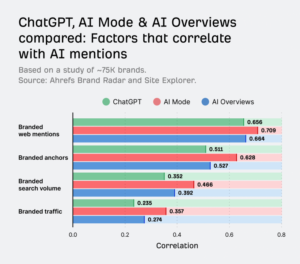
Source: Ahrefs
That’s why you should also look for gaps compared with your competitors beyond your own website. But it isn’t only about being present in places that AI systems might use as sources.
Fill the Source Gap based on data: prompt monitoring, an analysis of the sources cited for specific queries and a comparison of your brand’s presence with your competitors’. If, in a given topic cluster, competitors regularly appear on specific portals, rankings, reports or other sources and your brand doesn’t, that’s a concrete area to work on. Equally valuable are the sources you know, from your monitoring data, are often cited by AI models on the topic.
In our
AISO and
AI Authority Link Building work at Delante, this is exactly how we approach building visibility beyond the client’s own domain: we look for high-authority placements and, at the same time, use AI Search monitoring data to identify the sources that actually appear in answers to the prompts that matter to the brand. That way, off-site work can be directed where it has the greatest potential in terms of the brand’s actual visibility in AI Search.






 Wojciech Urban