

Update: December 2025
Table of contents:
- Profile of the Norwegian internet user
- SEO in Norway – what should you pay attention to?
- SEO in Norway vs. the rest of the world
- Which industries are worth doing SEO for in Norway?
- SEO Norway: summary
Norway is a country where you can showcase your services not only to native residents of the region, but also to a very strong Polish community, which numbers over 111,000 people (18% of all foreigners in the country). Our fellow Poles who move to this Scandinavian country are often keen to start their own businesses in order to secure a new market for their services.
Profile of the Norwegian internet user
How do you start SEO in Norway? By getting to know your potential audience!
Data from the Digital 2025 Norway report shows that Norway is an almost fully digitally saturated market. With a population of 5.60 million, as many as 5.55 million people use the internet, which means 99% penetration. Users are therefore constantly online and highly digitally aware. The number of mobile connections (5.99 million, i.e. 107% of the population) confirms that mobile-first is not a strategy, but a standard that should be taken into account already at the SEO and UX planning stage.
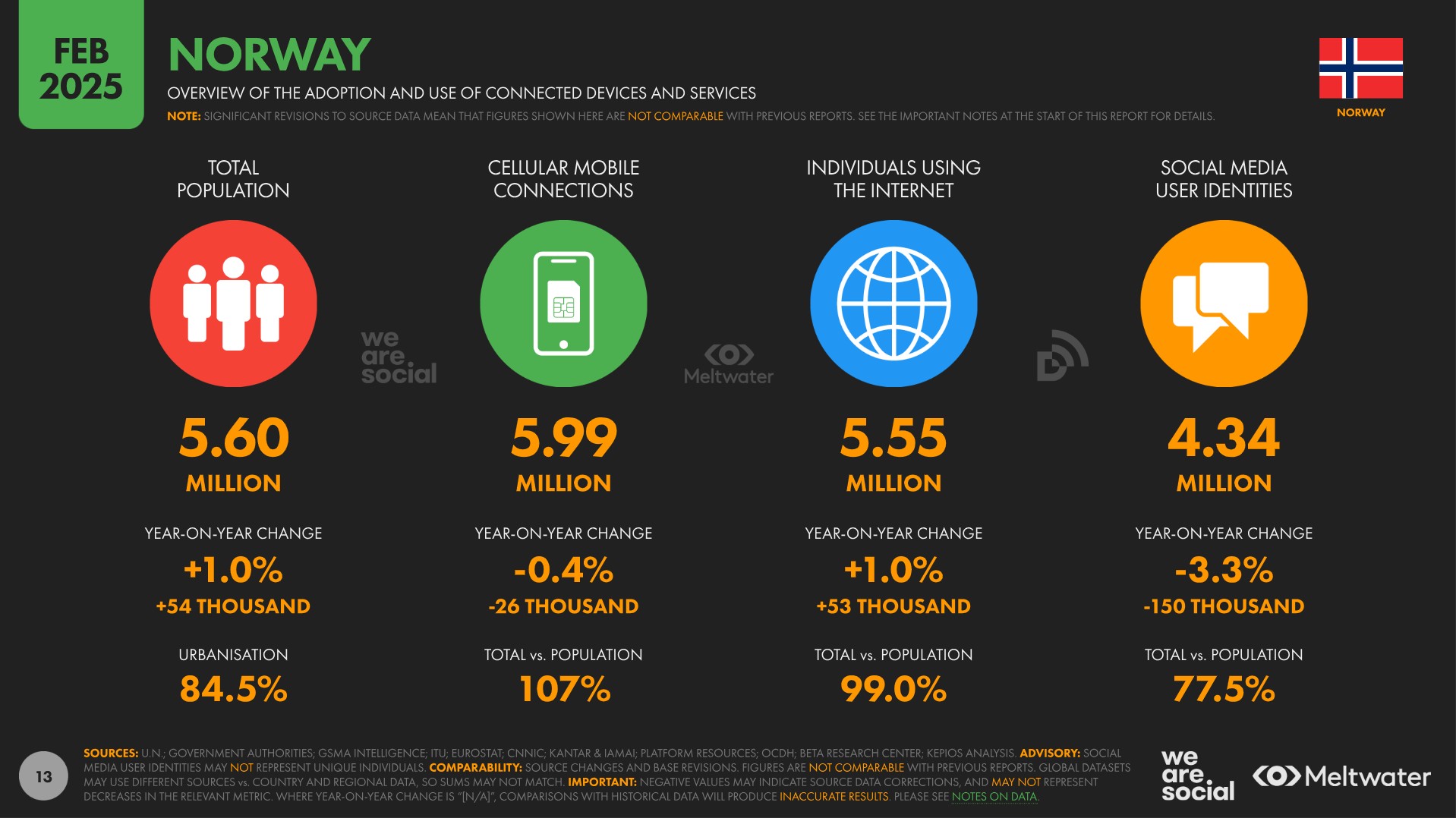
At the same time, 4.34 million social media users (77.5% of the population) indicates that search engines and social media strongly complement each other in the purchase and information journey. A high level of urbanisation (84.5%) and a stable increase in the number of internet users (+1% y/y) mean that the Norwegian user expects fast, precise, and useful content tailored to real intent. That is why effective SEO in Norway should be based on content quality, mobile performance, and a very good information structure, rather than on scale alone.
How does the Norwegian user use the internet?
As many as 47% of internet users (16+) purchase a product or service online at least once a week, which confirms the high maturity of the e-commerce market. Norwegians also make intensive use of tools that support purchasing decisions — 26.8% of users use price comparison sites weekly, which highlights the importance of visibility in Google for comparison, product, and transactional keywords.
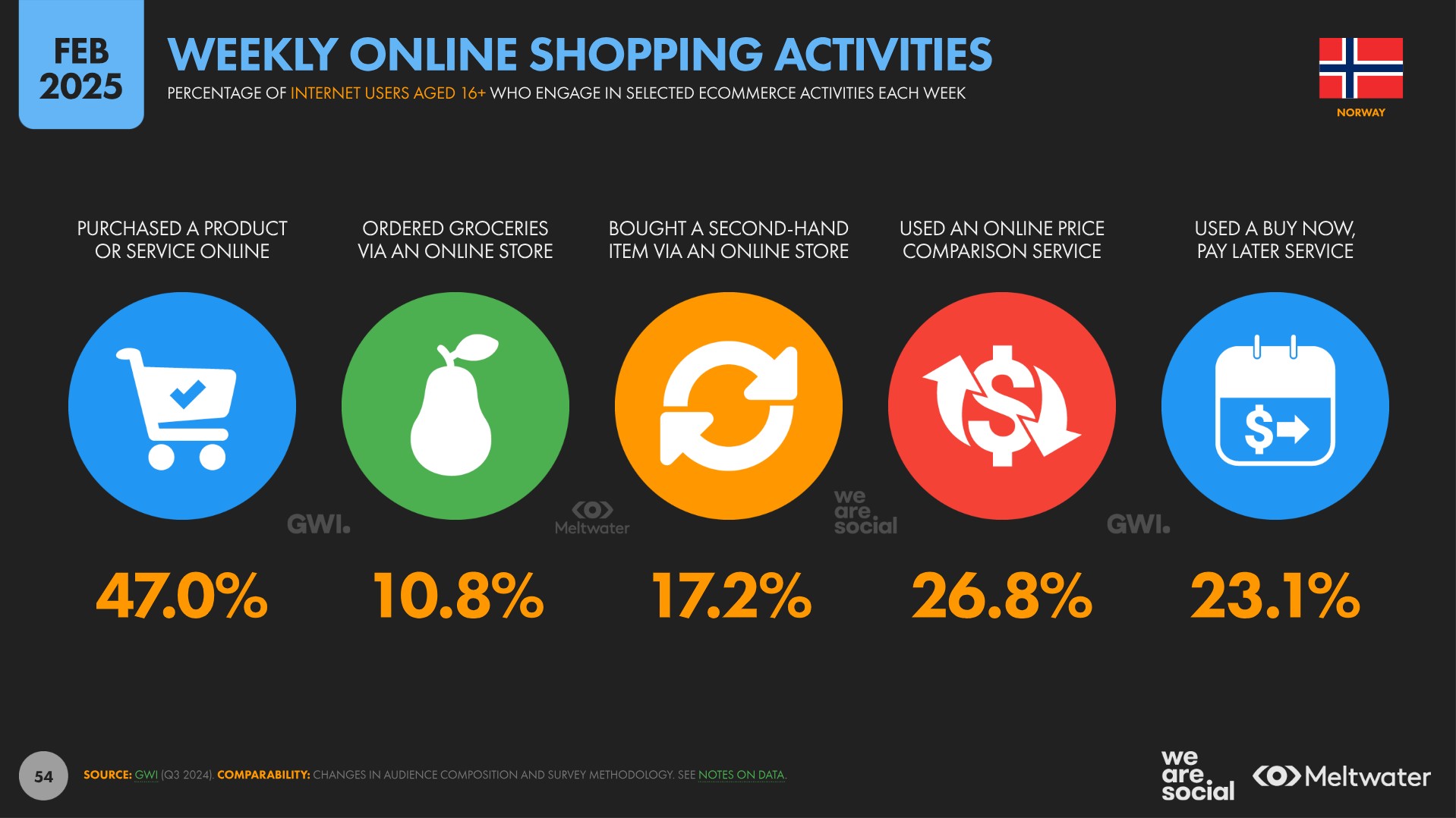
Flexible payment options are also gaining popularity: 23.1% of internet users use “buy now, pay later” services, which has a direct impact on conversion and expectations towards e-commerce offers. It is also worth paying attention to the second-hand market, which is used regularly by 17.2% of users, fitting into Norway’s strong sustainable consumption trends.
Online grocery shopping remains more selective — 10.8% of Norwegians order groceries weekly, which shows growth potential for this category, especially in larger cities. From an SEO and e-commerce perspective, the data clearly indicates that the Norwegian consumer is price-conscious, open to alternative purchasing models, and regularly uses online channels, making Norway an attractive market for well-planned sales and SEO strategies.
What do Norwegians use the internet for?
In Norway, the internet primarily serves an informational and practical purpose, and only then an entertainment one. The main reason for using the internet is searching for information (70%), followed by keeping up with news and events (68.2%) and staying in touch with family and friends (65.2%). Video content consumption also plays a significant role — 62.7% of Norwegians watch films, series, or TV programmes online, and more than half use the internet to listen to music (57.5%) and search for “how to” advice (57.1%).
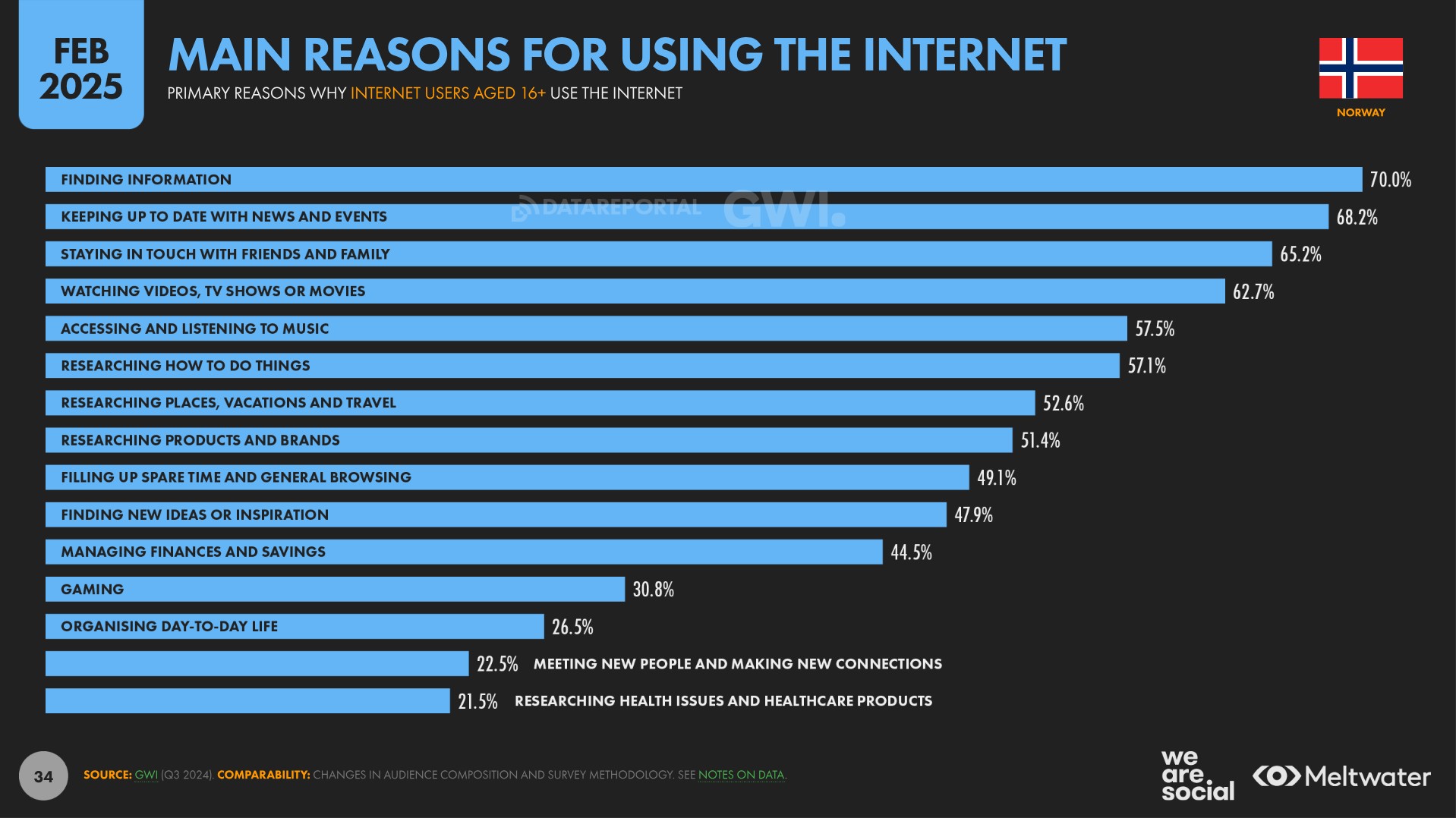
From an SEO perspective, behaviours related to the purchase process are also particularly important: 51.4% of users research products and brands, and 52.6% check places, holidays, and travel, confirming the high potential of guide-like, comparison, and transactional content.
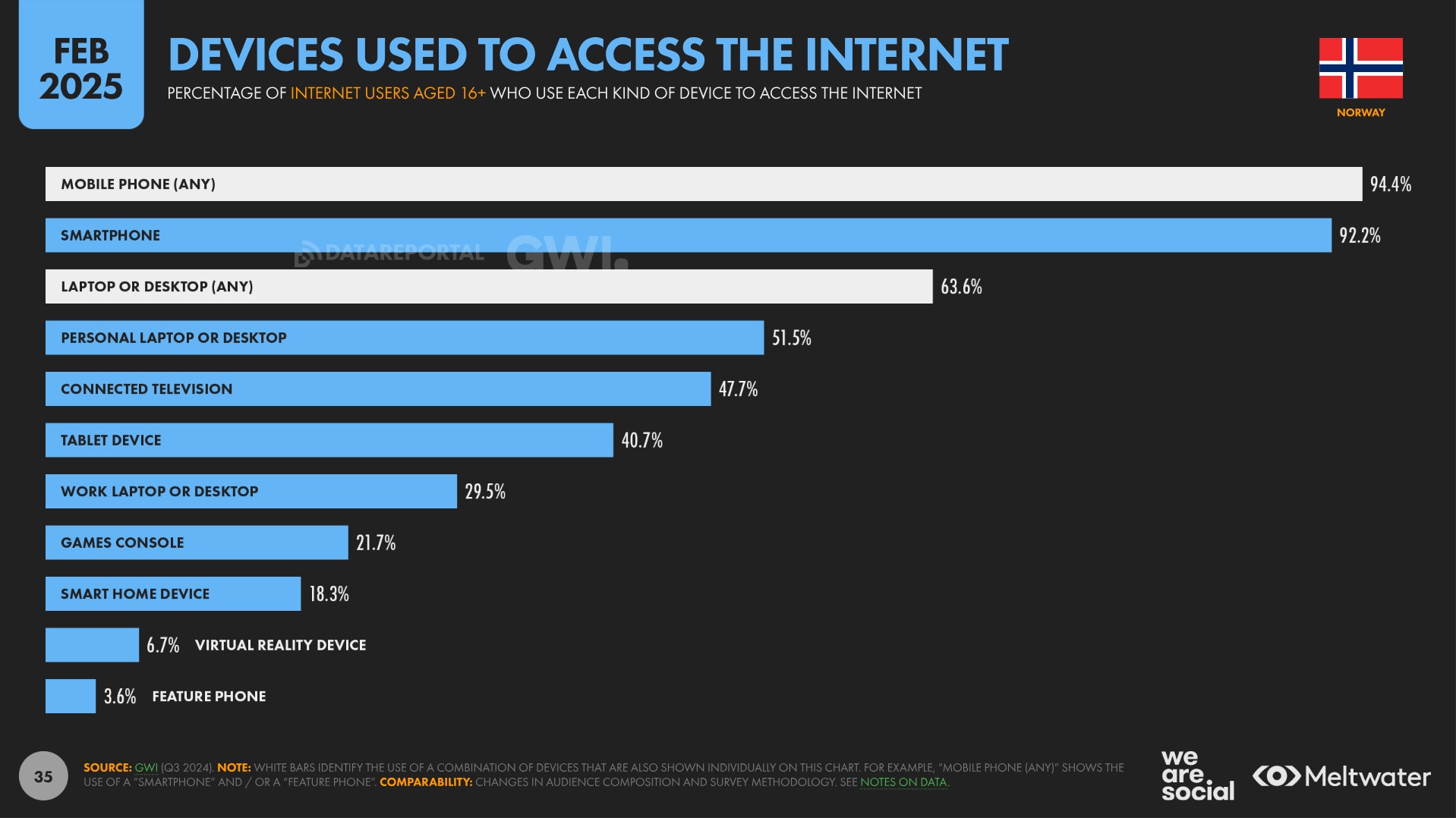 Source: Digital 2025 Norway
Challenges posed by the Norwegian market
A very important thing you need to know if you want to promote your website in Norway is that to purchase a .no domain, you must own a Norwegian company with a special ID number. Norwegians do not sell country-code domains on the open market.
Moreover, many online channels prefer a subscription model, with valuable content available only to users who pay for access.
Both of these factors show that Norwegians primarily look after their own interests and aim to maximise the benefits of doing business. Logistical issues may also arise when carrying out off-site activities. Most platforms require a Norwegian phone number, and attempts to register on some portals may fail due to an IP address that is not recognised as local.
The most popular search engines in Norway
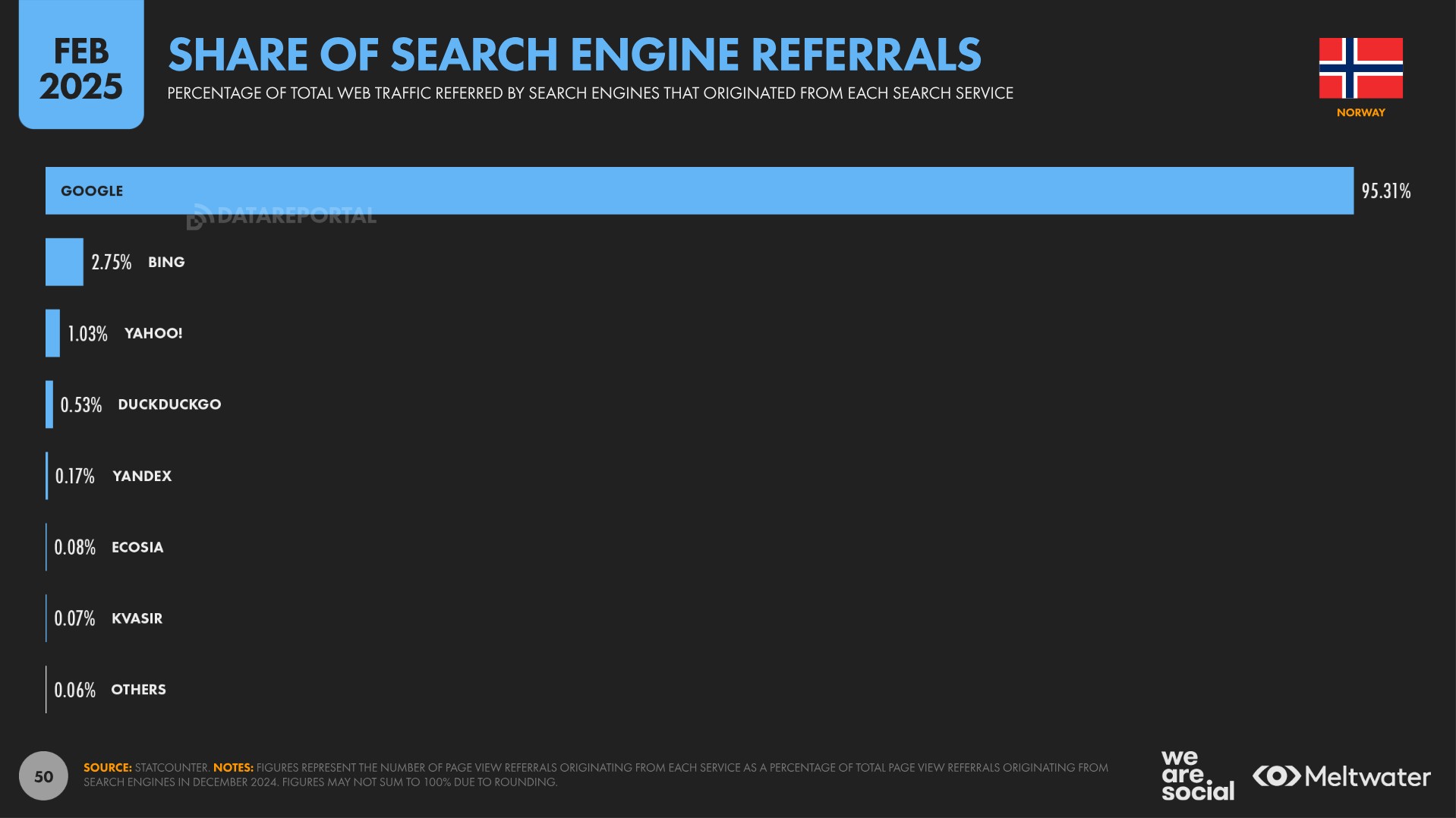
As in most countries (except Russia and the Czech Republic — you can read about them here: SEO in Russian and SEO in the Czech Republic), the most popular search engine in Norway is google.no, used by 95.31% of internet users. Bing ranks second (2.75%). Other browsers/search engines such as Yahoo, DuckDuckGo, or the local Kvasir account for a combined share of less than 2%. SEO in Norway will therefore be based primarily on optimisation efforts for Google.no.
Kvasir, despite its limited reach, may to some extent help with entering the Norwegian market and with local SEO. It is a commercial tool founded in 1995 and remains owned by Scandinavia Online AS. Unlike google.no, it is a source of local data, making it a useful tool for clients offering local services and products in a limited area.
Optimising for the Norwegian search engine will not necessarily cost more. Unfortunately, in this case you need to be prepared for logistical difficulties and, quite often, a language barrier. The best way to ensure the strategy runs smoothly is to contact the search engine’s Norwegian representatives.
Kvasir has not earned the reputation of being SEO friendly, although a high position in its results can bring profits to smaller companies.
You can observe how the two biggest search engines in the land of the Vikings work by conducting a simple experiment.
For a brief moment, let’s step into the shoes of a resident of Bodø who needs a new wallet. After typing the phrase “lommebok Bodø” into the local search engine, the organic results will primarily include shops operating locally or offering delivery to a specified location, as well as local classifieds sites, most often associated with newspaper titles that also operate offline in Bodø.

Using the same phrase in Google.no reveals a slightly different pattern. The first organic results are reserved for high-authority sites — such as the classifieds service gulesider.no. Only the next results overlap, as in the case of Kvasir.


SEO in Norway – what should you pay attention to?
SEO in Norway is not very different from SEO activities in other European countries, although certain patterns can be observed.
Norwegians value clear messaging and verified information, so your website should have a simple, intuitive layout. A key factor for SEO specialists in Norway is UX. Focusing on tailoring the site’s appearance for users is often done at the expense of off-site activities. The next step is, of course, content optimised for specific keywords. As with Polish websites, texts on the site must not be stuffed with keywords, and unique, high-quality content increases the conversion rate.
In Norway, local SEO will be particularly important, as the country is very vast and divided into areas that differ in climate, terrain, and many other factors that can themselves suggest which industries may have a chance to succeed in a given region. If you are looking for a large audience, try to target the main urban centres in Norway: Oslo, Bergen, Stavanger, and Trondheim.
Targeting communication locally can involve communication difficulties. Two standardised official languages — Bokmål and Nynorsk — and several regional ones are inflected through hundreds of dialects deeply rooted in the language structure. An Oslo resident will negate with “ikke”, while someone from Bergen will use “ikkje”. Although differences in written forms are not standardised, many people prefer to use constructions closer to spoken language. In such a case, it is worth asking whether links from EMDs are justified, especially for websites operating nationwide.
Google is not friendly to Norwegian dialects, which makes it harder for the search engine to understand user intent. Often, to maximise profits, it is better to avoid a local dialect and focus on the most popular language variety.
What does the advertising market look like?
We must not forget about backlinks and sponsored link campaigns — the rules are the same as for SEO in Poland. It is worth noting, however, that Norwegians do not like ads — this relates more to billboards, but such behaviours are often transferred into the digital world. The Norwegian market is a good area for both global and local keyword SEO — the possibilities are broad. The most common choice among SEO specialists is paid classifieds platforms and social media.
An important point about SEO in Norwegian is that organic SEO in this country is much more important than in Europe and the US. Organic search results are the natural results in SERPs that appear directly below ads. The popularity of organic SEO comes from the fact that few Norwegian companies use PPC ads. (source: www.mynewsdesk.com)
SEO in Norway vs. the rest of the world
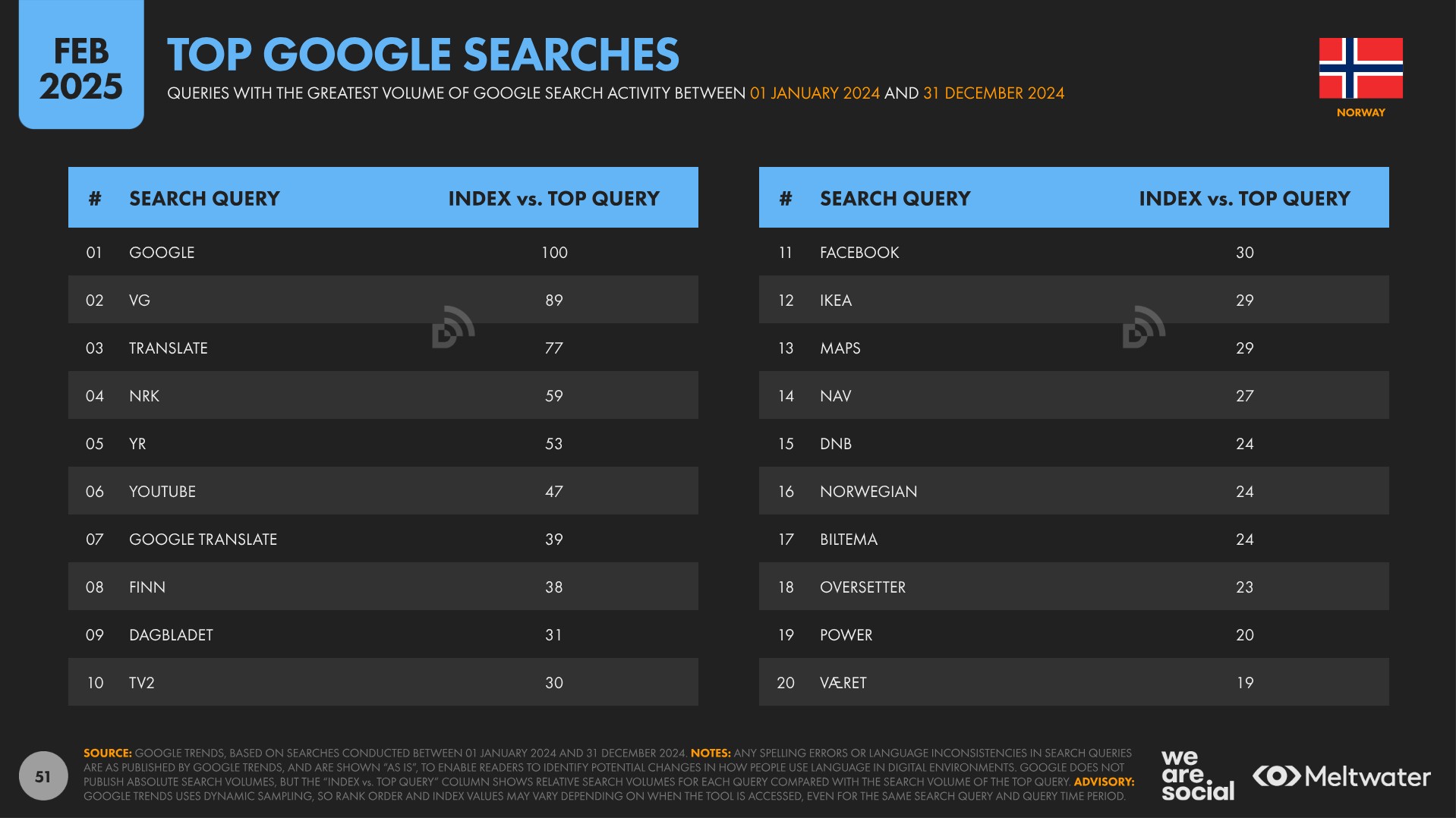
Compared with countries such as those in the Middle East, you can see a significant difference in how Norwegians search for phrases. Users in Norway far more often use short, single words or simple phrases, which are very often names of brands, services, institutions, or tools (e.g. Google, NRK, VG, FINN, YR). They are less likely to type full queries in the form of extended questions, such as “why isn’t my washing machine working?”. This means search intent is often implied and based on context rather than explicitly described in the query, which directly impacts how SEO content should be planned.
Compared with countries such as the US, there are also important differences in approaches to SEO. These stem mainly from a smaller population and a significantly limited number of active sites operating on country-code domains (.no). As a result, the content market is less saturated, and competition for many keywords — especially transactional and brand queries — remains relatively low. For an SEO strategy, this means a better chance of achieving visibility quickly with a well-chosen scope of activities.
Undoubtedly, Norwegians’ very good command of English contributes to the growing importance of international platforms and services operating outside the local ecosystem, such as Digg or Reddit. Users are not limited exclusively to Norwegian-language content, which increases competition from global domains. At the same time, that is precisely why Google treats valuable local sources as particularly important in the context of the Norwegian market, rewarding pages tailored to the local language, realities, and user intent. Gaining high-quality visibility in Norwegian search results therefore becomes a priority, especially as competition for many target keywords is limited. In practice, this means that with a well-planned SEO strategy, it is easier to outperform competitors and build a stable, long-term position in Google.
SERP på norsk
The number of indexed pages in Norwegian is much lower than English-language websites, so it is not difficult to rank in search results for Norwegian keywords. It should be noted that Norwegians use hundreds of dialects, so one word can have several variations. Norwegian Bokmål is the main language used in speech and writing by over 85% of the population; Norwegian Nynorsk is the second, typically used in writing; and Sami is the third language, classified as a regional language, used by around 30,000 people.
Where should you do SEO?
It is worth listing your business in Norwegian online directories. Below are the 4 most popular:
- www.gulesider.no
- www.1881.no
- nettkatalogen.no
- www.topannonser.no
Promote your business on social media!
As we mentioned when discussing SEO in other countries, one of the most important elements supporting SEO is promoting a brand, company, or service on social media. The same applies to Norway and other Scandinavian countries. This is a region where some of the highest proportions of households in the world have internet access. It is therefore no surprise that internet users spend many hours browsing social media.
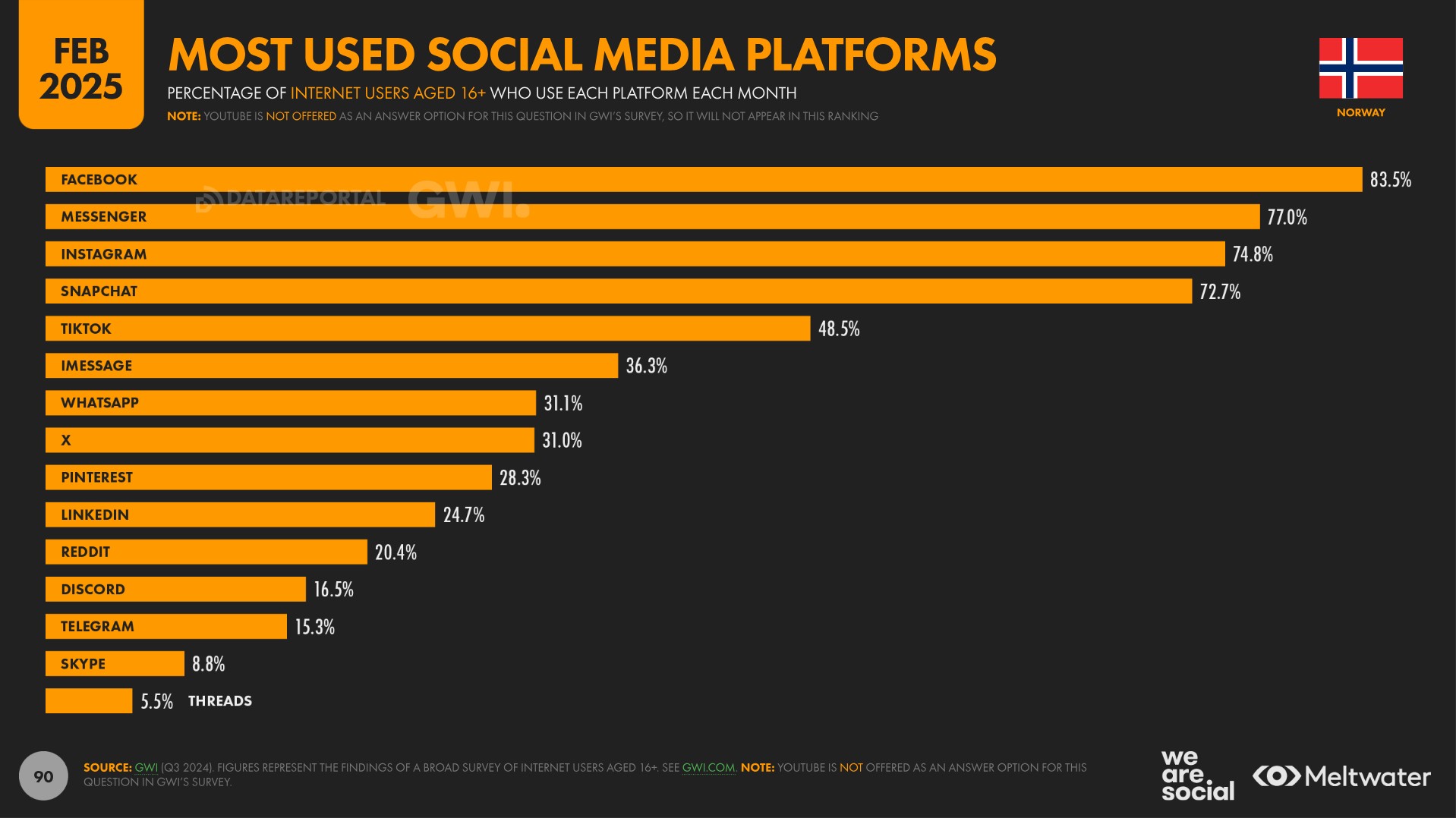
In 2025, social media in Norway is clearly dominated by a few key platforms with very high reach. The most used service remains Facebook, which is used monthly by 83.5% of internet users aged 16+. Next come Messenger (77.0%) and Instagram (74.8%), confirming the strong position of the Meta ecosystem in the Norwegian market. Snapchat also plays a very important role, reaching 72.7% and remaining one of the most important channels for communication and content consumption, especially among younger users. The top five is rounded out by TikTok, used by 48.5% of internet users, which has become a permanent part of the social media landscape as an entertainment platform driven by video formats.
It is also worth adding biip.no, once a popular social network among teenagers, which can be compared to Tinder or Poland’s Fotka.pl. For now, however, the platform has been suspended and a new version is expected to appear soon.
Social media in Norway will be a strong support for your company website’s SEO and an additional source of organic traffic. Build relationships and strengthen loyalty among potential audiences. Both SEO and social media take time to build momentum, but we assure you — their synergy delivers visible results.
Which industries are worth doing SEO for in Norway?
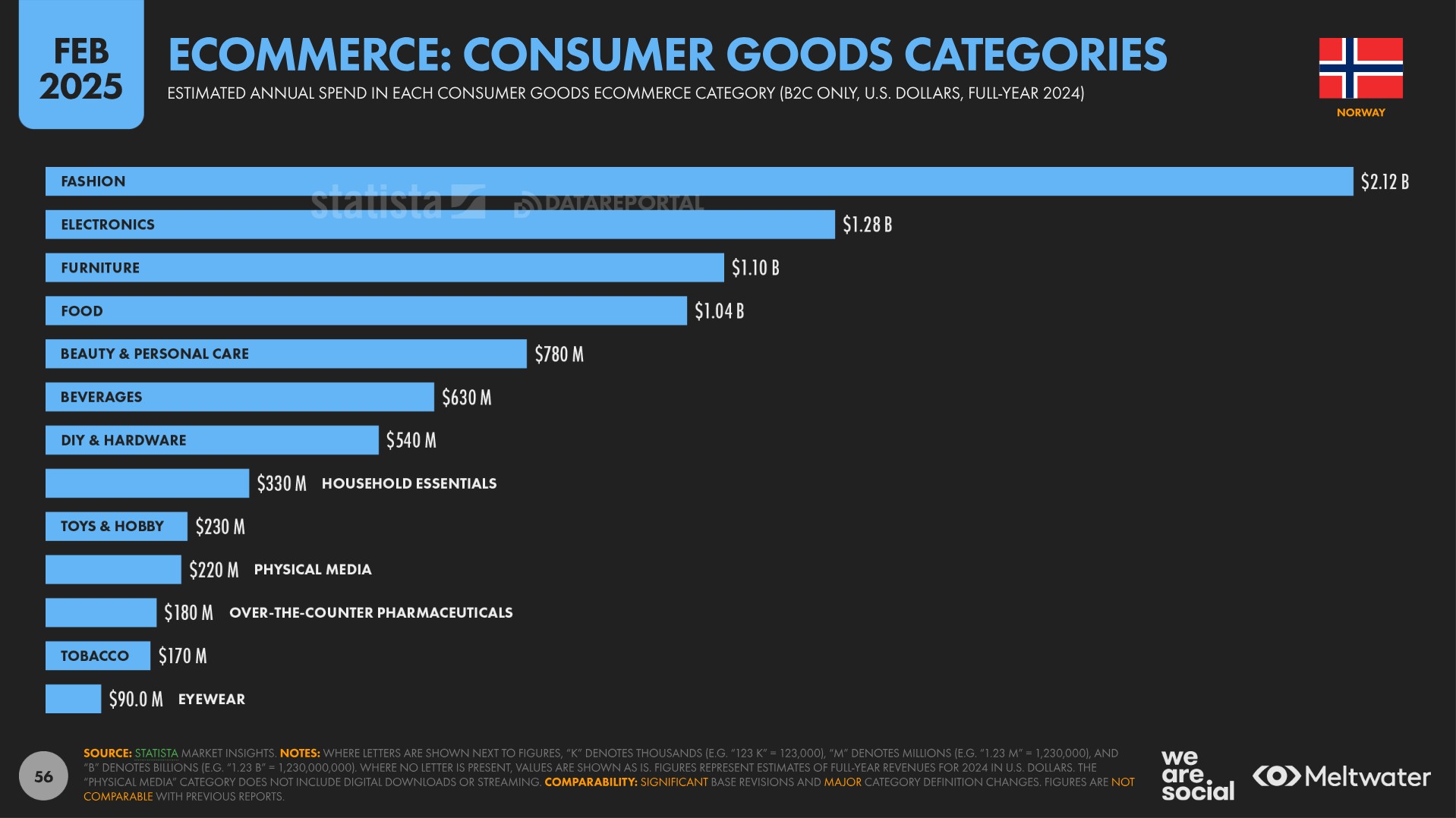
Poles are keen to develop their businesses in Norway. However, they often jump in at the deep end, entering the market with a product or service that has no demand in the country. Industries worth paying attention to, and whose websites are worth optimising for Norway, include:
- construction – Poles are one of the key exporters of high-quality construction materials,
- the timber industry – forests cover 80% of Norway’s land area, so wood is the most important export product,
- furniture – modern, ergonomic furniture is highly appreciated by residents,
- windows – living in Norway, you can notice that most windows in homes have panes made in Poland — a much cheaper solution for residents than buying locally,
- IT – software companies have a chance to succeed in the Norwegian market; Poland’s IT industry is at a very high level,
- renewable energy – Norwegians are known for caring about the environment, so photovoltaics, solar collectors, and other renewable energy sources are likely to be very popular in this Scandinavian country.
SEO Norway: summary
If you are still wondering whether SEO in Norway is profitable, our answer is — OF COURSE! It is not only an expansion into a new market, but also an opportunity to gain new contractors and establish cooperation with Norwegian companies, which can be beneficial for your business at home. When you rank your business in Norway’s online space, you gain access to a broad and affluent audience. There is plenty of room to manoeuvre, and it is up to you whether SEO in the land of fjords and forests will be a worthwhile investment.
This post is an update of content from 19 August 2016.