SEO in Germany. What do You Need to Know to Properly Plan Your Campaign on the Rhine?

8min.

Comments:2

29 May 2025

SEO in Germany. What do You Need to Know to Properly Plan Your Campaign on the Rhine?d-tags
How to properly use SEO in Germany and how does it differ from strategies in other countries? What factors should you take into account? Keep reading our article to find useful tips.

8min.

Comments:2

29 May 2025

SEO in GermanyToday we’re going to take a closer look at SEO in Germany, which is gracefully known in this country as Suchmaschinenoptimierung. This entry is undoubtedly worth reading, taking into consideration that even the German SEO professionals unanimously agree that the local market is rather demanding. So, open up your digital marketing notes, and let’s get it started.

German users – who are they and what search engines do they use?

Unsurprisingly, Google, with over 94% of all searches, is the leading search engine used in Germany. Bing, the second on the podium, is preferred by 2,79% of users, and Yahoo with less than 1% of all searches is an almost negligible search engine. Moreover, 88% of Germans use the Internet, which gives approximately the same proportion as in the United States. That definitely shows that digital marketing is a way to win quite a market share. The Internet is used mainly by young people – among those aged 16 – 34 over 90% regularly browse the net. However, later there is a noticeable decrease – 81% of people under 44 years of age and only 70% of those over 45 years of age use the Internet. Compared to other European countries, Germany is a relatively highly computerized society. So for example, in Poland, only 60% of those over 45 years of age use the Internet and the older the population gets, the less often they use the Internet.

… And what websites do they prefer?

When planning SEO in Germany, it’s important to remember about differing visual preferences of the German users. What previously worked when it comes to your social media graphics or website design may no longer be effective while aiming at the German market. While the English Internet users find minimalist website designs pleasing, Germans are fond of extensive descriptions. According to SEO professionals, Germans tend to treat websites as product business cards. So if they’re thoroughly prepared, they can convince the users of the high quality of the products or services. Therefore, when creating a text for a German user, first you need to emphasize the quality of the product and only then you can talk about its price.

German SEO consultations and strategies

Language – the key to the German SEO

What is absolutely necessary to run an SEO campaign on google.de? It’s the knowledge of German. According to what most people say, it’s a very demanding language and without its knowledge, you can’t really count on success. Although language barriers are omnipresent when it comes to foreign SEO, they’re particularly visible in Germany. If you decide to contact a client or an influencer, you must remember about linguistic and grammatical correctness of your message. Otherwise, there might be no response, which, in turn, translates into a failure of marketing activities such as content promotion which is based largely on building relationships on the Internet. Discourse typical for Germany is another important factor. Local businessmen are said to value clarity and transparency of information. Therefore, building any online relations with the use of ambiguous messages may be misunderstood.

Characters such as Ä, Ü, ß which aren’t present in English are another challenge – it’s difficult to use them from the default settings of the English keyboard. Although Google search engine is able to recognize words even when special characters are replaced by U or A, it’s worth following the rules while running the german SEO campaign as correctness is one of the criteria taken into account by Google robots while assessing a given website.

Download our free International SEO checklist and conquer global markets!

Download now!

German SEO – Keyword research challenge in Germany

When it comes to German, choosing the right keywords is a particular challenge. Sometimes, difficulties appear even when it comes to the number of words. For instance, the English phrase “search engine optimization” in German is written with only one word “Suchmaschinenoptimierung”. Challenging as the phrase looks (and sounds) it’s also a challenge in terms of the SEO process. Now, SEO professionals have to make the decision whether to optimize the content on the website for the whole phrase written in one word, or for its individual components. The German SEO specialists recommend not forgetting about component optimization.

The power of long-tail keywords

Thanks to the flexibility of the German language, users can precisely communicate to Google what they need and this must be taken into consideration while conducting keyword research and creating a list of key phrases. According to experts, SEO for long-tail keywords is much more effective. Moreover, German-speaking users sometimes tend to use “Englishized” word forms when entering queries in the search engine. And even if these words aren’t 100% grammatically or linguistically correct, they can have a significant volume of searches and must be taken into account when building a list of key phrases. To conclude, many SEO professionals point out that language is the main challenge when it comes to german SEO. The help of a native speaker would be an ideal solution to the problem – maybe you know someone who is bilingual, willing to cooperate, and would be happy to provide you with some SEO services?

Long-tail seo

SEO in Germany – practical tips

One of the typical, basic solutions present in International SEO is to convince the search engine geolocalizer about the target range of your website. If you’re using the top-level domain with the extension specific to Germany: .de, it’s worth hosting your website on the Rhine. Putting the website on a server in Germany costs from 10 to 20 euros for the first year. If for some reason you can’t change the domain to .de, and you position the site in one of the gTLD domains (including .com), remember to use the hreflang tag and Google Web Toolkit to determine the location of your site in Germany. Providing a German address and phone number in the contact tab is also helpful for geolocation.

Germany and nearby German-speaking countries – killing two birds with one stone?

If you decide on SEO in Germany, other German-speaking markets, such as Austrian or Swiss, can become your secondary targets and this might be also desired by your clients. However, in such a case you need to note certain language differences. The German spoken in Berlin and Vienna vary in technical, business, or legal vocabulary.

Expert Comment

The German market, like many others, has its own specifics. That’s why when you’re thinking about expanding your business there, you need to make sure to explore and learn all the characteristics. The things you should learn will vary for different industries, depending on what’s your core business. However, I think the most important is to understand the cultural context and learn as much as possible about shopping behavior, search engine differences, and rules that apply to your industry. This way you can start optimizing your website while adjusting particular elements of the SEO process to the local audience. That’s exactly what we did while working with one of our clients, Superloko, when we suggested implementing the “Trusted Shop” protocol – one that is very important for customers on the German market, while on the others may not be so crucial for gaining customers’ trust.

Milena Fietko Delante
Milena Fietko
Senior SEO Specialist

Building a link database for German websites. 3 basic methods

Below you can see various SEO techniques used in Germany while building link databases. In the case of country-focused SEO, there’s a general rule that external links to a German website should come from other German sites. Otherwise, you’re risking not being visible for search engine bots. So which sources are worth using while building a link database and which should be avoided?

  1. Directory entries. Although in many countries this is one of the most popular ways of gaining positions, it may not work in Germany as the directories are usually paid and cost even up to 50 euros. Below you can see some of the German directories, including the free ones:
    • http://bellnet.de – this directory advertises itself as the oldest German Internet directory which has been operating for almost 15 years. If you don’t do SEO for a church, charity, sports club or university, you’ll be charged a one-off fee of 50 euros.
    • http://oekoportal.de – a directory for ecologically oriented companies and free of charge. However, if you decide to use it, it requires placing a banner on your website with a link to the directory.
    • http://www.rss-verzeichnis.de – RSS feed directory. Adding your own RSS feed is free but it works only with German feeds.
    • http://www.schlaue-seiten.de – company entry in the “business” category is free of charge but works only with German companies.
    • http://www.seekxl.de– entry is free of charge but requires a backlink.
    • https://www.bunte-suche.de -the first entry is free of charge. However, the site requires placing a banner that meets special requirements and a link to the directory.
    • Remember to add a description of your website with the physical German address of the client for whom you run the SEO campaign to WHO.IS.international seo - link building

2. German websites with press releases – they allow you to post short information about your activities, thematic entries that resemble blogging, product descriptions, reports on your presence at trade fairs, conventions, industry meetings and many more.

    1. artikel-presse.de
    2. fachzeitungen.de
    3. inar.de
    4. pflumm.de

3. Link exchange systems. Basing your german SEO strategy on them is rather risky. More than a year ago Google officially admitted that it had taken action against link exchange systems, which are considered to be a black hat SEO technique. Rankseller.de and teliad.de were among the systems punished at that time. Therefore, if such a situation occurred once, we should expect that this type of SEO is burdened with significant risk.

The take-home message

When considering SEO in Germany, remember that it takes patience to enter this market. It’s not only a matter of cultural differences but it’s also about the german SEO practices.  The activities described by Google as impermissible are still being used on the German Internet. This, in turn, means that the competition on the market is rather sizeable and tends to use black hat SEO alongside other uncertain digital marketing practices. Nevertheless, let’s trust Google that it’ll improve its algorithms and implement direct actions that will eliminate such illegitimate behaviors. Then, websites that use SEO properly, should be ranked first in SERPs. Perhaps it’s worth taking such an approach and preparing yourself to wait a little longer to see the effects of your work.

Understanding the German market

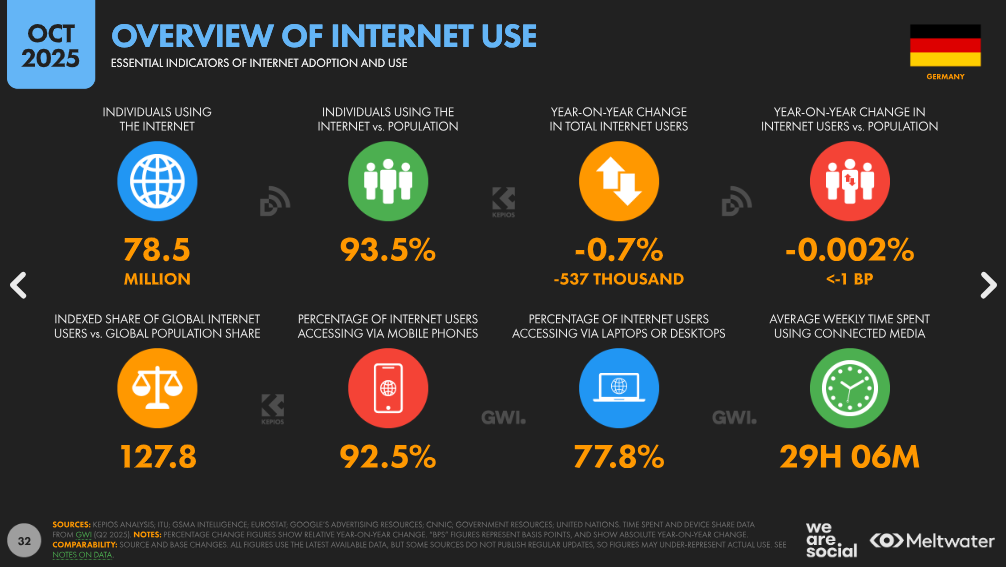
SEO specialists working on ranking up websites along the Rhine unanimously agree that this is a demanding market that must first be thoroughly understood. Undoubtedly, Germany is one of the largest European markets, which has been continuously growing in recent years. Nearly 79 million internet users live in Germany – their number has increased by over 7 million in the past decade. SEO in Germany will allow your website to achieve better visibility and reach a larger number of potential customers, who certainly are not lacking in this country.

internet usage in germany

source: Digital 2025 Germany

Moreover, the number of smartphones with internet access in Germany has been steadily increasing for 10 years and currently stands at 108 million, which means that nearly four out of ten Germans own two phones. When entering this market, you must therefore be mobile-friendly.

mobile internet connections in germany

source: Digital 2025 Germany

Furthermore, according to datareportal.com, in 2022 the average German internet user spent online 5 hours and 28 minutes, of which 1 hour and 48 minutes were on social media. When analyzing data regarding any market, it is important to remember that online user behavior constantly changes – especially with the growing popularity of AI-based tools such as ChatGPT, Gemini, or those implemented in Google results AI Overviews, and people increasingly gather information from social media as well.
At Delante, we keep up to date with all the changes affecting the visibility of our clients’ websites and continuously analyze where the users we want to reach are.

Want to learn more? Check out our article: How AI is Changing Search?

How do Germans use the internet?

The main reasons for internet usage by users in Germany (February 2025):

reasons for internet usage in germany

source: Digital 2025 Germany

Germans most often use the internet to find information, to contact family and friends, and to search for specific products and brands. This clearly shows that SEO in Germany can bring excellent results when we increase the visibility of products or services, making them more accessible to millions of users. At this point, it is worth noting which areas Germans most frequently shop online:

weekly online shopping areas in germany

source: Digital 2025 Germany

In the German market, as many as 41% of internet users decide to make an online purchase at least once a week.

Which products do Germans buy online most frequently?

most frequently purchased products in germany

source: Digital 2025 Germany

The fashion industry is the most popular, followed by furniture, electronics, food, and the beauty sector.

At Delante, we have extensive experience with these types of industries in the German market. We recommend checking out our Case Study for the Fashion Industry – Wordans

What matters most to German consumers?

When planning to enter the German market or expand your e-commerce business, it is worth paying attention to the factors influencing German users’ purchase decisions:

purchase decision factors in germany

source: Digital 2025 Germany

The factor that most encourages German consumers to purchase is free shipping; coupons and discounts, a favorable returns policy, user reviews, and next-day delivery are also very important.
German users also appreciate “Buy Now, Pay Later” solutions offered by platforms like Klarna. As many as 12.4% of buyers use such options (source: Digital 2025 Germany).

When operating in the German e-commerce market, it is worth considering the above data and providing users with at least some of the mentioned features.

It is important to emphasize that consumers from our western neighbor prefer domestic products, which should be taken into account when gaining this market. See how we helped our clients, endera.de and solovelybox.de, in such expansion.

Social media in Germany

When planning to expand your business or start marketing activities in the German market, it is also essential to remember social media. According to statistics, as much as 77% of the population in Germany regularly use social media.

Most used social media platforms in Germany (February 2025)

most popular social media in germany

source: Digital 2025 Germany

In Germany, the most commonly used social platform is WhatsApp. Next come Instagram, Facebook, TikTok, and Pinterest. SEO in Germany should also include activities on X, Pinterest, and Reddit.

Popular search engines in Germany

Like in Poland, the most popular search engine in Germany is Google, which holds 87.24% market share. Second is Bing with 5.73%, followed by Yandex.

search engines in germany

source: https://gs.statcounter.com/search-engine-market-share/all/germany

Looking at mobile and desktop searches separately, these values differ more. On desktop, Google’s popularity is 74.62%, while on mobile it reaches 93.49%.

desktop search engines

source: https://gs.statcounter.com/search-engine-market-share/all/germany

mobile search engines

source:https://gs.statcounter.com/search-engine-market-share/all/germany

While the percentages of Bing and Yandex on mobile are close to statistical error, the popularity of Bing on desktop, reaching 15.68% market share, is noticeable.

This means certain differences in website optimization depending on the type of search engine. However, most optimization practices are the same for both Google and Bing despite somewhat different algorithms. For example, for Bing domains with exact match names and use of exact keywords as well as meta tags “Keywords” still play a significant role.

We also need to mention searches in AI tools, which are gaining increasing popularity, with chatbots like ChatGPT generating more and more website visits. If you want to learn more about visibility in AI tools, read our article: AI SEO – what it is and how it will affect your business.

most popular chatbots in germany

source:https://gs.statcounter.com/search-engine-market-share/all/germany

Among AI solutions, ChatGPT enjoys the greatest popularity on the German market with 83.75%, second place is Perplexity with over 12%, and third is Google’s Gemini.

Understanding the habits of German internet users will allow you to develop the most effective SEO strategy, where the starting point should be preparing a version of the website with the extension appropriate for Germany, i.e., .de. In international SEO it is important to convince the geolocator about the intended website scope. With a .de domain and a local server, this becomes much easier.

Keywords in SEO for the German market

SEO in Google in Germany, as in any other country, should be preceded by a thorough analysis of competitors and keywords. A 1:1 translation of a phrase is often not enough; it must be properly placed in the given linguistic context.

Professional tools such as Google Analytics, Semrush, Ahrefs will be indispensable for this. However, it is worth noting that programs collecting global keyword data may be insufficient for German SERPs. Therefore, it is sometimes better to consider a solution with a larger database of strictly German phrases, such as Sistrix.

Choosing keywords for the German market is quite a challenge. For example, the English phrase “search engine optimization” can be written as one word in German – Suchmaschinenoptimierung. The decision an SEO specialist must make is whether to optimize the content on the website for the entire phrase (written as one word) or its components. Experts in German SEO advise that you should optimize for the components as well.

The German user, thanks to the flexibility of their language, can precisely communicate to Google what they need. If you want to rank your website in the German market, you should take this into account when creating your keyword list.

Moreover, according to SEO experts, optimization effectiveness for German websites is higher when using long-tail keywords. Germans like to create long tails related to the word kaufen (to buy), e.g., online kaufen (buy online) or günstig online kaufen (buy cheaply/conveniently online).

Furthermore, users from the Rhine region sometimes use anglicisms. Even if they are linguistically incorrect, they may have significant search volume and should be considered in your strategy.

Key issues in SEO for the German market

International SEO requires a well-optimized website. Therefore, attention should be paid to elements such as:

  • URL structure – a ccTLD domain (with the .de extension) allows creating SEO-friendly links that give Google a clear signal that the content is targeted at a specific country, in this case Germany; it is absolutely necessary to avoid URLs with parameters, e.g., www.example.com/page?gl=DE – unfriendly for indexing robots and users;
  • site loading speed – a Google ranking factor equally important in all countries; fast websites can have an advantage in SERPs because they provide users with a better experience navigating the site; our SEO strategy for one client, the superloko.de store, included improving site speed, and just image compression brought visible effects in this area;
  • mobile-first and responsiveness – since German customers heavily use mobile devices, optimizing the site for responsiveness is a must, especially important for positioning stores in Germany, which should load well on smartphones;
  • clean code and semantic HTML tags – code problems can negatively affect website performance and thus worsen SEO results. It is worth verifying the correctness of the code with a special HTML validator that can detect syntax errors.

Download a free international SEO checklist and grow your business abroad!

Content optimization

International SEO should not be based on duplicating content already on your native website. If you want to provide content for the German audience, tailor it to their intent, ensuring substantive value and linguistic correctness. It is best to commission texts to native speakers to avoid mistakes that could harm your company’s reputation.

In your content, don’t forget about elements such as:

  • tag titles containing keywords,
  • filled meta descriptions,
  • text structure with H1-H6 headers,
  • multimedia (photos, videos, infographics).

Link building in Germany

In Germany, as in the Polish market, acquiring backlinks from local domains and building a link profile with high authority is very important for Google rankings. Links to a German website should come from German-language domains. Below are some ways to gain such links.

Press publications

German journalists willingly include links in the articles they publish. They look favorably on short company news, thematic blog-like posts, product descriptions, and reports from trade fairs, conferences, industry meetings, etc.

Guest posts and social media

Among other effective methods of link building in Germany are writing articles for local blogs or sponsoring local events and happenings. This is a great opportunity for your website address to appear on regional portals. Also, remember about brand mentions, often called the new link building. These are brand mentions in various places online (forums, blogs, articles, rankings, reviews, etc.), preferably near the most important keywords for the promoted business. They are especially important in the context of AI tools, which use this type of content when generating responses for users.

Links from social media are also crucial. Although not an official ranking factor, they help increase brand awareness and website visits. Collaborating with influencers and activity on social media can strengthen website SEO.

Directory listings

This is one of the most popular methods of acquiring incoming links, although compared to Polish directories, it is not the cheapest in Germany. NAP listing prices range from 50 to 100 Euros per link. In the current situation and search changes, directories and NAP listings are also extremely useful for creating brand mentions, and AI models use information from them when generating answers.

Monitoring and analyzing results

SEO in Germany requires continuous monitoring and analysis of results. To do this, connect your site to free Google tools – Search Console and Analytics, supported by other independent tools operating in the German market, such as SEMrush, Ahrefs, or Moz.

The information obtained this way can lead you to key conclusions. Perhaps a phrase was mistranslated and therefore does not rank, or maybe it is worth obtaining an additional link to improve the ranking of a given keyword.

Summary: key aspects of positioning in Germany

SEO for websites in Germany is a long-term process that might not be easy. Therefore, the SEO strategy for the German market must be consistent and well thought out. Regardless of whether you already have a strong position in Polish Google, you must build authority in the German market from scratch. Professional and substantive content, good technical optimization, and acquiring links from German-language domains will help you with this.

You also cannot forget about regular monitoring of the results and competitors’ moves analysis. Without them, the undertaken actions will cease to be effective.

If you wonder whether to handle SEO in-house or with an agency, remember that this undertaking requires consistency and considerable work. The first option may generate greater savings but may prove illusory in the long run – without experience, you will burn your budget.

SEO costs in Germany when hiring an agency start, on average, from 2000 euros, but the experts’ knowledge will translate into measurable effects and stable Google positions.

Stay up to date with the latest SEO news!
Subscribe to our newsletter
Delante – Best technical SEO agency
Author
Mateusz Calik - CEO
Author
Matt Calik

CEO

CEO, has been building Delante since 2014. Responsible for international SEARCH strategies. He has a strong analytical approach to online marketing backed by more than 12 years of experience. Previously associated with the IT industry, as well as the automotive, tobacco, and financial markets. Has experience in creating scaled processes based on agile methodologies.

Author
Mateusz Calik - CEO
Author
Matt Calik

CEO

CEO, has been building Delante since 2014. Responsible for international SEARCH strategies. He has a strong analytical approach to online marketing backed by more than 12 years of experience. Previously associated with the IT industry, as well as the automotive, tobacco, and financial markets. Has experience in creating scaled processes based on agile methodologies.

FAQ

1. Should I update my SEO strategy for the German market?

Yes! Even if you already have one SEO strategy, you’re fully satisfied with it and it brings you results – it’s best to update it to adjust the strategy to German SEO standards. SEO in Germany and in every other country has individual characteristics due to other cultural backgrounds and customers’ behavior. What works for one market, may not be the best option when entering another one. So, if you want your SEO to be really successful, always create a strategy for the specific market 🙂

2. I want to enter German market - should I create another website?

Not necessarily 🙂 Usually creating an appropriate language version of your website will be enough. We’re discussing the domain matter in more detail above 🙂 If you’re adding the language version to your domain, make sure you got your hreflangs covered! Learn more about it here: Hreflangs. How to Tag the Language Versions of Your Website?

3. How much Do I have to pay for German SEO?

Tough question! The price of the SEO process varies, as it depends on many factors including current website SEO optimizations, its visibility, competition on market, and so much more! that’s why it’s being set individually for every website. To get a general picture of SEO prices go to our pricing page, or simply get a free quote – we’ll have a good look and your website and come up with a precise price for your German SEO strategy 🙂