 d-tags


 Loading...
What is automation in Google Ads?
Automation in Google Ads means using tools, algorithms, and artificial intelligence systems to perform tasks that were previously done manually.
Automation not only saves time but can significantly improve campaign effectiveness. Google’s algorithms analyze data in real-time and adjust actions to maximize conversions or return on ad spend (ROAS).
Automated bidding strategies
Google Ads offers a variety of smart bidding strategies powered by machine learning that optimize campaigns in real time, eliminating the need for manual bid adjustments for each ad group. The system analyzes hundreds of signals and shows your ads to users at the best possible moment to maximize results based on your chosen goal.
Here are some key automated bidding strategies:
- Maximize conversions — the system tries to get as many conversions as possible within your budget.
- Maximize conversion value — focuses on achieving the highest total transaction value rather than just volume.
- Target ROAS — lets you set a minimum return on ad spend you expect from each dollar spent.
- Target CPA (cost per acquisition) — aims to acquire conversions at a specified average cost, ideal when you know the exact CPA that keeps your campaign profitable.
This is a prime example of Google Ads automation, where the system independently makes decisions on bid optimization and campaign goal achievement. This ensures your ads reach the right audience at the optimal time, saving you time and improving campaign performance.
For a deeper dive into bidding strategies, check out our previous post.
Responsive search and display ads
Automation also extends to ad creatives. With responsive search ads (RSAs) and responsive display ads (RDAs), advertisers provide multiple headlines and descriptions, and the system tests different combinations to find the best-performing variations.
Dynamic Search Ads (DSA) and Performance Max campaigns
DSA campaigns automatically index your website content and match it to user queries, dynamically generating ads on the fly. This allows effective promotion of a broad range of products or services without creating individual ads for each page — a great solution for large e-commerce stores with extensive inventories. Keep in mind that better SEO optimization of your site improves ad relevance and targeting accuracy.
Performance Max (PMax) campaigns utilize all available assets — including text, images, videos, audience signals, and website content — to precisely target the most valuable users. Your ads then appear across multiple channels simultaneously, such as Search, YouTube, Display Network, Gmail, and Discover. Based on gathered data, the system dynamically selects the most effective channels and optimizes creatives and budgets in real time.
Enabling the final URL in PMax allows Google to direct users to the most relevant landing pages on your site, provided text assets are included — improving ad relevance and effectiveness. You can also allow Google to automatically enhance uploaded videos by creating additional versions in vertical, square, and shortened formats, which can boost reach and engagement.
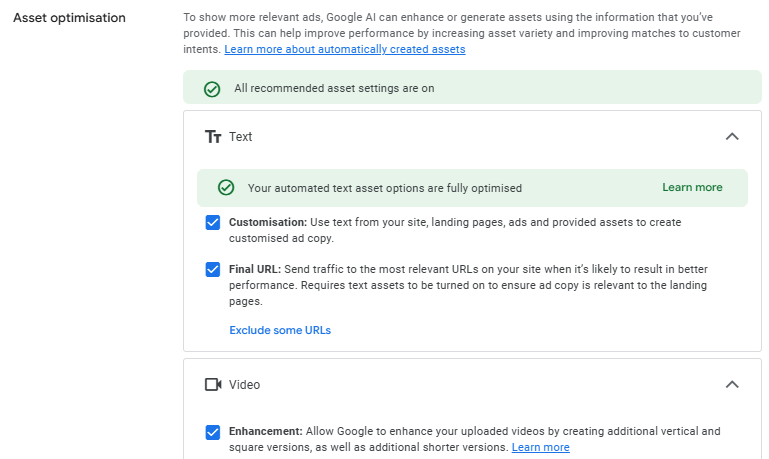
Source: Google Ads platform
AI in Search Campaigns
AI Max for Search Campaigns is a new feature in Google Ads that integrates advanced artificial intelligence with traditional Search campaigns. It’s not a separate campaign type but a set of optional functions you can activate in existing campaigns to increase reach and performance. AI Max uses your website data, ad copy, and assets to reach new users and drive more conversions while maintaining similar CPA and ROAS levels.
It introduces a new keywordless targeting model based on analyzing landing page content and ad assets, enabling targeting based on user intent rather than specific keywords. AI Max works alongside Smart Bidding strategies and does not change keyword prioritization in auctions. This feature rollout is scheduled to begin in late May 2025.
Automated rules and scripts
Google Ads allows you to create automated rules that respond to changing campaign conditions — for example, pausing high-cost keywords without conversions, increasing budgets for campaigns with good ROAS, or activating ads for specific promotions at scheduled times. As the screenshot below shows, there are many possibilities for setting up rules.

Source: Google Ads platform
For more advanced users, Google Ads scripts are available, which can be customized for almost any scenario — from monitoring spend to automatically generating performance reports.
Are there drawbacks to automation in Google Ads?
While Google Ads automation offers many benefits, it’s important to remember it’s not without downsides. Lack of full control, the risk of algorithmic mistakes, and the need for significant historical data are some challenges.
Therefore, the best approach combines automation with manual oversight and optimization — for example, setting bid limits, adding negative keywords, or reviewing ad creatives regularly.
Summary
Google Ads campaign automation is the future of digital advertising. It allows you to operate faster, more efficiently, and at a larger scale. Whether you run a small online store or manage numerous campaigns at an agency, investing time to understand how to automate Google Ads campaigns and leverage Google’s tools fully is worthwhile.
However, remember that even the best automation cannot replace a solid strategy and regular performance monitoring. The best results come from combining technology with human expertise.
For more on leveraging AI and automation in Google Ads, read our previous post that explores AI’s impact on ad management: Using AI to Create Google Ads.
And if you want to stay up to date with SEM and SEO news, subscribe to our newsletter!