The Most Popular Delivery Methods for Online Shoppers in Poland – Ranking

9min.

Comments:0

08 July 2025

The Most Popular Delivery Methods for Online Shoppers in Poland – Rankingd-tags
Are you planning to open an e-commerce store in Poland? Or, do you already have a Polish branch? In both cases, there's one thing you need to know: online shoppers in Poland love a fast, reliable delivery tailored to their expectations. But what do they expect? Find it out!

9min.

Comments:0

08 July 2025

Delivery Methods in Online Stores – What’s All the Fuss About?

If you don’t ensure that popular delivery methods are available in your store, you may lose customers.

The customer has landed in your store, which has everything they’re looking for. The prices are attractive, the site is fast, the product images encourage clicking. They add the product to their cart, go through the payment process… and it’s at that point, at the last stage, in the “Choose Your Delivery Method” section, when the magic fades away. It turns out that the only option is a courier between 9 AM and 5 PM, but they work in an office without a reception. There’s no favorite parcel locker. In that one moment, the experience at the final stage nullifies all the earlier work.

In logistics jargon, the term “last mile” is used. This is the final, most critical, and simultaneously the most expensive part of the shipment’s journey – from the local warehouse straight into the customer’s hands. You can have the most advanced marketing in the world and generate a huge, valuable amount of traffic to your website. However, if the experience at this final stage is negative, all your earlier work is wasted.

What Are the Most Popular Delivery Methods in Poland? How to Gain Customer Loyalty?

If you run your e-commerce store and want to sell more, attract new customers, and retain the current ones, you need to take care of what happens after clicking “Buy Now.” The delivery options you offer have a real impact on purchasing decisions. Data from the “E‑commerce in Poland 2024” report by Gemius clearly shows what customers really expect.

Here’s the ranking of the most popular delivery methods in Poland:

  1. 🥇Delivery to parcel locker
  2. 🥈At home/at work delivery
  3. 🥉Delivery to partner outlet
  4. Delivery by mail to home or work
  5. Delivery to a physical store (click & collect)
  6. Delivery to a postal office
  7. Transfer directly from the website

The delivery methods you offer impact the shopping decisions of your customers. According to the data from the Gemius “E-commerce in Poland” report, we can clearly see what the Polish consumer expects.

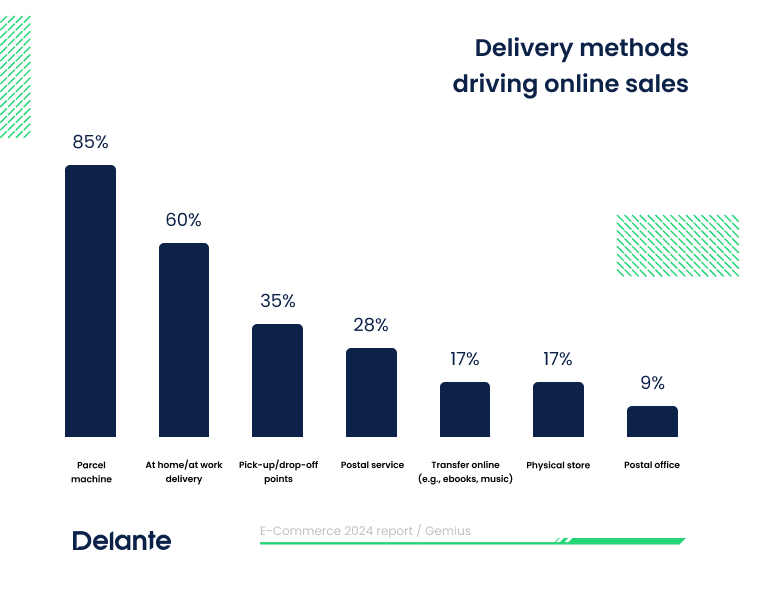
Most popular delivery methods in Poland

Source: [1]

Delivery methods driving online sales in Poland:

  1. Parcel locker – 85%
  2. At home/at work delivery – 60%
  3. Partner pick-up/drop-off point – 35%
  4. Postal service delivery (at home/work) – 28%
  5. Direct transfer from the website – 17%
  6. Delivery to a physical store (click & collect) – 17%
  7. Postal office – 9%

🥇No. 1: Parcel Lockers (85%) – The Undisputed King of Convenience

If you were to invest in just one delivery method, choose parcel lockers. It is currently the preferred option in Poland – 85% of internet users list it as their favorite delivery method. And among them, the number one choice is… no surprise here – Paczkomat®. It’s the choice of 88% of the respondents. Mr. Rafał Brzoska loves it!

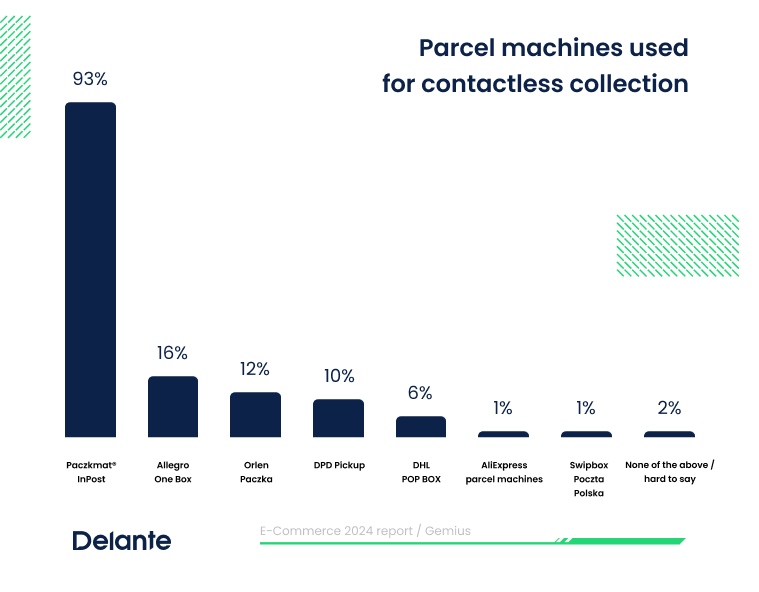
Most popular parcel lockers in Poland

Source: [1]

Most popular parcel lockers for contactless collection in Poland:

  1. Paczkomat® InPost – 93%
  2. Allegro One Box – 16%
  3. Orlen Paczka – 12%
  4. DPD Pickup – 10%
  5. DHL POP BOX – 6%
  6. AliExpress parcel lockers – 1%
  7. Swipbox Poczta Polska – 1%
  8. None of the above/hard to say – 2%

Why is this the case? Because parcel lockers combine what is most important in online shopping: time, convenience, and independence. You pick up the package whenever you want – morning, evening, or at night. You don’t wait for the courier. You don’t have to be at home.

Not having this option in your store is not just an oversight. It’s a conscious decision to disregard reaching the largest and most engaged group of online customers.

🥈No. 2: At Home/at Work Delivery (60%) – Still a Valued Delivery Method in Poland

In second place, with 60%, is an option that for years was the gold standard in e-commerce. Courier delivery straight to your door is still highly valued. Not everyone likes technology, not everyone trusts the locker – some prefer when the package is delivered right to their doorstep.

For many, it’s simply more convenient. Especially if they live in rural areas, have mobility issues, or work remotely and are home most of the day. Couriers today offer better services – you can track your shipment online, change the delivery time, and even redirect the package to a different address. And which courier companies are most popular today? A little hint: Mr. Rafał Brzoska likes it again 😉

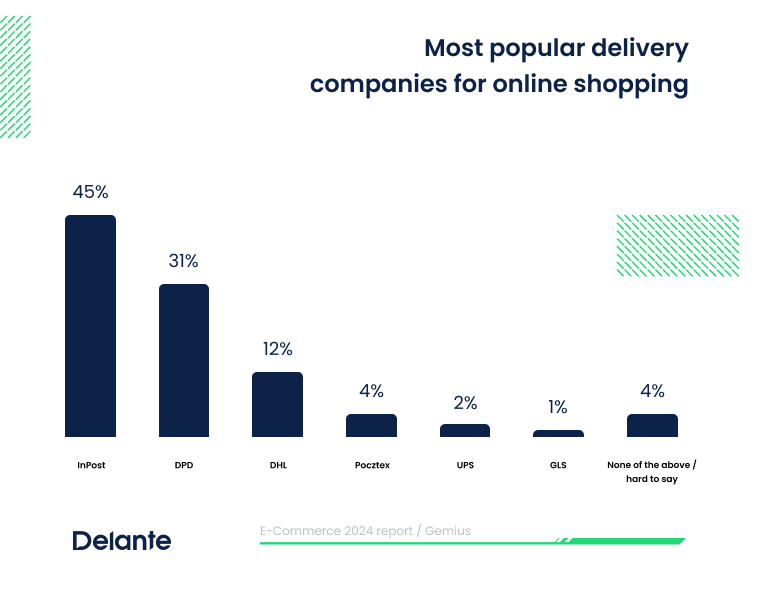
Most popular last-mile delivery companies in Poland

Source: [1]

Most popular last-mile delivery companies in Poland:

  1. InPost – 45%
  2. DPD – 31%
  3. DHL – 12%
  4. Pocztex – 4%
  5. UPS – 2%
  6. GLS – 1%
  7. None of the above/hard to say

🥉No. 3: Delivery to Partner Pick-up Drop-off Points (35%) – Convenience “On the Go”

The podium closes with an option that combines convenience and availability – pickup at partner points such as Żabka, ORLEN, or Ruch. Chosen by 35% of buyers. This shows the enormous potential of this form of logistics.

What’s its superpower? Integration into everyday life. Your customer doesn’t need to plan a trip to pick up a parcel. Instead, Ttey pick it up “on the go” – while buying bread in the morning, refueling the car on their way home, or getting a newspaper at the kiosk.

No. 4: Postal Service – Just Behind the Podium

Although parcel lockers and couriers have dominated the market in recent years, postal deliveries are still a popular solution, especially for less urgent orders. 28% of Poles still choose delivery via Poczta Polska (Polish Postal Service), and it’s still a great option if you want to offer your customers cheaper delivery methods. Poczta has a well-developed network of points, and parcels are delivered both to homes and pickup points.

What’s more, it’s usually one of the cheaper delivery options, which matters for customers who don’t need express delivery and simply want to save on shipping costs.

No. 5: Click & Collect

The click & collect model—order online, pick up in-store—works great if you run both an e-commerce site and physical retail locations. It offers customers flexibility and savings—they don’t pay for shipping and often receive their order faster than with courier delivery.

This model works particularly well in industries like fashion, cosmetics, or electronics. Customers can inspect the product on the spot and, if something’s not right, return it immediately. This enhances their sense of control over the purchase.

Make sure the availability of this service is clearly communicated. And ensure that in-store pickup is truly fast—if the customer has to wait in line for 15 minutes, the convenience of the option is lost.

No. 6: Postal Service

Picking up an order at a post office branch is a somewhat outdated method, but still in use. For some people—especially in smaller towns where other pickup options are limited—it might be the only available choice.

It’s worth considering offering this option, but don’t build your logistics strategy around it. If you want to reach a broad audience, focus primarily on more mobile solutions—parcel lockers, partner pickup points, or courier delivery.

No. 7: Direct Transfer from the Website

Direct download from the website ranks last in our list because it applies to a specific category of products—digital goods, such as e-books, online courses, music, licenses, or software. Fast file delivery right after purchase encourages customers to complete their transaction.

If you run an e-commerce store selling digital products, make sure the purchase and download process is seamless. Files must be easily accessible, the platform should run smoothly without delays, and informational messages (like confirmation of download via email) must be clear. In this case, it’s not just about convenience—it’s about trust. The customer needs to be confident that once they click “Buy,” they’ll immediately receive what they paid for.

What Courier Companies in Poland Offer Apps or Systems for Online Store Deliveries?

Building a flexible delivery system based on modern apps and courier integrations should be a priority for you. Which companies are worth integrating with, and what tools should you implement to increase conversion and customer satisfaction?

InPost

InPost - logo
InPost is currently the undisputed leader among delivery methods. The company offers ready-to-use plugins for popular platforms such as WooCommerce, PrestaShop, Magento, and Shopify. Additionally, thanks to the API, you can implement custom solutions and automations that simplify shipment management. It’s also worth using dynamic parcel locker maps that appear to the customer during the checkout process – this increases conversion and shortens decision-making time. https://inpost.pl/en/integration

DPD

DPD - logo
DPD offers flexible solutions. With services such as DPD Home, DPD Pickup, Predict, and Live Tracking, you can offer customers full control over delivery—choice of location, date, time, or even redirection of the parcel. Their DPD Shipper system allows you to automate label generation, parcel tracking, and sending notifications to customers. DPD solutions can also be implemented in CMS systems like Magento, PrestaShop, IdoSell, or Comarch. According to the company, integration with Shoper and Shopify will soon be available. https://www.dpd.com/pl/en

DHL

DHL - logo
DHL Express is a great solution when you need international shipping or fast premium deliveries. The company offers an e-commerce API enabling shipment creation, tracking, and price calculation. Additionally, ready-made modules are available for WooCommerce, PrestaShop, and Magento. https://www.dhl.com/pl-en/ecommerce/business-customers/domestic/ecommerce.html

UPS

UPS - logo
UPS is the global standard in express shipping. With the UPS Developer Kit, you gain full API access for creating shipments, tracking, rating, and integrating with your ERP or e-commerce platform. Ready-made plugins for WooCommerce and Magento are also available. UPS B2B portals allow you to manage shipments, analyze costs, create labels, and control returns. https://www.ups.com/pl/en/business-solutions/expand-your-online-business/ecommerce-plug-ins

GLS

GLS - logo
With the GLS WebAPI, you can generate labels, track shipments, and manage dispatches directly from your store panel. Integrations for WooCommerce, PrestaShop, or Magento are available through partners and allow for easy addition of this delivery method. https://gls-group.com/PL/en/ecommerce/

Pocztex

Pocztex - logo
To integrate your store with services from Poczta Polska, you can use the free integration of the Elektroniczny Nadawca application. For custom software, integration files are available with WebAPI, pickup point maps, and parcel tracking services. SaaS platforms such as Shoper, IdoSell, Shoplo, or Selly allow activation of Poczta Polska services directly from the admin panel. https://www.pocztex.pl/en/for-you

Optimized Deliveries Are Just the Beginning – Find the Weak Spots in Your Purchase Journey

What if, despite offering all the popular delivery options, your cart conversion rates are still unsatisfactory? Sometimes the problem lies deeper – in a non-intuitive form, misleading messages, or a technical error that only appears on certain devices. Wondering exactly where your customers are dropping off at the last step?

Work with Delante. Our Senior SEO & UX Specialist, Damian Hliwa, will conduct a detailed e-commerce purchase path analysis just for you. He’ll step into your customers’ shoes to precisely identify every point where hesitation or frustration occurs and then provide you with ready solutions to eliminate it. Check out the details!

Which Return Methods Are Most Preferred by Poles?

Now let’s reverse the situation. The package has arrived, but unfortunately – the size is wrong, the color looks different in reality, or the gift was a miss. And there’s nothing wrong with that – returns are a natural part of online shopping. However, this process must be easy, quick, and hassle-free.

The most popular returns methods in Poland include:

  1. 🥇Parcel lockers
  2. 🥈Courier pick-up
  3. 🥉Collection at a physical store
  4. Postal service
  5. Returns in partner pick-up/drop-off points

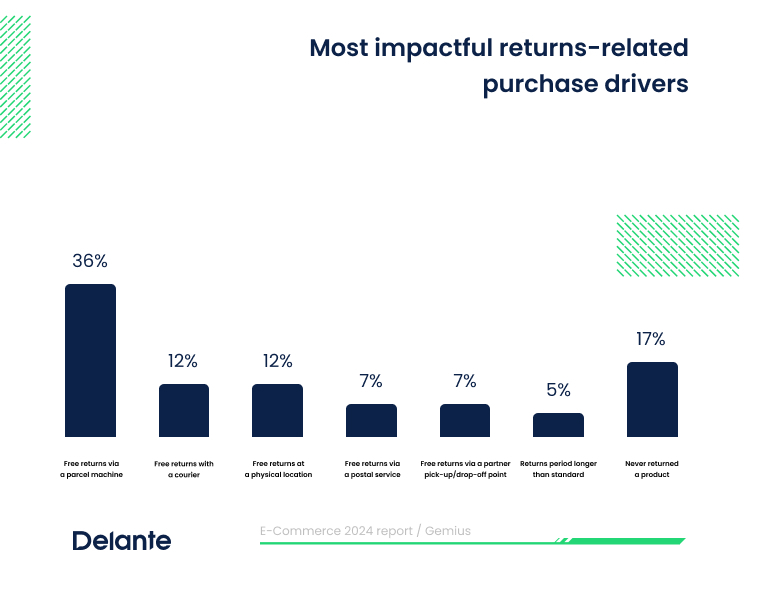
Most impactful returns-related purchase drivers in Poland

Source: [1]


The most impactful returns-related purchase drivers in Poland:

  1. Free return via parcel locker – 36%
  2. I have never returned a product – 17%
  3. Free return via courier – 12%
  4. Free return to a physical store – 12%
  5. Free return via postal service – 7%
  6. Free return via a partner point – 7%
  7. Extended return period beyond standard – 5%

No. 1: Return via Parcel Locker 🥇

There’s no more convenient option today than returning a product via a parcel locker. No need to schedule a courier, no need to wait in line—just drop off the parcel at any time. For you as an e-commerce owner, this is a clear signal: if you don’t yet offer this return option, you’re falling behind.
Parcel lockers have become the standard. Their number grows every month—according to data from Q1 2025, there are nearly 54,000 such points operating in Poland. What’s more, most users know their locations by heart because they use them regularly.

No. 2: Return via Courier 🥈

While parcel lockers dominate, many customers still appreciate the traditional courier return. This is especially attractive for those who prefer someone to pick up the package directly from their home or office—no need to go out or look for a drop-off point.
Make sure the process is as simple as possible: return label in the package, clear instructions, quick registration through an online form. Automate what you can and take the logistics burden off your customer.

Free courier returns can also be a good loyalty tool—available, for example, only to logged-in users or for orders exceeding a certain amount. Don’t make everyone pay for convenience. Decide who benefits most from it and build relationships around that.

No. 3: Return to a Physical Store 🥉

If you operate omnichannel sales—combining e-commerce with physical stores—this return method can be your ace in the hole. For many customers, in-person contact and resolving the matter “on the spot” is a huge advantage. Returning in-store gives them instant confirmation that the issue has been resolved and often leads to faster refunds.
But that’s not all. A person returning a package in-store often ends up making a new purchase. So, a return can turn into another sale.

No. 4: Return via Postal Service

A bit less popular but still relevant—postal returns. Often chosen by people from smaller towns where there are no parcel lockers or partner points. The key here is simplicity.

You need to clearly explain where and how to send the parcel—ideally provide a ready-to-use return label and support in case issues arise.

No. 5: Return via Partner Point

If you offer returns via a partner pickup point, you eliminate the need for special planning. The customer can drop off the return while running errands. This is a real time-saver worth promoting.

The customer is already slightly disappointed, and your task is to ensure that the return process doesn’t deepen that frustration—but turns it into a positive experience. A clear and transparent return policy is a major competitive advantage. If you communicate it right from your homepage, the customer immediately feels more secure. In industries like fashion, footwear, or accessories—where return rates are naturally higher—a well-implemented return process can significantly boost conversion.

Delivery Methods in Online Stores – What Can You Do Right Now?

Implementing parcel lockers, improving your return policy, and clear communication—these are real actions you can take immediately. They don’t require major investments, and their effects are visible quickly—in the form of fewer abandoned carts, more returning customers, and better conversion rates. What can you do to communicate delivery and return options on your site to attract potential customers?

  1. Make sure return and delivery information is visible right on the homepage.
  2. Show delivery and return options already in the shopping cart.
  3. Include an FAQ explaining how each option works. Give your customer clarity about the available delivery and return methods.
  4. Extend the standard return period—for example, to 14 days. Giving customers more time relieves pressure. This strategy works especially well in industries like fashion, home & decor, or electronics.

Transparency is the currency of trust today. Remember, customers return not only to places where they bought a great product. They come back where the experience was easy, stress-free, and predictable. If you deliver that kind of experience, they’ll give you something even more valuable—loyalty.

Sources:

[1] https://gemius.com/documents/66/RAPORT_E-COMMERCE_2024.pdf

Author
Damian Hliwa - Senior SEO & UX Specialist
Author
Damian Hliwa

Head of SEO

Over the several years of his career in SEO, Damian has gone through many positions. They start from internship, through team leader to head of SEO. During these years, his main specialization has been and still remains SEO and technical audits, but he is no stranger to linkbuilding or content campaigns. After hours, a filmmaker and photographer as a so-called one-man-army, a lover of good coffee brewed with all kinds of methods, Polish mountains and cycling.

Author
Marcin Polak - Junior SEO Specialist
Author
Marcin Polak

Junior SEO Specialist

Junior SEO Specialist with experience in copywriting. He has been with Delante since 2023, where he combines creative writing with an analytical approach to SEO. A graduate of the Jagiellonian University (Journalism and Social Communication, Sports Management). Outside of work, he is an active fan of sports, cooking, and TV series.

Author
Damian Hliwa - Senior SEO & UX Specialist
Author
Damian Hliwa

Head of SEO

Over the several years of his career in SEO, Damian has gone through many positions. They start from internship, through team leader to head of SEO. During these years, his main specialization has been and still remains SEO and technical audits, but he is no stranger to linkbuilding or content campaigns. After hours, a filmmaker and photographer as a so-called one-man-army, a lover of good coffee brewed with all kinds of methods, Polish mountains and cycling.

Author
Marcin Polak - Junior SEO Specialist
Author
Marcin Polak

Junior SEO Specialist

Junior SEO Specialist with experience in copywriting. He has been with Delante since 2023, where he combines creative writing with an analytical approach to SEO. A graduate of the Jagiellonian University (Journalism and Social Communication, Sports Management). Outside of work, he is an active fan of sports, cooking, and TV series.