Zero Click Searches refer to queries in search engines where users get an answer directly on the search results page (SERP) without the need to click on any link leading to an external website. What are their types? How can you improve your visibility in "no-click results"? Find out below!
Zero Click Searches refer to search queries where users receive an answer without clicking on any search result. In other words, users satisfy their informational need without leaving the search results page (SERP), as search engines present the answer directly in the form of a snippet displayed at the top of the results, a knowledge panel, a carousel, “People Also Ask” suggestions, or, more recently, AI-powered results.
They began to develop in response to changing user needs, as people increasingly seek quick, specific answers to their questions. Recognizing this trend, Google started displaying content snippets, calculators, maps, and other elements directly on the search results page. This allows users to get the information they need in a fraction of a second without leaving the search engine page.
Source: Nr 1
According to research by Datos and SparkToro from 2024, nearly 60% of all searches in the United States (specifically 58.5% on mobile and desktop devices) and 59.7% in the European Union ended without clicking on any link.
What are the Types of Zero Click Searches?
Zero Click Searches are closely related to the evolution of search engine results pages (SERP), which today offer much more than just a list of ten blue links. Google has introduced a range of features that directly answer users’ queries, addressing their diverse informational, navigational, or transactional intents. Here are the most important types – to make it more fun and keep your attention, get ready for a solid dose of Pedro Pascal:
AI Overviews
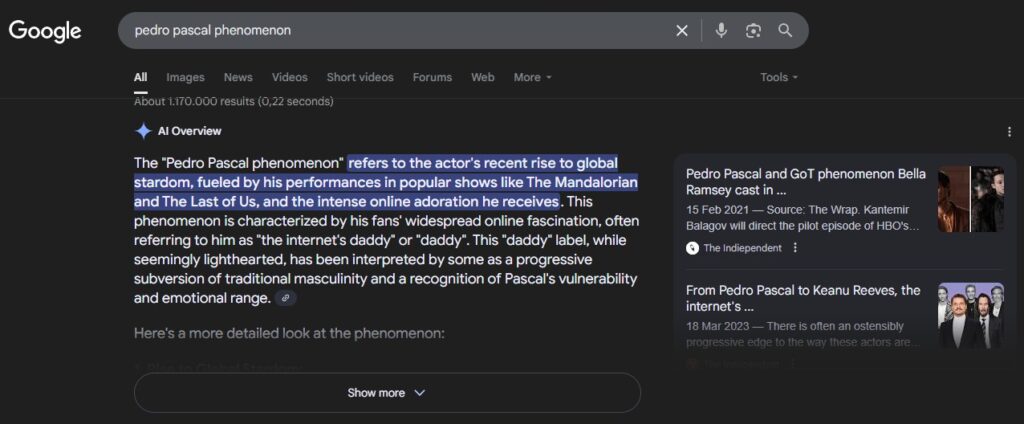
I believe this option doesn’t need much introduction. 😉 Available in the U.S. since 2024 and in European countries from March 2025, it’s been keeping not only SEO specialists up at night. Continuously evolving, even after the launch of AI Mode in the U.S. These AI-generated summaries appear at the very top of the results, synthesizing information from multiple sources.
Whether we can trust AI Overviews is a whole different story. 😉 My favorite example, which Lily Ray recently shared (originally found by Robbie Dee):
Featured Snippets
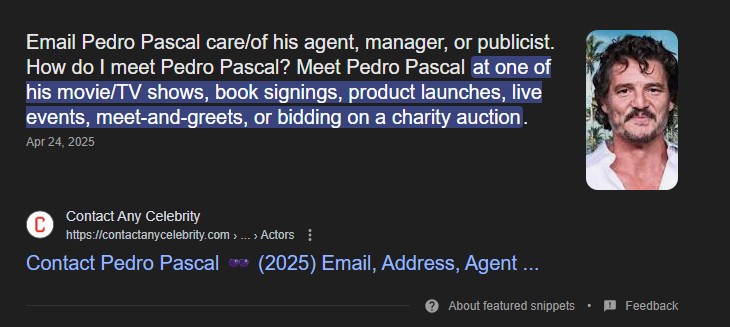
These are shortened answers displayed at the very top of the results, often in the form of a paragraph, list, or table, taken directly from websites. Although they contain a link to the source, many users find the information sufficient, eliminating the need to click. Currently, for many queries, Featured Snippets appear below AI Overviews results.
This is the answer to the “how to meet pedro pascal” question.
Direct Answer
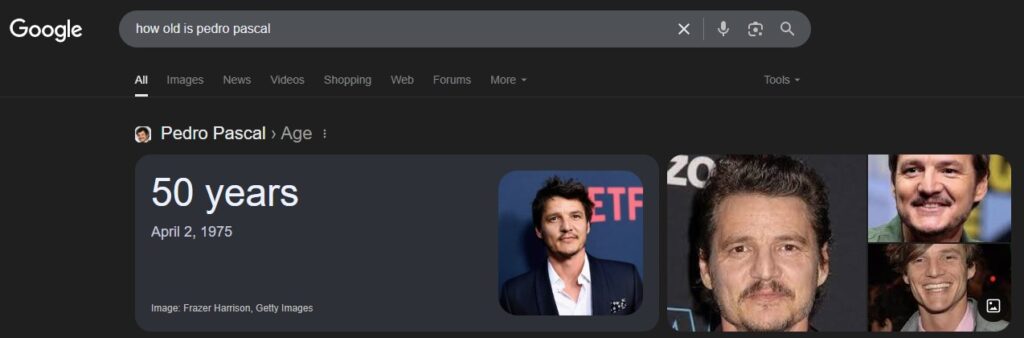
Direct Answers are simplified versions of Featured Snippets, providing concise answers to straightforward questions, such as weather, definitions, or currency converters. These results often do not include links to external websites, making them a typical example of zero-click searches.
Knowledge Panels
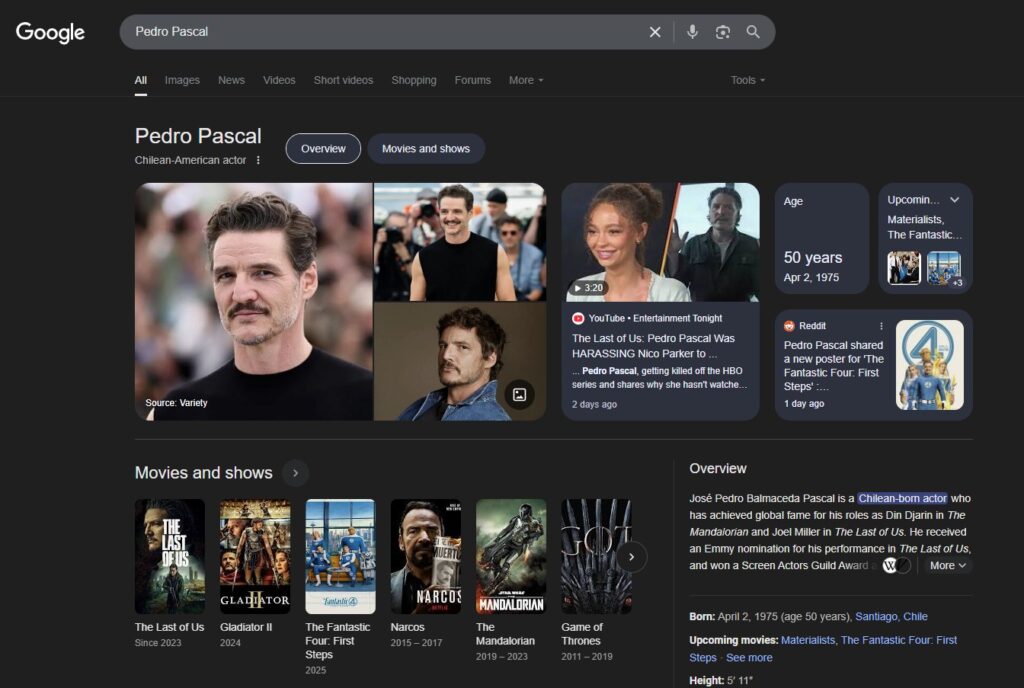
Extensive informational blocks that appear on the results page, containing data about people, businesses, places, or encyclopedic terms, sourced from various Google and web sources. They provide comprehensive knowledge in one place.
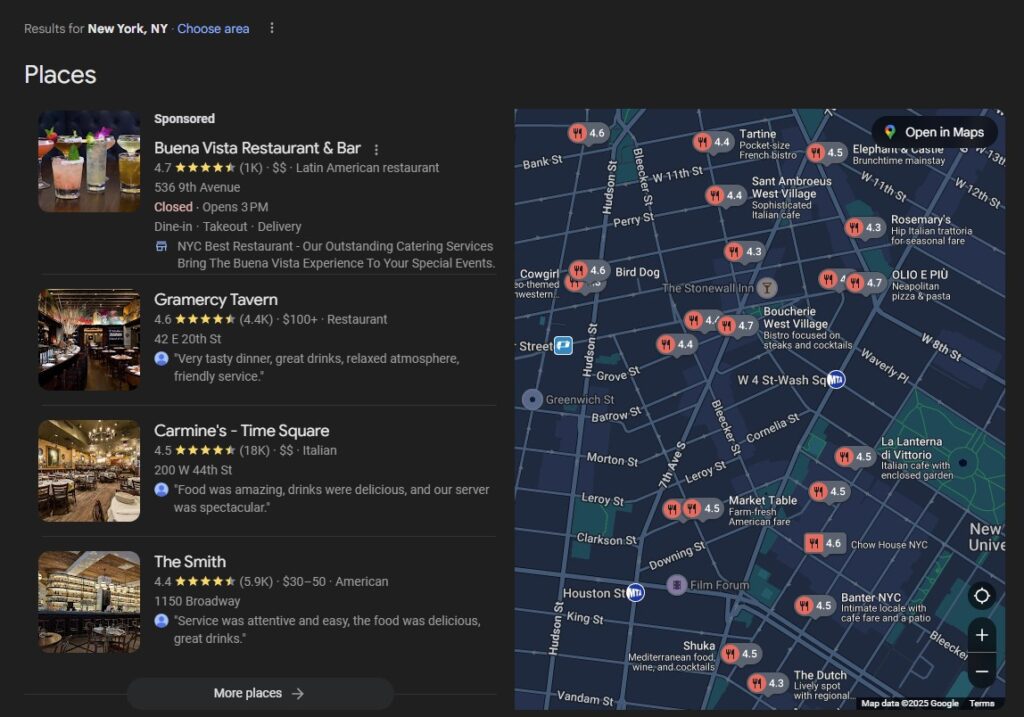
Results displaying a map and a list of local businesses that match the query, such as “restaurant near me” or “auto mechanic in Chicago.” These are crucial for brick-and-mortar businesses, as users often find the address, phone number, hours of operation, and reviews without visiting the website. And ok, no Pedro Pascal here:
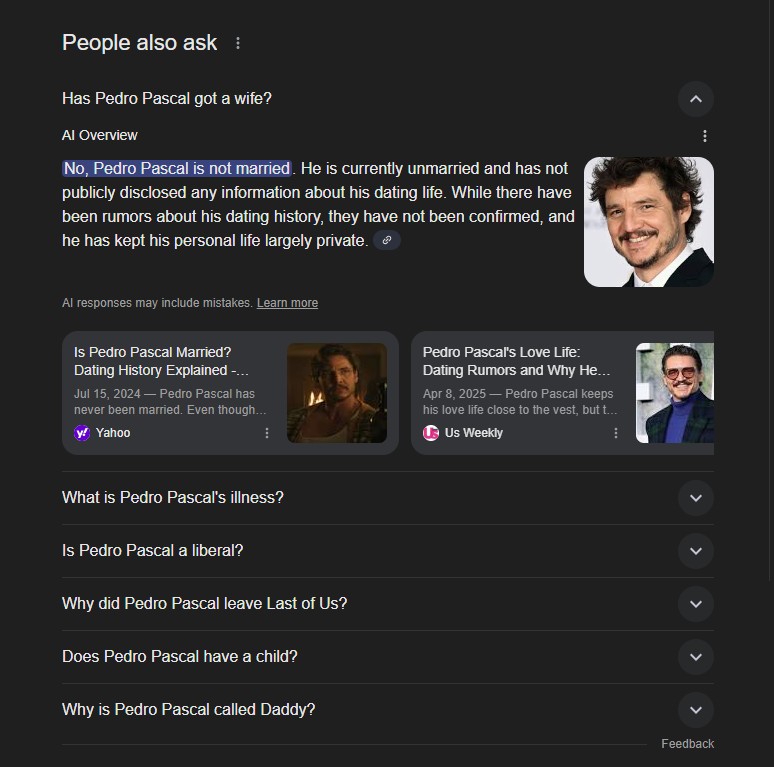
People Also Ask
Expandable sections containing related questions and brief answers that may encourage users to explore the topic further, though often the answer is sufficient to satisfy initial curiosity. 👀
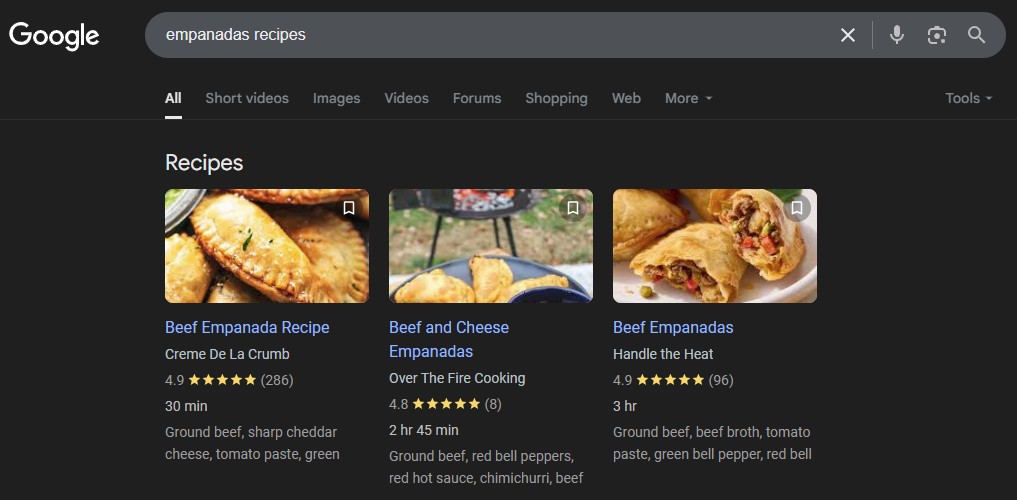
Recipe Snippets
If you run a food blog – it’s a must-have! It allows you to display parts of recipes or links to them at the top of the SERP. Again, without Pedro. But there’s a connection!
Zero Click Searches and SEO – Why Being Present in no-click Results Makes Sense?
Not so long ago, your main goal in SEO was clear – to drive users to your website. Everything revolved around carefully selected keywords, ranking positions on Google, and CTRs that were supposed to tell you if you were on the right track. But today, things are a bit different.
Zero Click Searches are mico moments when a user gets an answer to their question before they even visit any website. They might see a definition, phone number, location, or even a review – all without leaving Google. Stop counting clicks – start watching brand visibility. And that can be just as valuable, if not more valuable. Your brand shows up in the results? Great. Even if someone doesn’t click, they’ll remember you. And maybe next time, they’ll choose you because they recognize you as an expert. Or go to buy your products.
You might still be wondering, “If no one clicks, what’s the point?” That’s a logical question, but it’s worth looking deeper. Visibility in Zero Click Searches is about building brand awareness at a very specific moment – when someone is actively searching for an answer. Your name, logo, domain – all of that appears exactly when the user is most engaged.
Someone sees you in the search results and starts associating you with a particular field. If Google shows your content first, it means you’re credible. And if you appear there repeatedly, the user starts to trust you, even if they don’t realize it. When they truly need a solution – a service, consultation, or product – you’ll be the first to come to mind.
Currently, the growing share of Zero Click Searches in the overall number of user searches is a trend that is certainly here to stay, and it’s crucial to adapt to it. In this situation, the traditional SEO approach which was practiced for many years may no longer be sufficient. Even a very high position in the search results may not translate into a satisfying CTR. Simply monitoring rankings is no longer enough – we need to look much broader, because appearing in the TOP3 search results is no longer a guarantee of achieving real goals. That’s why it’s so important to adapt your efforts to the current situation. We have no control over elements like Featured Snippets, Direct Answers, or AI Overviews appearing in Google – our goal should be to get featured in them. And we can do this by answering user intents, optimizing for AISO, and focusing on domain authority.
Michał Grzyb
SEO Specialist
How to improve your visibility in Zero Click Searches?
To effectively start appearing in Zero Click Searches and adapt to the growing role of artificial intelligence in search, businesses need to rethink their SEO strategies. How can this be done?
1. Optimize Content for Zero Click Searches
Creating content for Zero Click Searches is more than just writing a well-crafted SEO article. It’s about providing a direct answer to a specific question that users receive instantly. You need to understand what your audience is searching for and deliver it in the most accessible way.
Utilize tools like Answer the Public, Google Suggest, or AI platforms to see what problems people want solved. Then, write succinctly, directly, and to the point.Short paragraphs, bullet points, and tables work best – these are the formats Google prefers when selecting featured snippets.
Pay attention to the structure of your text. Use H2 and H3 headings, break content into logical sections. This not only makes it easier to read but also increases your chances of appearing in featured snippets. Don’t forget about meta data. The title and description are the first things a user sees. Even if they don’t click, they may remember your brand. And if they do click – that’s a win for you.
2. AISO – Positioning Your Site in AI Responses
In the context of AI Overviews and other language models (LLMs), the AISO approach becomes a priority. AI models like ChatGPT, Gemini, or Perplexity pull information from the web to generate synthetic responses. To have your brand quoted and recommended in these results, you must ensure your content is optimized for AI readability.
This means creating fact-rich, concise content, avoiding “fluff,” and ensuring your brand name frequently appears next to the keywords you want to be visible for. Make sure your site is accessible to LLM bots, without barriers like JavaScript or other restrictions, as this is crucial for AI crawlability.
With our AISO service, you have an even greater chance that your site will be quoted or recommended by artificial intelligence in synthetic responses.
3. Local SEO in the Context of Zero Click Searches
If you run a local business, you have a huge advantage. A user types in “hairdresser in NYC” or “dentist in Chicago” and doesn’t need to visit any website – everything is served on a silver platter: address, hours, reviews, phone number. How can you get there?
Optimize your Google Business Profile (formerly known as Google My Business) – fill out all the details: company name, address, phone number, opening hours, photos, and even special offers. Regularly update the information.
Reviews – encourage customers to leave reviews. And respond to them. Google sees that you’re active – this is a signal that it’s worth showing you higher in the results.
Add as many details as possible – categories, services, events, FAQs. This makes your profile more complete and useful to users. Google rewards businesses that provide full and up-to-date information.
Local results are often the first point of contact with a customer. If you make a good impression, you’re likely to get a call, a visit, or even a loyal customer.
Here, you can also count on Delante’s support. Our local SEO services guarantee that every element of your website and business profile will be optimized for SEO.
For local businesses, being in Local Packs is one of the most important parts of being visible on Google. To get there, you need to make sure your business listing is complete. It’s important to have consistent data with your website, up-to-date opening hours, contact details, LocalBusiness schema, and a map embedded on your contact page to better link your website to your business profile. Google appreciates profiles that actively maintain their business cards, so it is worth regularly adding posts, photos, and products and services with engaging descriptions. You should also respond to positive and negative reviews, showing that customer opinions matter. A regularly maintained, updated Google Business profile significantly increases your chances of visibility in local results.
Wiktoria Wójciak
Senior SEO Specialist
Sign up for our newsletter!
Discover the latest tips, case studies, and strategies from digital-marketing experts!
By providing your email address, you agree to receive our newsletter. You can unsubscribe at any time.
New Game, New Rules. Zero Click Search – Summary
Zero Click Searches and the growing role of AI are not the end of SEO – they mark a new era. One in which not only traffic matters but also awareness, trust, and authority. It’s a game for the user’s attention in the micro-moment of decision-making. It’s not enough to just be there – you need to be visible, credible, and memorable.
The question is: what will you do with this opportunity?Will you treat Zero Click Searches as a threat or as a path to building your brand without a single click? It’s up to you whether you’ll outpace the competition – before anyone clicks.
Senior SEO Specialist. At Delante since August 2017. She specializes in SEO strategies for E-commerce, IT, and YMYL sectors (including PL, US, UK, and DACH markets). By combining technical optimization with a business-driven Customer Success approach, she builds profitable, long-term client relationships. An expert in content strategies and website migrations. Project Manager and author of the case study nominated for the Global Search Awards 2024. After hours: cinema, traveling, and Heroes III.
SEO Specialist with experience in copywriting. He has been with Delante since 2023, where he combines creative writing with an analytical approach to SEO. A graduate of the Jagiellonian University (Journalism and Social Communication, Sports Management). Outside of work, he is an active fan of sports, cooking, and TV series.
Senior SEO Specialist. At Delante since August 2017. She specializes in SEO strategies for E-commerce, IT, and YMYL sectors (including PL, US, UK, and DACH markets). By combining technical optimization with a business-driven Customer Success approach, she builds profitable, long-term client relationships. An expert in content strategies and website migrations. Project Manager and author of the case study nominated for the Global Search Awards 2024. After hours: cinema, traveling, and Heroes III.
SEO Specialist with experience in copywriting. He has been with Delante since 2023, where he combines creative writing with an analytical approach to SEO. A graduate of the Jagiellonian University (Journalism and Social Communication, Sports Management). Outside of work, he is an active fan of sports, cooking, and TV series.


 d-tags

 Loading...