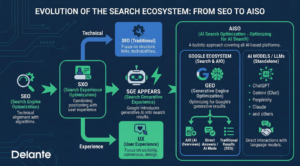
Here we reach the most interesting shift. SGE led to the creation of GEO (Generative Engine Optimization), which focuses on optimizing pages for new AI-driven elements only in Google. We are talking about:
- AIO (AI Overviews) – concise, AI-generated summaries at the top of search results.
- AI Mode – a conversational mode where the user can ask the search engine follow-up questions and enter more complex queries. Google acts as an AI assistant answering the user’s questions.
Why does this change the rules of the game and the KPIs of current SEO efforts? We are no longer fighting just for traffic and clicks from Google when it comes to these solutions; we are fighting for brand authority, for being mentioned in the AI’s answer, and for cementing the brand in the user’s consciousness.
The broader context that encompasses GEO is AISO (AI Search Optimization). This concept is far more holistic and acknowledges that Google is slowly losing its monopoly, and users are looking for information in places other than the classic search engine. AISO also covers brand visibility across all Large Language Models, such as ChatGPT, Claude (Anthropic), Perplexity, or Copilot (Microsoft).
In summary, AISO is much broader than GEO, which is focused solely on the Google ecosystem.
AISO is about making sure your brand is in the “memory” of these models. If ChatGPT hasn’t “read” about you in its training data, or doesn’t see you in its web browsing tools, you simply do not exist to the AI user.
This evolution shows the transition from code manipulation (traditional SEO) to digital authority management (AISO).
In GEO, but especially in AISO, you no longer optimize “for a keyword.” You optimize for an “entity” (your corporate/personal brand) and “context.” AI must understand that you are an expert in a given field to cite you in its answer. It’s a return to the roots of marketing, what matters is what people say about you and how credible you are, not how many times you stuff “cheap shoes” in the footer of your website.









 Michał Grzyb