Bing Shopping Campaigns (Microsoft Ads): How to Maximize E-commerce Profitability?

4min.

Comments:0

07 May 2026

Ads
Bing Shopping Campaigns (Microsoft Ads): How to Maximize E-commerce Profitability?d-tags
The battle for clicks in the Google Ads ecosystem currently feels like an arms race. CPC rates are rising dynamically, algorithms demand increasingly large budgets, yet e-commerce margins dictate that Customer Acquisition Costs must drop. The strategic answer to these conflicting challenges is to diversify advertising channels. Discover why investing in Microsoft Shopping Ads is a highly profitable move for the e-commerce sector.

4min.

Comments:0

07 May 2026

What Are Microsoft Shopping Ads?

Microsoft Shopping Ads is a product advertising format deployed across the Microsoft ecosystem (including search engines and tools like Bing, Edge, MSN, Copilot, Yahoo, and DuckDuckGo). It allows online retailers to display their products, complete with an image and price point, directly within the search results.

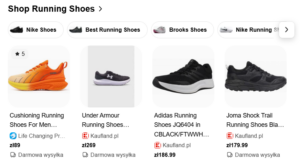
bing search engine results

Source: Bing search engine

For e-commerce managers, Bing product ads present a strategic alternative to Google Ads. This channel is characterized by significantly lower campaign costs (cheaper CPC), allowing you to drive down your Customer Acquisition Cost (CAC) while reaching a desktop-heavy user base with superior purchasing power.

Read also: Why B2B and E-commerce Need to Pay Attention to Microsoft Ads

Cognitive Traps: Why Does E-commerce Ignore Bing?

The vast majority of online stores exclude Bing from their advertising budgets, citing its lower market share as the primary reason. You likely do this as well, and that decision is a major strategic misstep in e-commerce. From a business psychology perspective, rejecting this channel is a textbook example of the cognitive traps that ensnare marketing managers.

  • The Bandwagon Effect

Your competitors are mindlessly pumping their entire budgets into Google Shopping Ads, so you feel compelled to allocate 100% of your budget there, too. This is the classic bandwagon effect: you follow the herd, burn your budget on inflated CPC bids, and ultimately skyrocket your cost per conversion. Does this mean you should abandon Google Shopping Ads? Absolutely not, but sometimes the smartest alternative to a costly bidding war is to diversify channels.

  • The Illusion of the Google Monopoly

Google is often treated as synonymous with “search,” creating an illusion of an absolute monopoly. Managers assume it is the only place customers shop, overlooking that the modern purchasing funnel is much broader. Today, customers search for products on social media, ask AI models for brand recommendations, and check specific items on search engines, but not just on Google. By completely ignoring Bing in your ad budget allocation, you are leaving low-cost, high-intent conversions on the table.

  • The Sunk Cost Fallacy

“We’ve already invested so much work into optimizing Google Merchant Center that we simply don’t have the time to build everything from scratch for another search engine.” This objection is a massive blocker, and it is entirely based on a myth. Launching a campaign in Microsoft Ads does not require rebuilding your infrastructure, which we will explain shortly.

The true measures of profitability in advertising campaigns are your Return on Ad Spend (ROAS) and your Customer Acquisition Cost (CAC). By ignoring the Microsoft ecosystem, you are simply leaving the most highly qualified leads and high-margin sales to your competitors, inevitably resulting in a lower ROAS and a higher CAC for your brand.

What is Bing’s Market Share in Search?

For an E-commerce Director or Head of Performance, the decision to enter a new channel must be anchored in hard numbers. Let’s look at the facts.

On mobile devices, Google absolutely dominates, holding over a 90% market share. However, on desktop devices, that share drops to around 80%. From an e-commerce perspective, this is critical data: many purchasing decisions, particularly for high-ticket items (electronics, home appliances, B2B software), are made on larger desktop screens.

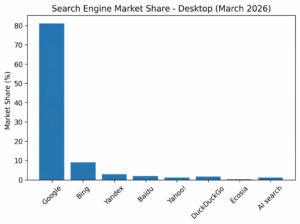
According to Statcounter data, Bing’s global desktop search engine market share stood at 10.3% in March 2026. This means that by refusing to invest in Microsoft Ads, you are immediately cutting yourself off from 10% of the total market.

browser market share 2026

Data source: Statcounter Global Stats

Why is Investing in Bing Shopping Ads Profitable for E-commerce?

    • Lower Campaign Costs and Higher ROAS: Fewer advertisers mean significantly less bidding pressure in the auction system, resulting in a naturally lower CPC. Industry data consistently shows that clicks in Microsoft Ads are, on average, 40% to 60% cheaper than identical campaigns run in the Google ecosystem.
    • Access to a Premium Customer Base: According to Microsoft Advertising’s internal demographic reports, a staggering 38% of Bing users sit in the top 25% income bracket. Edge browser users are often managers, executives, or senior staff who work on corporate devices. This translates directly to higher purchasing power and a higher Average Order Value (AOV) (1).
    • An AI-Integrated Ecosystem: Microsoft was the first to deeply integrate its AI assistant (Copilot) into both its core search engine and the Windows operating system. A presence in Microsoft Shopping Ads simultaneously increases your chances of appearing in Copilot’s answers when a high-net-worth user asks for product recommendations. Furthermore, since ChatGPT leverages Bing search results for its real-time knowledge base, advertising in this environment can directly improve your brand’s visibility in ChatGPT’s responses.

    How to Pitch Microsoft Ads to Your CMO

    How do you sell this concept “up the ladder” in your organization? Anchor your pitch in these three pillars to secure executive buy-in:

    • The Ultimate Environment for Premium B2C and B2B Brands

    Many enterprise corporations restrict employees from changing the default browser on their work computers. Hundreds of thousands of corporate employees use Edge every single day. If your catalog includes IT hardware, office equipment, high-end appliances, or luxury goods, Edge is exactly where you will find your potential clients shopping during their lunch breaks.

    Furthermore, Bing allows you to target ad audiences based on their exact job titles and industries using LinkedIn data, which Microsoft also owns!
    • Diversification is Responsible Risk Management

    Relying on a single vendor for 100% of your e-commerce advertising budget is a massive vulnerability. Microsoft Ads is not meant to replace Google Ads; it is a complementary channel that allows you to reach an entirely different customer segment at a fraction of Google Ads’ cost.

    • Zero Barrier to Entry and Zero Tech Debt

    One of the biggest objections to launching new ad channels is the operational time required from in-house specialists or agencies. However, very few realize that the Microsoft ecosystem is built entirely on a Plug & Play framework. You do not need to generate new XML feeds or rebuild your keyword architecture from scratch. The platform allows you to integrate and sync your account directly with Google Merchant Center. Launching a pilot campaign takes just a few clicks.

    The Recommendation for Next Quarter

    For many e-commerce stores, launching Microsoft Shopping Ads is the fastest and easiest quick-win available in budget management. Where should you start?

    Instead of increasing your Google Ads budget by another 10%, allocate that exact fraction of your budget into a pilot campaign on Microsoft Shopping Ads. Configure the automatic import from Google Merchant Center, set a test budget for 30–45 days, and use the hard data (ROAS and CAC metrics) to decide if scaling the channel further makes financial sense.

    Do you feel that Bing Shopping Ads could be a major growth lever for your e-commerce business? Contact us, we would be happy to help you map out the strategy and configure your campaigns.

    Sources:

    1. https://about.ads.microsoft.com/en/tools/planning/search-data

    Microsoft Shopping Ads

    We will design and execute highly profitable advertising campaigns for your products.

    Let's talk!
    Tomek Gniecki
    Tomek Gniecki SEM & Analytics Specialist

    Author
    Tomek Gniecki - SEM & Analytics Specialist
    Author
    Tomek Gniecki

    SEM & Analytics Specialist

    Graduate of Marketing and Market Communication at Cracow University of Economics. At Delante he is involved in running Google Ads campaigns and the implementation and configuration of Google Analytics. He also conducts training in web analytics. Privately a guitarist, a lover of heavy music and good football.

    Author
    Tomek Gniecki - SEM & Analytics Specialist
    Author
    Tomek Gniecki

    SEM & Analytics Specialist

    Graduate of Marketing and Market Communication at Cracow University of Economics. At Delante he is involved in running Google Ads campaigns and the implementation and configuration of Google Analytics. He also conducts training in web analytics. Privately a guitarist, a lover of heavy music and good football.

    FAQ

    Does launching product ads in Bing Ads require a lot of manual work?

    No. Microsoft’s advertising system is explicitly designed to minimize the barrier to entry for advertisers migrating from Google. Directly from the dashboard, you can seamlessly connect your Google Merchant Center account. Microsoft will automatically and cyclically pull your live pricing and inventory data straight from its competitor, ensuring you never have to duplicate your workload.

    Are Microsoft Shopping Ads only for massive, enterprise-level online stores?

    Quite the opposite. In an era of skyrocketing CPC rates on Google, smaller stores with tighter budgets are the most vulnerable to burning cash in bidding wars against industry giants. Bing features significantly lower auction competition, meaning even a modest advertising budget can generate a highly satisfying volume of traffic and a superior Return on Ad Spend (ROAS).

    Where exactly will my e-commerce ads be displayed? Just on the Bing search engine?

    The Microsoft Search Network ecosystem extends far beyond just Bing. Your product ads can appear natively within the Edge browser, on major news portals like MSN and Yahoo, in the privacy-focused DuckDuckGo search engine, and directly within the results generated by the Copilot AI assistant.