
AI Visibility Report for the Automotive Industry 2026 Is Now Available!

4min.

Comments:0

25 June 2026

Ads
AI Visibility Report for the Automotive Industry 2026 Is Now Available!d-tags
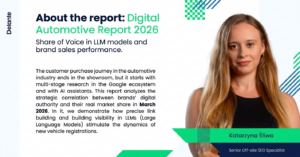
Buying a new car starts long before anyone walks into a showroom. The purchase journey usually begins with online research, either within the Google ecosystem or with the help of AI assistants. In our report, we examined the correlation between brands' digital authority and their real market share in March 2026. We demonstrated how AI Authority Link Building and AISO activities stimulate the dynamics of new vehicle registrations. Download the report and find out who the digital leader of the automotive industry is!

4min.

Comments:0

25 June 2026

Report Goals and Metrics Used

The main goal of the analysis was to examine the correlation between visibility in LLMs and brands’ sales results. We took into account metrics such as:

  • Share of Voice, a percentage indicator showing a brand’s share of total communication within a given industry or niche, benchmarked against the competition.
  • Citations and mentions, two metrics measuring the number of times a brand is mentioned and cited in answers generated by AI tools (for example in AI Overviews from Google, but also inside ChatGPT and other models).
  • Ratio LLM Citation, the correlation between the number of domains linking to a website and the number of citations in AI tools, which lets us assess how effective a brand’s link building strategy is.
 

AI Visibility Automotive Report

Research Methodology

Using Ahrefs, we analyzed the fundamental digital metrics for the brands under review:

  • Monthly organic traffic
  • Number of referring domains (RD)
  • Global number of citations in AI results

On top of that, we selected 10 key prompts (consumer queries) with the highest sales potential. Based on these, we ran direct tests in language models, which allowed us to check how brand visibility looks in specific purchase scenarios.

We then set the collected digital visibility data against new car registration statistics for March 2026. This allowed us to demonstrate how broad AI Authority Link Building activities translate into real sales dominance.

Who Dominates Online? Global Ahrefs Data

Before moving on to the AI visibility analysis, we looked at the digital fundamentals of each brand.

Before we go further, it is worth explaining what exactly sits behind the “Total AI citations” metric that runs through the entire report. It is not an invented or roughly estimated value. It comes from aggregated Ahrefs data, which monitors how often a given brand is mentioned, recommended, or cited in answers generated by the most popular AI ecosystems. Ahrefs collects this data by testing thousands of real consumer queries and checking how often a given brand appears in the answers.

Brand Monthly organic traffic Referring domains (RD) Total AI citations
1Toyota 756 658 2 168 3 064
2Skoda 503 829 1 124 1 038
3BMW 408 460 1 729 1 731
4Mercedes 379 920 1 019 1 271
5Audi 347 565 769 1 291
6Cupra 237 226 770 693
7Lexus 188 364 1 208 596
8Volvo 184 515 622 839
9Tesla 178 997 433 154
10MG 88 243 113 129
Total 3 273 777 9 955 11 006

Toyota sets the market benchmark, holding an almost 3x advantage in AI citations over premium brands. This is the effect of mass authority built over many years. On the other end, brands like MG and Tesla, despite their sales presence, are practically absent from AI recommendations, with both scoring below 200 citations. This poses a direct risk of losing the modern customer, whose purchase process starts with a question to an AI assistant.

The Efficiency Ratio: How Hard Does One Link Work?

The central finding of the report is the Pearson correlation coefficient between the number of referring domains (RD) and the total number of citations in AI models, which came out at k = 0.89. This value indicates a very strong positive correlation.

What does this mean in practice? Every expansion of a brand’s base of high-authority referring domains translates directly into more citations in ChatGPT, AI Overviews, and Perplexity.

A correlation of 0.89 is mathematical proof that link building is the direct fuel powering AI answers. AI does not guess, it analyzes link profiles.

The brand efficiency ranking looks as follows:

  • Audi: 1.68, the quality leader. With just 769 referring domains, it generates as many as 1,291 citations. Selective link building builds higher authority in the eyes of AI.
  • Toyota: 1.41, enormous scale combined with high quality.
  • Volvo: 1.35, Mercedes: 1.25, MG: 1.14
  • BMW: 1.00, a 1:1 efficiency, the classic benchmark of stable visibility.
  • Skoda: 0.92, a larger link base (1,124 RD) but a lower citation total (1,038). Quantitative scaling without precise targeting for LLMs.
  • Lexus: 0.49, Tesla: 0.36, a signal that these brands’ links are largely ignored by AI algorithms as low-value.

Conclusion: A high Ratio means link building is carried out in sources recognized by AI as authoritative (Premium RD). Every additional 100 high-authority referring domains translates into around 100 new recommendations in ChatGPT, Google AI Overviews, or Perplexity.

AI Visibility vs. Sales: Data From March 2026

When the digital data is set against hard new car registration statistics, the picture becomes unambiguous:

Brand Registrations (units) Total citations (LLM) Market share
1Toyota 8 180 3 064 15,53%
2Skoda 6 840 1 038 10,73%
3BMW 3 639 1 731 5,33%
4Audi 2 980 1 291 5,05%
5Mercedes 2 832 1 271 4,28%
6Volvo 2 734 839 3,69%
7MG 1 841 129 2,73%
8Lexus 1 379 596 2,51%
9Cupra 1 168 693 2,15%
10Tesla 494 154 0,56%
Total 32 087 9 806 52,56%

The five brands with the highest AI citation totals (Toyota, BMW, Audi, Mercedes, Skoda) together control over 40% of new vehicle registrations in the period studied. AI visibility is today’s “insurance policy” for market share.

Tesla’s case is particularly telling. Despite strong brand recognition and fairly decent organic traffic (179K monthly), just 154 AI citations correlate with the lowest market share in the ranking (0.56%). A brand that does not exist in AI recommendations loses customers before they ever reach the showroom.

The New Purchase Journey Model

The report’s findings confirm that the traditional purchase journey in the automotive industry has fundamentally changed. Today it looks like this:

  1. Link building (authority building)
  2. LLM visibility (total AI citations)
  3. Brand choice (Share of Voice)
  4. Potential registration

Three Brand Types, Three Strategies

The report allows us to distinguish three characteristic models of how brands operate in the digital ecosystem:

Segmenty marek – Ratio cytowań AI
The Scale Effect

Legacy

example Skoda · Ratio: 0,92

Brands running on the fuel of historical popularity. A large link base, but built without precise targeting for LLMs. Efficiency below the market average.

The Multiplier Effect

Digital

example Audi · Ratio: 1,68

Brands that punch above their scale thanks to link quality. Selective link building in Premium RD sources generates almost twice as many AI citations as linking domains.

The Absence Risk

Invisible

example MG · Ratio: 1,14
example Tesla · Ratio: 0,36

Brands that sell but are digitally absent or poorly represented in AI. MG has growth potential, with a high Ratio on a small base. Tesla, in turn, has high organic traffic but dramatically low conversion into citations, which suggests a structural problem with link profile quality.

Which Brands Did We Include in the Study?

We analyzed data on the most popular brands in the automotive industry:

  • BMW
  • Mercedes
  • Volvo
  • Tesla
  • MG
  • Skoda
  • Cupra
  • Lexus
  • Toyota
  • Audi


marki w raporcie AI Visibility for Automotive Industry

Who Is Behind the Report and the Research?

The report was authored by Kasia Śliwa, our Senior Off-site SEO Specialist, who successfully helps major brands build visibility across multiple international markets. She is the creator of the AI Authority Link Building service at Delante, through which she supports brands in gaining visibility in AI tools (ChatGPT, Perplexity, Gemini).

Kasia delivered a talk titled “The New Role of Links in Building Authority. From Ranking to Citation: A Strategy for Building Dual Brand Exposure in Organic Search and AI” at one of the biggest marketing conferences in Poland, I Love Marketing. She had the opportunity to present the report’s findings and share insights that earned recognition among industry experts!

You can also expand your knowledge of the role authority plays in building AI visibility by reading Kasia’s expert article: Why Does Your Business Need Authority, Not Just Links, in the AI Era?

Author
Author
Karolina Książek

Social Media Specialist