How Does AI Recommend Hotels? What Increases Your Property’s Visibility and Chances of Being Recommended in ChatGPT and Google AI Overviews?

5min.

Comments:0

07 July 2026

How Does AI Recommend Hotels? What Increases Your Property’s Visibility and Chances of Being Recommended in ChatGPT and Google AI Overviews?d-tags
A year ago, users typed "hotel Kraków city center" into Google. Today, they increasingly ask ChatGPT: "Recommend a hotel in Kraków near the Main Square with parking and a good breakfast." For hoteliers, this changes not only how people search, but also the rules of building online visibility.

5min.

Comments:0

07 July 2026

In the world of AISO (AI Search Optimization), ranking high in search results is no longer the only factor that determines visibility. What matters more and more is whether an AI model can understand your hotel’s offer and consider it a relevant answer to the user’s question.

Why Are Users Increasingly Turning to AI to Find Hotels?

User behavior in travel planning is clearly shifting. Instead of typing short keyword phrases and manually comparing dozens of search results, people increasingly describe their needs as natural language questions. They expect a fast, tailored recommendation that accounts for location, budget, amenities, and the purpose of their trip.

Examples of prompts submitted to ChatGPT or Google AI Overviews:

  • “Recommend a family-friendly hotel in the mountains with a pool and good food.”
  • “Where should I stay for a weekend by the coast, ideally in a quiet area but close to the beach?”
  • “Which hotel in Kraków has good reviews and is close to the Old Town?”

This is a change not only in how questions are asked, but also in user expectations. In traditional search, the decision was made by a human analyzing one result after another. In AI Search, part of that work is done by a language model, which first interprets the query and then selects the information it considers most relevant. That is why it becomes so important to publish content that AI can understand and use.

How Do ChatGPT and Google AI Overviews Choose Which Hotels to Recommend?

Tools like ChatGPT or Google AI Overviews do not rely on a single, up-to-date hotel database or on booking systems. To answer a user’s question, they analyze publicly available information across the web. They may draw on content from hotel websites, industry portals, review platforms, and business directories.

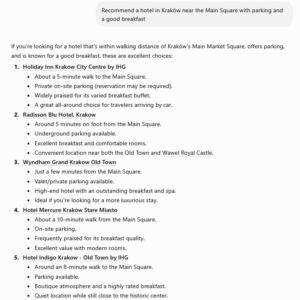
What does this look like in practice? Let’s assume a user types: “Recommend a hotel in Kraków near the Main Square with parking and a good breakfast.”

[Image: Example ChatGPT response to a query about a hotel in Kraków with specific requirements (June 2026).]

As the example above shows, AI does not pick hotels at random. To generate such an answer, it needs to find information confirming the hotel’s location, parking availability, breakfast offer, and guest reviews. If that information is missing or imprecise, the hotel may be left out of the recommendation, even if it actually meets all of the user’s requirements.

This means hotels have a better chance of being recommended when they:

  • publish detailed, up-to-date information on their own website,
  • are present on credible industry platforms,
  • keep their data consistent across different sources.

In practice, this comes down to building trust with both users and search algorithms. Google has long promoted content aligned with E-E-A-T (Experience, Expertise, Authoritativeness, Trustworthiness), and many of these signals also help AI systems assess a property’s credibility. The more reliable information there is confirming a hotel’s offer, the higher the chance it will be included in an AI-generated answer.

Which AISO Actions Increase Your Hotel’s Chances of Being Recommended?

Detailed property descriptions
Experience shows that many hotels limit their descriptions to a few marketing lines, while potential guests are looking for answers to very specific questions. This applies to room types, available amenities, stay policies, and the property’s location relative to local attractions. This is exactly the kind of information that helps users make a decision, while also giving AI models the context they need to generate more accurate recommendations.

FAQ section
A well-prepared FAQ section organizes information and answers the questions users actually ask. This makes it easier for AI models to identify content that matches specific queries. When a user asks ChatGPT or Google AI Overviews whether a hotel offers parking, breakfast, or a pet-friendly stay, the model typically looks for the answer in exactly these sections. That is why an FAQ should address real guest questions rather than serve a purely marketing function.

Schema.org structured data
Implementing Schema.org markup (LodgingBusiness, Hotel, Review) helps both search engines and AI models understand what your property is. Structured data confirms the context, that this is a hotel, not a restaurant or an office.

User reviews
Reviews give AI models additional context about the quality of the property and the guest experience. Language models take into account both the sentiment and the content of reviews from platforms such as Google Maps, TripAdvisor, and Booking.com. A high volume of positive, detailed reviews increases the chance of being mentioned in AI-generated answers.

Local SEO
A complete, up-to-date Google Business Profile is the foundation. Categories, opening hours, photos, and responses to reviews all build local authority, which Google draws on directly when generating AI Overviews for queries with local intent.

Data consistency (NAP)
The name, address, and phone number (NAP, Name, Address, Phone) must be identical everywhere the hotel appears: on its own website, in Google, in industry directories, and on OTA platforms. Discrepancies lower the trust AI models place in the reliability of your data.

SEO tip:

Consistency does not mean copying the same descriptions across every platform. Keep the key facts aligned (such as amenities, location, and contact details), but create unique content for your own website and for external platforms. This benefits both your SEO and the quality of the information AI systems draw on.

Presence on credible platforms and in directories
Mentions on industry portals (TripAdvisor, Booking.com, Hotels.com), local tourism websites, press articles, and blog reviews build external authority. AI treats these as confirmation that the hotel is a trustworthy property.

Up-to-date photos and information
Outdated data (for example, prices from several years ago or an old restaurant menu) reduces your website’s credibility. Google AI Overviews favors fresh, regularly updated content.

Checklist: Is Your Hotel Ready for AI Search?

  • Descriptions of rooms, services, and amenities contain specific information, not just marketing slogans.
  • The FAQ section answers the questions guests ask most often.
  • Schema.org structured data (e.g., Hotel, LodgingBusiness, Review, AggregateRating) has been implemented.
  • The Google Business Profile listing is complete and up to date.
  • The hotel name, address, and phone number (NAP) are consistent across all sources.
  • Guest reviews are monitored regularly, and the hotel responds to new ones.
  • The hotel is listed on the most important industry portals and platforms.
  • Photos of the property on the website and in Google Business Profile are current and reflect the actual offer.
  • Additional services, such as the spa, restaurant, or conference rooms, have their own subpages with unique descriptions.
  • The website loads fast and meets Core Web Vitals requirements.

Key Takeaways

There is no single technique that will make ChatGPT or Google AI Overviews start recommending your hotel. AI systems analyze many signals at once, from content quality and structured data to user reviews and presence in credible sources.

Effective AISO is therefore not about looking for shortcuts, but about consistently building a valuable online presence. A hotel that provides users and search engines with reliable information increases its chances of appearing both in Google results and in AI-generated answers.

Sources:

AISO: SEO for AI Tools

Build visibility where your potential customers are already searching

Learn More!
Michał Grzyb
Michał Grzyb SEO & AI Specialist

Author
Author
Szymon Wolski

Presales Consultant

Szymon holds a degree in International Economic Relations from the University of Gdańsk. Over the past four years, he has gained experience in the international travel industry, working with hotel, restaurant, and event venue owners from around the world. Through collaborating with clients across diverse markets, he developed a strong ability to understand business needs and recommend solutions tailored to specific goals.

At Delante, Szymon supports companies at the very beginning of their cooperation journey, helping them understand the challenges of online visibility and identify the right SEO, SEM, and AISO strategies for their business. He is particularly interested in the development of AI Search and the growing impact of artificial intelligence on the way people search for information and make decisions online.

Outside of work, he enjoys staying active – from running and spending time by the water to hiking while travelling

Author
Author
Szymon Wolski

Presales Consultant

Szymon holds a degree in International Economic Relations from the University of Gdańsk. Over the past four years, he has gained experience in the international travel industry, working with hotel, restaurant, and event venue owners from around the world. Through collaborating with clients across diverse markets, he developed a strong ability to understand business needs and recommend solutions tailored to specific goals.

At Delante, Szymon supports companies at the very beginning of their cooperation journey, helping them understand the challenges of online visibility and identify the right SEO, SEM, and AISO strategies for their business. He is particularly interested in the development of AI Search and the growing impact of artificial intelligence on the way people search for information and make decisions online.

Outside of work, he enjoys staying active – from running and spending time by the water to hiking while travelling

FAQ

Can ChatGPT book a hotel directly?

No, at least not in its basic version. ChatGPT (without plugins or external tools) cannot process bookings or access OTA systems in real time. It can, however, recommend specific properties based on its training data and current online content. Completing a booking requires going to the hotel’s website or a booking intermediary.

Do Google reviews really influence AI recommendations?

Yes. Both Google AI Overviews and language models trained on web data take review scores and review content into account. A high average rating, a large number of reviews, and positive sentiment all increase a property’s credibility in the eyes of the algorithms. It is also worth responding to reviews actively, as this signals engagement and an actively managed listing.

Is being listed on Booking.com and TripAdvisor enough for AI to recommend my hotel?

Presence on OTA platforms and in directories is a good start, but not enough on its own. AI draws on many sources at once, so what counts is the sum of signals: your own website with valuable content, structured data, local SEO, NAP consistency, and activity on credible platforms. A Booking.com profile alone, without a well-developed website of your own, is too narrow a base to compete effectively in AI Search.