
How Much Does Advertising Cost in Meta Ads? Budget Perspective and Algorithmic Efficiency in 2026

3min.

Comments:0

10 June 2026

How Much Does Advertising Cost in Meta Ads? Budget Perspective and Algorithmic Efficiency in 2026d-tags
The Operational Metrics Trap: Why CPC and CPM Do Not Define Profitability Algorithmic Liquidity Threshold: The Minimum Budget That Makes Business Sense Cost Gradation vs. Business Objectives: From Awareness to Transaction What Actually Shapes Cost? Key Drivers of Pricing Summary: How to Manage Costs in Meta Ads

3min.

Comments:0

10 June 2026

Most discussions around the Meta advertising ecosystem tend to focus on average CPC or CPM rates. However, from the perspective of a Marketing Manager reporting to the board and responsible for delivering annual targets, these metrics are purely operational. The cost per click is not a KPI – it is merely a derivative of traffic quality and the efficiency of the analytical infrastructure.

For organizations managing budgets of several to tens of thousands of PLN per month, the real question is not “how much does an impression cost?” but rather: “how effectively does the Meta Ads system convert media budget into a stable customer acquisition cost (CAC) and a satisfactory return on investment (ROI)?”
The Operational Metrics Trap: Why CPC and CPM Do Not Define Profitability

The market has grown accustomed to operating with broad benchmarks – in domestic conditions, CPC rates typically range from a few dozen groszy to several złoty, while CPM fluctuates between a dozen and several dozen złoty. In high-barrier, highly competitive segments such as B2B, SaaS, or finance, these values multiply significantly.

However, treating these figures as a reference point for annual budget planning is often a strategic mistake. Two organizations competing for the same audience in Meta Ads may experience drastically different business costs. The reason is not the auction bid itself, but the maturity of the entire marketing ecosystem:

  • First-party data quality: systems fueled by precise CRM data and implemented server-side tagging move through the learning phase significantly faster,
  • Funnel architecture: conversion performance at the landing page level directly determines whether a high CPM translates into an acceptable CPA.

Instead of optimizing campaigns solely for lower CPC, mature marketing organizations focus on share of voice and margin stabilization. Cheap traffic that does not generate transactions in CRM is, in reality, a hidden cost that burdens the company’s financial performance.

Algorithmic Liquidity Threshold: The Minimum Budget That Makes Business Sense

In discussions about entry thresholds, minimum platform requirements are often confused with the budget necessary to achieve scale. Modern advertising systems rely on probabilistic models and machine learning. For the algorithm to accurately identify purchase intent, it requires sufficient data density over time. In practice, the learning phase requires approximately 50 conversion events per ad set within 7 days.

From a decision-making perspective: if the cost of a desired event (e.g., qualified lead or e-commerce purchase) is 150 PLN, then the minimum operational budget required to exit the learning phase is approximately 7,500 PLN per ad set per month.

Investing below this threshold results in a permanent state of instability, where the algorithm randomly rotates creatives and acquisition costs fluctuate drastically day-to-day. For a business stakeholder managing the budget, this means capital inefficiency with no chance of repeatable performance.

Cost Gradation vs. Business Objectives: From Awareness to Transaction

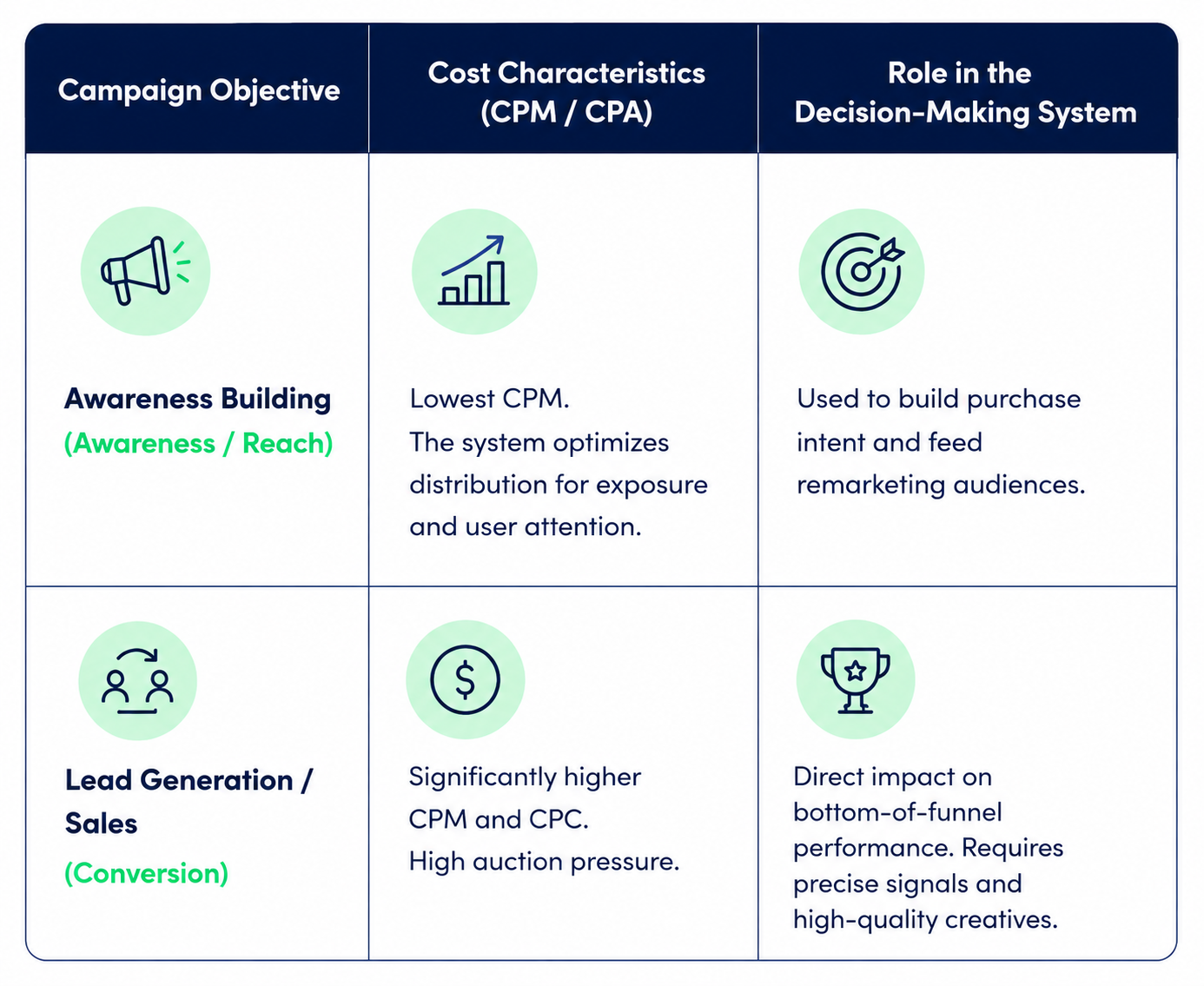
The cost structure in Meta Ads is directly tied to the level of risk the system assumes during optimization.

Attempting to directly compare the cost efficiency of awareness campaigns with conversion-driven campaigns is a methodological error. A mature strategy distributes the budget in a way that lower-cost upper-funnel activities continuously reduce the final CAC at the bottom of the funnel.

What Actually Shapes Cost? Key Drivers of Pricing

Modern Meta Ads performance is increasingly less dependent on manual targeting (broad audiences are becoming the standard), and increasingly driven by two variables: data quality and creative execution.

  • Creative as the new targeting: the algorithm evaluates initial user reactions (CTR, attention retention). If the creative resonates, Meta rewards the advertiser with higher auction priority, directly lowering CPM. Weak creatives increase cost of reach, regardless of budget size.
  • Seasonality and auction pressure in Q4: advertising costs are highly sensitive to the business calendar. In Q4 (Black Friday, holiday season), the concentrated presence of large brands significantly increases CPM rates – by as much as 40–60% in some categories. For Marketing Managers, this means securing higher operational budgets in advance or shifting focus toward retention and first-party data.

Summary: How to Manage Costs in Meta Ads

The cost of advertising in Meta Ads is not a fixed value nor a parameter that can be rigidly assumed in a spreadsheet at the beginning of the year. It is a variable dependent on the technological and strategic maturity of the organization.

At Delante, we do not view Meta Ads through the lens of generating cheap clicks. We treat this ecosystem as part of a broader system for brand positioning and precise demand capture. Organizations equipped with structured data, an agile creative testing process, and transparent analytics are able to maintain cost stability and predictable scalability – regardless of increasing auction pressure in the market.

Author
Weronika Strzeżyk - Junior SEM Specialist
Author
Weronika Strzeżyk

SEM Specialist

A graduate of the AGH University of Science and Technology and the University of Economics in Krakow. At Delante since the SEM internship in August 2023.

In her free time, she is an enthusiast of watching ski jumping and exploring the culture of the Pieniny and Upper Silesia regions.

Author
Weronika Strzeżyk - Junior SEM Specialist
Author
Weronika Strzeżyk

SEM Specialist

A graduate of the AGH University of Science and Technology and the University of Economics in Krakow. At Delante since the SEM internship in August 2023.

In her free time, she is an enthusiast of watching ski jumping and exploring the culture of the Pieniny and Upper Silesia regions.