How can you really use AI in SEO? There are tons of options! Content creation, on-page optimization or link building can all benefit from AI if you know how to use it. Interested in learning more? Then, keep reading!
How to Use SEO with AI? 5 Practical Applications of AI for SEO Prepared by Delante
Without any further ado, let’s look at the practical side of AI. How can you use it in your SEO, and which areas will benefit the most?
Keyword Analysis
Firstly, you may use AI for keyword analysis. This is actually something that is already available in tools like SEMrush, which come with modules enabling you to locate the most promising keywords for new content on your site. For instance, if you’re creating a content plan for your blog, all you have to do is… enter your domain name, and the AI will provide you with tailored insights throughout your research.
You can also use generative AI engines, like ChatGPT, Perplexity, or other ChatGPT alternatives. In this case, you can:
connect your AI engine with your SEO tools and ask for a recommendation based on the data from the latter – this requires additional effort and tools to link both sides together,
ask in the AI engine directly for keyword recommendations for your site – remember, it won’t give you accurate information, but it can still be helpful (for instance, showing you which keywords you should look for in SEO tools)
Content Writing
This is perhaps the most popular way to use AI in SEO (especially since over 50% of content on the web is already AI-generated). Using artificial intelligence for content writing may be tempting, but does it really make sense? How does Google react and can this rank you up or down?
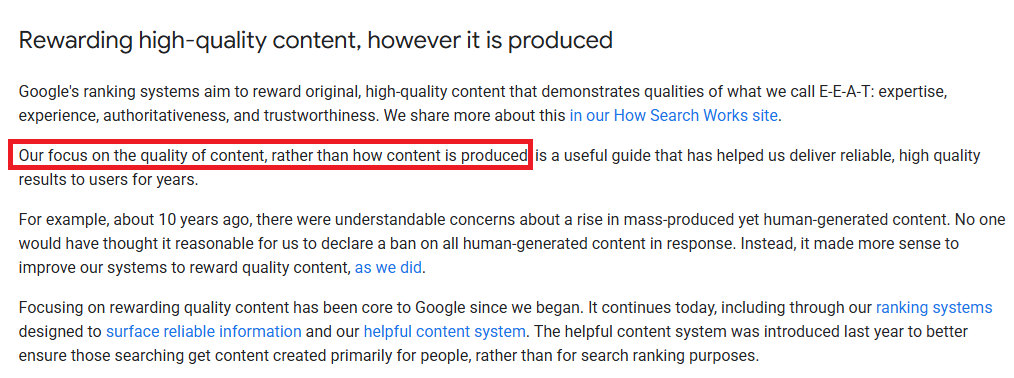
As you can see, in theory, you can use AI for generating content. However, it needs to be valuable and high-quality to help you rank up. This means that if you want to generate whole content pieces you should:
provide the search engine with resources – your knowledge and insights on the topic,
verify the factual side of the generated text,
verify the linguistic side of the generated text,
verify if the generated text is well-optimized.
This means that you cannot (and shouldn’t) mass-generate content for your website – it will be low-quality and if you publish it all at once, your pages might drop in searches. However, you can use AI if you:
are an expert or have experts in your team who can’t really write a good text, but have valuable insights on the topics you want to write about,
have a specific, time-consuming type of content to create, where it might be quicker to use AI (e.g., generating large tables, writing content based on a template, completing long reference lists).
Don’t know if your content is unique and valuable for the user?
How to use AI for on-page SEO? You can use both general-purpose and SEO-specific tools!
General-purpose tools
SEO-specific tools
You can copy your content into a generative AI engine and ask it for SEO optimizations (e.g., internal linking based on a spreadsheet with all crucial pages and the keywords they are optimized for). The more specific your prompt, the better the AI will be. Remember to verify the changes afterward, to ensure that AI hasn’t made any additional tweaks to your content that you didn’t ask for.
Tools like Surfer SEO enable you to view relevant keywords connected to the topic or even automatically insert internal linking into your content. They might also suggest content length and keyword density for specific phrases. Don’t let the craze get you, though – while these tools are great, you should also verify their suggestions, so that you don’t overoptimize the content or create a piece that works only for the robots, not for the users.
Link Building
In terms of link building, you can once again connect your generative AI tools with SEO platforms to draw from the data in your prompts. Later, you can use them to:
suggest the best anchor and placement within the content for your link,
analyze your competitors’ backlink profiles,
create content for guest posts (as long as you keep it high-quality, as mentioned before).
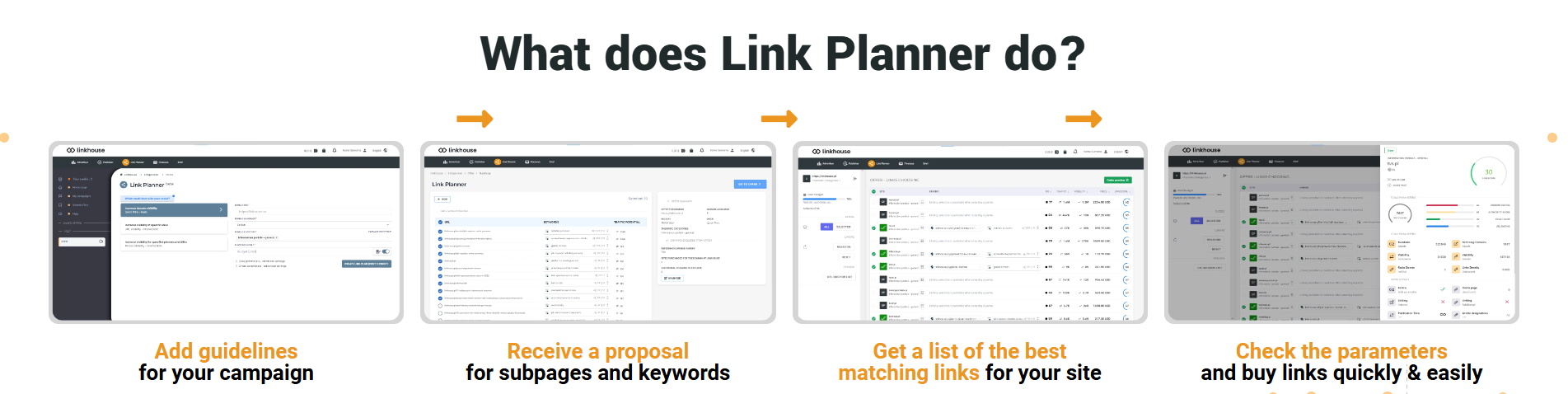
You might also use more advanced AI-powered tools for creating and conducting fully-fledged link building strategies – a good example here is Linkhouse’s Link Planner.
Source: https://linkhouse.net/link-planner/
Performance Analytics
Finally, you can merge AI with your analytics tools to analyze your data more quickly. The sky is the limit, but we’ve prepared a few suggestions on how you can use this in practice:
quickly analyzing what type of blog content generates sales,
analyzing general data to find areas for improvement,
locating performance issues, such as broken links.
Is It a Good Idea to Use AI for SEO?
Yes, using AI for SEO is good, as it can speed up many processes, leaving time for more value-adding tasks. However, considering the problems with content creation in the AI era, the issues of hallucinations, and the potential for errors and overoptimizations, you need to be smart when using it. Think about it this way:
How will you benefit from using AI for the particular SEO area? Do you use it to save time, improve quality, or to cover skill gaps?
Do you have the skills and know-how to implement necessary corrections in AI-optimized or AI-generated content? Can you spot the problems and fix them?
Will the AI really help you fulfill the goal? Are the benefits higher vs. the costs of implementing AI-powered tools and the time or quality received without them?
During the ongoing AI hype, we need to be reasonable. If it takes me less time to write a text (write = create the textual layer) than to fix the content generated by AI why should I use it? On the other hand, if I have a template that I have to follow strictly, why should I copy and paste it every time if I can ask AI to shape my texts for the specific template?
From my perspective, the question isn’t whether we should or shouldn’t use AI, but when should we use it to benefit rather than lose time and get frustrated. We need to learn to distinguish between situations where it’s our ally and when it’s a fake friend, which benefits us only in theory.
Adrian Mrozowski
Content Specialist
The Takeaway
How to do SEO with AI? You’ve got multiple options. You may use AI to improve your on-page optimizations, create content, analyze data, or search for keywords. Moreover, there are several specialized tools designed specifically for SEO that are powered by artificial intelligence – you can use them to your advantage. At the same time, remember that such tools won’t replace SEO skills – they can support you, but only if you have a good grasp of SEO. What if you don’t? There’s nothing to worry about – you can always opt for SEO services at Delante. Contact us and let us take your business forward!
R&D specialist in SEO and web analytics. He feels most comfortable in the area of technical SEO, and his main task is to ensure that websites are optimized for search engines and achieve high rankings in search results.
R&D specialist in SEO and web analytics. He feels most comfortable in the area of technical SEO, and his main task is to ensure that websites are optimized for search engines and achieve high rankings in search results.







![AI now constitutes 0.0082% of global online traffic — and this percentage is still rising [Report]](https://delante.co/wp-content/uploads/2025/01/blog-styczen-AI-raport-cover-1.jpg)


