What Happens to Brand Visibility After 3 Months Without SEO?

5min.

Comments:0

16 June 2026

SEO
What Happens to Brand Visibility After 3 Months Without SEO?d-tags
When budget pressure hits, cost-cutting decisions at companies most often land on marketing. Because of its nature and its long-term payoff, SEO becomes a natural target for CFOs hunting for savings. From management's point of view, a few months' pause in site optimization looks like a cost-free way to save budget within a given quarter. In practice, it means taking on so-called SEO debt, which ends up generating a far higher cost than the apparent, momentary saving.

5min.

Comments:0

16 June 2026

The First Month After Stopping: A False Calm and Psychological Traps

The opening stretch after work stops can look calm in terms of results. This comes down to so-called SEO inertia, the real lag in how Google’s algorithms react. The effect cuts both ways:

  • On one hand, it delays the first results after you roll out optimization, and a visibility improvement often shows up only after several weeks.
  • On the other, when you stop optimizing and refreshing the site, the algorithms also catch this with a delay, usually after around 3-4 weeks.

This inertia can therefore mask the negative effects of pausing SEO and lead straight into the psychological trap of false security.

Once you switch off SEO budgets, traffic may hold steady for the first month. The board and the CMO might read this as confirmation of their hypothesis that stopping activity carries no negative consequences, and that SEO was a service they had been overpaying for.

That is a fundamental mistake and a lapse in attention, because beneath the “mask” of stable results, Google’s bots are already registering the absence of fresh signals on the site (optimization, new links, content).

The Second Month of Paused Activity: Algorithmic Loss of Trust

Around weeks 5-8 after optimization stops, the first declines begin to appear.

To start with, the site begins losing visibility on informational and long-tail queries, the longer, more detailed searches. The following mechanisms are responsible:

  • Query Deserves Freshness Google’s algorithm rewards up-to-date pages. In an era of disinformation and a web flooded with “junk” content, freshness and ongoing optimization are among the key factors for building authority in Google’s eyes. When a site stops being developed, with no new content or updates to existing pages, Google reads this as a sign that the site is becoming less relevant. It then starts swapping the positions the site earned for competitors who keep publishing new content and rolling out optimization.
  • Link decay The link profile pointing to every domain steadily erodes. Over time some pages get removed, the content on them changes, and some links are swapped for others. Add the absence of active link building and earning new mentions, and the net balance of the backlink profile turns negative. For Google and LLMs, this signals a drop in domain authority and, with it, a drop in visibility.

What Do the Statistics Say About Declines From the Second Month On?

Experiments and market analyses show that after roughly 2 months without SEO, organic traffic starts to fall sharply. Depending on the industry and how competitive it is, first-quarter declines can range from 15% to as much as 40% of organic traffic.

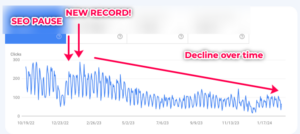
The US marketing agency Nexus Marketing ran an analysis based on one of its own sites. At the peak of the site’s visibility, they suspended SEO. After the first month they still saw growth, driven by earlier work, but once the SEO inertia period passed, the slide downhill began.

The second month after stopping was the turning point when the trend reversed, and over the following 12 months the site lost as much as 64% of its organic traffic.
 

spadki widoczności po zastopowaniu seo

(Source: nexusmarketing.com)

Your Competitors Aren’t Sleeping

According to data from The State of Marketing Report 2026 by HubSpot, 41% of marketers said that updating and actively working on their SEO strategy is their top priority. At the same time, 47% of Enterprise businesses named SEO as the most scalable channel for acquiring traffic and growing revenue. This shows that for larger players, SEO is a marketing priority in 2026.
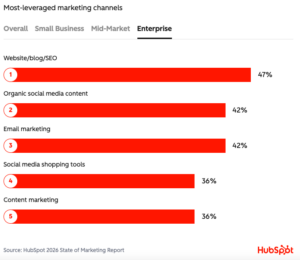
 

efektywne kanały ruchu i sprzedaży enterprise

Source: The State of Marketing Report HubSpot 2026

Your decision to freeze the SEO budget is an invitation for competitors to take over the positions and visibility your brand worked to build.

SEO Services From Delante

Let's talk strategy for your site!

Contact us!
Przemek Jaskierski
Przemek Jaskierski SEO Strategy Manager

The Third Month: A Reputation Crisis and a Financial Hit

After a quarter without activity, the declines start to hit the keywords that matter most from a business standpoint, the so-called money keywords. Typically sales-driven, commercial queries that used to generate leads stop working.

Beyond the drop in visibility and organic traffic, the brand begins to experience a reputation crisis driven by the so-called mere exposure effect. It works like this: people subconsciously prefer to buy from, or choose the services of, a company they see most often, in ads, on social media, in search results, or in AI-generated answers. The greater the exposure, the greater the trust.

If a user sees a brand in the top positions after typing a query into Google, they subconsciously start to equate that brand with the industry leader. The moment your brand disappears from the search results, it also stops being the first choice for a potential customer.

We can compare this to the store shelf illusion. If a product in a shop is moved from eye level down to the bottom shelf, its sales drop dramatically, because nobody wants to bend down, and reaching for a product placed higher is far easier. Visibility in Google works the same way.

Pages that show up at the top of the results have a far greater chance of the proverbial “click” than sites on the second page, which fewer than 1% of users ever reach. The moment your site loses visibility on its most business-critical keywords, it also becomes invisible to potential customers.

Why Do 3 Months Without SEO Generate Losses?

A quarter without SEO means, above all, financial losses. Stopping SEO creates costs that are hidden at first glance and that outweigh the apparent 3-month “saving.” What costs are we talking about?

  • Rising customer acquisition cost (CAC)

When organic traffic falls, a gap opens up in lead generation. To maintain revenue, the company is forced to “fill in” the missing results with paid traffic. That traffic carries a much higher cost per click (CPC), which in turn pushes up the CAC and lowers margin.

  • The SEO debt phenomenon

Stopping SEO leads to SEO debt that builds up cumulatively. Returning to previously earned results after a 3-month break takes 6 to 9 months of intensive work. According to market estimates, recovering visibility after a break costs on average 150-200% more than simply paying for regular SEO over the same period.

The US agency Coalition Technologies ran an analysis that showed plainly that the longer the stagnation and the bigger the visibility losses, the greater the effort required to get back to previous results.

dług seo

(Source: coalitiontechnologies.com)

Why does this happen? Time spent in stagnation works heavily against the site:

  • Competitors are actively working on their sites during that same period, cementing their position.
  • Algorithms change, and adapting your site to new requirements after a longer gap is far more labor-intensive than reacting to changes as they happen.
  • Loss of authority in Google’s eyes can come fast, but rebuilding it, despite the work you put in, can take many months.
  • Stopping activity also generates extra costs, in the form of having to commission recovery audits and increase the budget for aggressive link building.

In the table below, we’ve laid out how a 3-month break in SEO affects various financial aspects:

Indicator

Continuous SEO

3-Month SEO Break

Marketing budget

Steady, predictable operating cost.

Apparent saving in months 1-3.

Sales funnel stability

Steady flow of free, intent-driven leads.

Funnel broken, drastic drop in conversions in month 3.

Cost of returning to the starting point

$0 (gains delivered under the contract).

SEO debt: need to pay extra for recovery audits, content, and aggressive link building.

Total ROI balance

High, long-term return on investment.

Negative, loss of market position, higher paid-ad costs.

How to Reconcile Budget Cuts With SEO Continuity?

SEO is like cycling uphill: when you stop pedaling, you don’t stay put, you start rolling back down. If you stop, you won’t just lose the effects you earned and the budget you already invested, you’ll also generate an additional cost needed to get back to where you were.

So what should you do if you absolutely have to find budget savings? As a CMO, the financially responsible decision is to switch temporarily to a so-called survival package, which can take various forms, for example reducing the volume of new content while maintaining protection of your most important positions and basic link building. That way you save part of the budget while avoiding drastic SEO debt and protecting your brand from losing trust in the eyes of customers and Google’s algorithms.

Sources:

Author
Wiktoria Wójciak - SEO Specialist
Author
Wiktoria Wójciak

Senior SEO Specialist

She joined the Delante team in 2021, specializing in local SEO and managing Google My Business Profiles.

A graduate in Information Management from Jagiellonian University, she analyzes and optimizes service and e-commerce websites in her daily work. She feels comfortable working in any industry, as long as client communication is based on mutual understanding and cooperation. She believes that good relationships and shared goals are key to achieving satisfying results.

At Delante, she is responsible for processes such as Google My Business optimization and listing positioning. She believes that SEO success lies in understanding the client’s needs and taking a flexible approach to the specifics of each industry.

Author
Wiktoria Wójciak - SEO Specialist
Author
Wiktoria Wójciak

Senior SEO Specialist

She joined the Delante team in 2021, specializing in local SEO and managing Google My Business Profiles.

A graduate in Information Management from Jagiellonian University, she analyzes and optimizes service and e-commerce websites in her daily work. She feels comfortable working in any industry, as long as client communication is based on mutual understanding and cooperation. She believes that good relationships and shared goals are key to achieving satisfying results.

At Delante, she is responsible for processes such as Google My Business optimization and listing positioning. She believes that SEO success lies in understanding the client’s needs and taking a flexible approach to the specifics of each industry.

FAQ

Will my site's rankings drop immediately after I switch off SEO?

No, rankings won’t fall overnight, and that’s down to so-called SEO inertia. This phenomenon refers to the delay in how Google’s algorithms react to the work done on a site, or the lack of it. Just as you usually have to wait for results after optimizing a site, the same applies to the declines that follow once activity stops. Through the first month the drops typically won’t be noticeable, but in the second and third months visibility starts to deteriorate at an avalanche pace.

How much organic traffic can you lose after 3 months without SEO?

Industry tests show that 3 months of completely halting SEO can cost a company anywhere from 15% to 40% of its organic traffic. The scale depends largely on how competitive the industry is, the more actively your competitors work, the faster and bigger your visibility losses will be.

What is SEO debt, and how much does it cost to pay off?

SEO debt is the cost and effort a company has to take on to get back to previously earned results after stopping activity. A 3-month break will usually require 6 to 9 months of intensive work to recover the lost positions. Competitors aren’t sleeping and algorithms keep changing, which is why the later cost of reactivation runs 150-200% higher than the cost of maintaining continuous activity.

Which is better: switching off SEO entirely or cutting the budget?

Cutting the budget and moving to a lower tier (maintenance SEO) that focuses only on the keywords critical to the business (money keywords) is by far the better option. Stopping activity altogether creates SEO debt, and returning to earlier results demands greater costs, more effort, and a longer timeline. Limited activity, even single implementations, sends a better signal to Google’s algorithms than complete stagnation.