Around weeks 5-8 after optimization stops, the first declines begin to appear.
To start with, the site begins losing visibility on informational and long-tail queries, the longer, more detailed searches. The following mechanisms are responsible:
- Query Deserves Freshness Google’s algorithm rewards up-to-date pages. In an era of disinformation and a web flooded with “junk” content, freshness and ongoing optimization are among the key factors for building authority in Google’s eyes. When a site stops being developed, with no new content or updates to existing pages, Google reads this as a sign that the site is becoming less relevant. It then starts swapping the positions the site earned for competitors who keep publishing new content and rolling out optimization.
- Link decay The link profile pointing to every domain steadily erodes. Over time some pages get removed, the content on them changes, and some links are swapped for others. Add the absence of active link building and earning new mentions, and the net balance of the backlink profile turns negative. For Google and LLMs, this signals a drop in domain authority and, with it, a drop in visibility.
What Do the Statistics Say About Declines From the Second Month On?
Experiments and market analyses show that after roughly 2 months without SEO, organic traffic starts to fall sharply. Depending on the industry and how competitive it is, first-quarter declines can range from 15% to as much as 40% of organic traffic.
The US marketing agency Nexus Marketing ran an analysis based on one of its own sites. At the peak of the site’s visibility, they suspended SEO. After the first month they still saw growth, driven by earlier work, but once the SEO inertia period passed, the slide downhill began.
The second month after stopping was the turning point when the trend reversed, and over the following 12 months the site lost as much as 64% of its organic traffic.
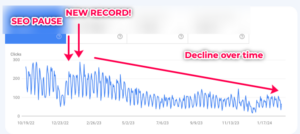
(Source: nexusmarketing.com)
Your Competitors Aren’t Sleeping
According to data from The State of Marketing Report 2026 by HubSpot, 41% of marketers said that updating and actively working on their SEO strategy is their top priority. At the same time, 47% of Enterprise businesses named SEO as the most scalable channel for acquiring traffic and growing revenue. This shows that for larger players, SEO is a marketing priority in 2026.
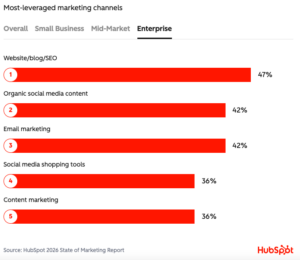
Source: The State of Marketing Report HubSpot 2026
Your decision to freeze the SEO budget is an invitation for competitors to take over the positions and visibility your brand worked to build.








 Przemek Jaskierski