1. Create Data and Material Worth Citing
The best way to earn mentions naturally is sharing your own knowledge, which other people will use to create their own material and AI models will use to generate answers.
As part of this, a company can publish:
- proprietary market research saturated with hard data,
- reports based on internal data,
- recurring summaries of changes in the industry,
- indexes or rankings.
The more unique the analysis, the greater the value it adds for the brand. A report titled “Marketing trends in 2026,” for example, will compete with at least a hundred similar pieces published by other companies. A report titled “How customer acquisition costs changed across 150 Polish online stores between 2024 and 2026,” on the other hand, delivers specific data and strong conclusions that industry portals and other companies can cite.
2. Run e-PR Activities Built on Expert Knowledge
Creating valuable material to be cited is a good first step, and one worth following up with e-PR activities that will help promote a proprietary report and make it available to a wider audience. A well thought out e-PR strategy lets you earn mentions from editorial publications, news services and industry material.
If things are changing in the industry, if new solutions or regulations are appearing, that is a good opportunity to earn a brand mention with an expert comment from a specialist working at the company. At moments like these, industry media often look for expert statements for their articles, so an e-PR strategy should be built in part on reacting quickly to situations like this. That way the mention comes about naturally, is surrounded semantically by current knowledge, and helps create a professional brand image.
3. Build Recognition for the Experts Connected With Your Brand
And speaking of experts, building the authority of the company’s employees is also a valuable investment in earning mentions later on.
Below is a short checklist of the things worth taking care of:
- Create dedicated profiles for your employees on your site, describing their education, experience and areas of specialization.
- Prepare short biographies with an author description and a photo, to use as bylines on the material you publish on the site.
- Get your employees involved in speaking at conferences and appearing in podcasts, webinars and interviews.
The more semantic connections (entities) an expert has with the industry, the more strongly this will affect their authority in the eyes of AI models. A brand that can point to a group of experts like this automatically gains credibility and a chance to earn mentions naturally in valuable sources.
4. Appear in Comparisons and Rankings
Comparison queries are the kind of prompts that give a brand the greatest chance of being cited by AI. Users often ask LLMs about:
- the best tools for X,
- proven companies offering Y,
- alternatives to product Z, and so on.
It is worth analyzing which comparisons and lists are already being cited by AI tools for industry prompts. The next step is checking what conditions have to be met for the brand to be included in a comparison like that. Another approach is publishing your own material comparing products or services, which can also increase the chance of earning a mention.
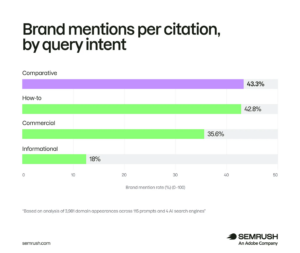
The importance of a brand’s presence in publications of this kind is confirmed by data from an analysis carried out by Semrush. According to the study, comparison content generates 2.4 times more mentions in AI tools than purely informational material. The analysis was carried out across four different AI based tools and search engines, on data for close to 4,000 websites. It shows how presence in ranking and comparison publications increases the chance of brand visibility in generative answers.
Source: Semrush
5. Develop Your Presence on Review Sites
Reviews left on sites dedicated to them can also be treated as user generated brand mentions. Depending on the industry, the following portals may matter:
- Google Business Profile (essential for businesses operating locally),
- G2,
- Capterra,
- Trustpilot,
- Clutch,
- TripAdvisor,
- Booking,
- marketplaces,
- specialist industry portals.
A company should ask customers for reviews at natural moments in the process, for example after a project ends, after a problem is solved, after a result is achieved, or, in the case of e-commerce, after a purchase.
It is worth encouraging customers to describe a specific experience, for example what problem the company helped them solve, why they chose that solution, what result they got, and what type of user they would recommend the product or service to.
6. Take Part in Communities Where Users Actually Make Decisions
Mentions can also be earned on forums that gather a community around an industry, and on portals such as Reddit. These places online can carry questions the brand is in a natural position to answer.
A brand’s presence in channels like these, and the mentions it earns there, may involve:
- answering questions,
- explaining problems,
- responding to criticism,
- correcting inaccurate information.
Avoid spam tactics based on creating accounts in bulk and publishing forced comments: this creates reputational risk and may breach the platforms’ rules.
7. Update Existing Mentions
Sometimes an audit of publications you already have can bring real benefits. Checking earlier articles may reveal that a piece contains only a mention with no link (and perhaps the publisher will agree to add one), that there are errors in how the brand name is written that need correcting, or that some information is out of date.
Contact with the author should bring value for the other side too, so it is worth preparing new data, a report or information that will help update the publication.









 Kasia Śliwa