Will Your Product Make the ChatGPT Shortlist Before Black Friday? How AI Narrows Down Product Choices

8min.

Comments:0

29 October 2026

Will Your Product Make the ChatGPT Shortlist Before Black Friday? How AI Narrows Down Product Choices
Black Friday starts long before the actual purchase: 60% of consumers start researching products with the upcoming deals in mind as much as a month or two in advance. See how ChatGPT builds shortlists, what decides whether a specific product gets recommended and what you can do to make sure your offer is among the options shoppers consider.

8min.

Comments:0

29 October 2026

Key Takeaways

    • AI is playing a growing role in choosing products before they’re bought. A customer can ask ChatGPT to narrow the offer down to a few products that best match their needs, and part of today’s battle for attention and sales is fought on that shortlist.
    • Products are increasingly chosen long before Black Friday itself. According to BCG, 60% of consumers start researching deals as early as October or the beginning of November.
    • A mention of a product doesn’t yet mean a recommendation. It’s worth distinguishing between Mention, Recommendation and Selection: a product can appear in an AI answer, make the shortlist and only later be named as the best-matching option.
    • Whether a product makes the shortlist depends not only on its features, but also on the quality and consistency of its data. Complete specifications, up-to-date pricing and availability, variants, reviews and information available in different places online help AI assess the product and compare it with competitors.
    • Monitoring real shopping prompts and metrics such as Mention Share, Recommendation Share, Selection Share and AI Product Accuracy Rate lets you see where a product loses its edge and whether it actually makes shortlists

    Customers Buy During Black Week, but Choose the Product Earlier

    For many customers, Black Friday is the moment they buy a product they chose much earlier.

    In its Black Friday 2025 report, BCG showed that 60% of consumers start researching deals as early as October or the beginning of November. At the same time, only about ⅓ of the customers surveyed knew at that stage which brand and product they wanted to go for. In addition, 77% of respondents said they often put off purchases specifically to take advantage of Black Friday deals.

    This means the few weeks before the sale itself can be a key moment for e-commerce, when brands start competing with their rivals.

    AI Is Already Part of That Earlier Choice

    When choosing a product, consumers who want to save time on research are increasingly turning to AI to help them find the options that best match their needs.

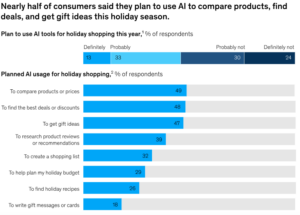
    A McKinsey survey published at the end of August 2026 shows that 46% of consumers (almost half) say they will probably or definitely use AI tools for this year’s holiday shopping.

    Of the group planning to use AI:

    • 49% want to compare products or prices
    • 48% plan to look for deals
    • 32% will create a shopping list

    mckinsey ai usage for shopping

    Source: McKinsey

    Meanwhile, Salesforce reports that 50% of shoppers already use an AI assistant at some stage of the purchase journey, and that using AI as the first step of the journey (research) grew by 200% between May 2025 and May 2026. The company also predicts that in Q4 2026, as much as 20% of e-commerce traffic could come from AI agents.

    AI is moving from a supplementary source of inspiration used by a small share of shoppers to one of the first places where customers start choosing a product. That’s why, for every e-commerce business, being on product shortlists in ChatGPT should be a priority, especially during periods of heightened purchase intent.

    What Exactly Is a “ChatGPT Shortlist”?

    According to the McKinsey report, comparing and choosing products is one of the most common ways people use AI when shopping.

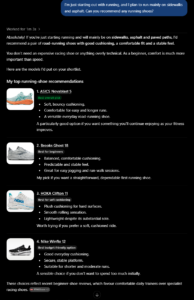
    Instead of browsing thousands of available products, the customer asks AI to narrow them down to a shortlist of options that meet their needs. ChatGPT or another model may first clarify the user’s needs with follow-up questions, then search for products and compare their specifications, prices and reviews before finally putting together a set of the best options along with the reasons for choosing them. That’s how the user ends up with a ready-made AI shortlist of several well-matched products.

    example shortlist

    Source: ChatGPT, example shortlist

    How Is the Customer Journey Changing?

    AI shortlists are a “side effect” of changes taking place in the customer’s purchase journey.

    It used to look like this:

    1. The customer types a keyword into Google (e.g. running shoes).
    2. They then pick the first few pages from the search results and open them in new tabs.
    3. They move on to comparing products based on what’s on those pages.
    4. They make a purchase decision and buy one of the products they considered.

    Now the customer journey increasingly follows a different path:

    1. The customer has a specific shopping need, so they turn to AI for help.
    2. An LLM or AI agent helps them clarify their requirements.
    3. AI then prepares a comparison and product recommendations in the form of a shortlist.
    4. The customer checks the products on the shortlist and decides to buy one of them.

    In today’s purchase journey, step 4 may change over time as Agentic Commerce develops, which means handing the purchase itself over to an AI agent as well. For now this is a fairly niche trend, but it will certainly grow, and e-commerce businesses should get ready for it.

    Learn more: SEO in the Era of Agentic Commerce. How to Prepare Your E-commerce for AI Customers and Agents

    What does this look like in practice?

    Instead of typing “upright vacuum” into Google, the user sends a prompt to an LLM: “I’m looking for an upright vacuum that can clean a 700 sq ft apartment on a single charge. I have two cats, so I need it to be good at picking up pet hair. The vacuum should also be lightweight, and my budget is $500 max.”

    With criteria this detailed, AI can eliminate products step by step. This is the stage where e-commerce platforms battle to make the shortlist.

    How Does ChatGPT Narrow Down Product Choices?

    We don’t know the details of how ChatGPT’s closed algorithm works, but OpenAI has revealed some of its product selection criteria in its description of the Shopping Research feature. These include the context of the query, price, reviews, available variants and any other requirements the user gives in the prompt itself.

    An LLM builds a shortlist in the following stages:

    • Need

    Identifying the user’s need, e.g. “I need an espresso machine.”

    • Constraints

    At this stage, the model narrows down the products based on the criteria the user has given, e.g. under $400, compact, easy to clean.

    • Discovery

    AI finds potential products.

    • Elimination

    It checks products and stores for fit with the criteria, accurate product data and store credibility.

    • Shortlist

    A closed list, usually of the 3 to 5 best-matching options.

    • Recommendation

    Pointing out the advantages of specific options.

    • Selection

    At the final stage, the user, or the AI agent in the case of Agentic Commerce, chooses a product and makes the purchase.

    A Mention Isn’t a Shortlist Yet

    You need to distinguish between a simple mention in an LLM’s answer and a clear recommendation. If, for example, ChatGPT says in its answer, “Products A, B, C and X are popular on the market,” the product has been mentioned.

    In the next step, it might recommend: “For your needs, I’d consider A and X.” That’s the moment the product makes the shortlist. The stage after that is selection, when the LLM names one product as the best match.

    That’s why it’s worth remembering that a mention in an answer doesn’t yet mean a recommendation, and a recommendation in the form of a place on the shortlist doesn’t mean being chosen.

    Why Might a Product Not Make the Shortlist?

    There can be several reasons:

    • The content is missing a parameter that matters to the user

    The product may meet the criteria, but AI may not have the data to confirm it.

    For example, a user is looking for a coffee machine that’s easy to clean. Brand X’s machine is exactly that, but the information is missing from the product description and specifications. Without that information stated explicitly, the AI model won’t recommend the brand if it can be sure of that parameter for a competitor’s product.

    • The product is hard to compare

    Product content should be written so that it’s easy to compare with other options. It should list the technical data in a table or list, show the variants and describe compatibility and possible uses. Instead of emotional marketing copy, it’s better to focus on specific data that makes the product easy to compare.

    Learn more: How to Prepare E-commerce Content for AI Shopping Agents? A Practical Guide

    • The information is inconsistent

    If the product’s price on the website differs from the one in the product feed, that alone can lead AI to disqualify the brand. Providing reliable recommendations from trusted websites is one of the key “missions” of LLMs. If they come across inconsistent data on your website, they’ll go for the safer choice and recommend a competitor with well-organized product data.

    • AI has weaker evidence for a given use

    Describing a feature may not be enough on its own. What tips the scales toward a specific product can be external evidence, such as reviews. If reviews of the product on external sites add further confirmation, the chances that AI will put it on the shortlist go up.

    A shortlist isn’t built solely on what a manufacturer writes about itself. All the information available about the brand and its products in different places online matters.
    • A competitor meets the constraints better

    If a competitor offers a lower price, more product variants, faster delivery and better return terms, there’s a good chance that will become the advantage that decides who makes the shortlist.

    • The product isn’t accessible to the AI system

    If a store isn’t technically prepared for Agentic Commerce, the LLM may not even have access to the product data. That way, your brand can drop out of the race as early as the product research stage. It’s worth monitoring the Agent Accessibility Score, a metric that shows what share of your offer is technically accessible to AI agents and usable by them.

    Read more: How to Adapt Your Store Architecture to Agentic Commerce?

    Black Friday Adds One More Very Important Factor: Freshness

    During a shopping period as intense as Black Friday, up-to-date product data matters even more. During Black Week, prices, deals and stock levels change rapidly. So a product may be on ChatGPT’s shortlist on Monday and gone by Friday, because the data wasn’t updated, the delivery date changed or a competitor suddenly cut its price.

    OpenAI is preparing the Agentic Commerce Protocol, which will let sellers feed up-to-date product data directly into ChatGPT and make it easier for agents to complete purchases.

    Jak mierzyć, czy produkt trafia na shortlistę ChatGPT?

    Monitorowanie obecności marki w shortlistach warto zacząć od utworzenia promptów zakupowych z myślą o najważniejszych produktach. Warto wybrać np. 20-30 rzeczywistych scenariuszy zakupowych dla topowych produktów i regularnie monitorować je w czasie.

    Jakie KPI monitorować w zakresie wybranych promptów?

    KPI metric What does it measure?
    Mention Share How often does the product appear in AI answers?
    Recommendation Share How often is the product among the recommended products?
    Selection Share How often is the product named as the best option?
    AI Product Accuracy Rate Is the data used in the recommendation consistent with the current offer?

    Example Dashboard Before Black Friday

    The monitoring results for a selected product might look like this:

    Product Mention Share Recommendation Share Selection Share AI Product Accuracy
    Competitor A 89% 72% 38% 97%
    Competitor B 74% 55% 29% 91%
    Our product 71% 32% 11% 84%

    How should you read this data? Our brand has fairly good visibility and the product shows up in mentions, but it’s recommended and chosen far less often. That points to a Shortlist Gap, which may be caused by, among other things, a lower AI Product Accuracy score. At this stage, the company should run a benchmark against its competitors and check what might be causing the problem.

    Does Your Product Stand a Chance of Making the Shortlist? A Checklist

    If you want to check whether your product stands a chance of making ChatGPT’s recommendations, see whether AI will be able to answer these questions based on the information available:

    • Who is this product for?
    • What problem does it solve?
    • Who will it work better for than competing products?
    • What are its limitations?
    • How is it different from similar models?
    • How much does it cost?
    • Is it available?
    • When will it be delivered?
    • How do users rate it?

    The more of these answers are ambiguous, the greater the risk that your product will be left out.

    Be Visible in AI Tools

    We can help you with that!

    Check out our offer
    Michał Grzyb
    Michał Grzyb SEO & AI Specialist

    Sources:

    • https://www.bcg.com/publications/2025/consumers-are-rewriting-rules-year-end-sales
    • https://www.mckinsey.com/industries/consumer-packaged-goods/our-insights/the-state-of-the-us-consumer
    • https://openai.com/pl-PL/index/chatgpt-shopping-research/
    Author

    Gosia Kwiecień, Delante’s Head of SEO, leads with a decade of expertise, ensuring client success and fostering a team culture where every member’s growth and contribution is valued.

    Author

    Gosia Kwiecień, Delante’s Head of SEO, leads with a decade of expertise, ensuring client success and fostering a team culture where every member’s growth and contribution is valued.

    FAQ

    What Decides Whether a Product Makes the ChatGPT Shortlist?

    A product’s place on the shortlist depends mainly on how well it matches the user’s needs and on the quality and availability of the information AI can use to assess it. Price, technical specifications, availability, variants, reviews and purchase terms can all matter. Consistent data and information about the product available outside the manufacturer’s or store’s website are important too.

    Why Might ChatGPT Not Recommend My Product?

    A product may be left out if AI can’t find information confirming that it matches the user’s requirements, if the product data is incomplete or inconsistent or if competing offers meet the given criteria better. Limited AI access to product data can also be a problem. That’s why it’s worth making sure you have complete specifications, up-to-date prices and availability as well as information that makes it easy to compare the product with competitors.

    How Can I Check Whether My Product Appears in ChatGPT's Recommendations?

    The simplest way is to prepare a set of real shopping scenarios and check AI’s answers regularly. It’s worth tracking metrics such as Mention Share, which is how often the product appears in mentions, Recommendation Share, which shows its share of recommended products, and Selection Share, which shows how often the product is chosen as the best option. You can also check the AI Product Accuracy Rate to see whether the information AI uses matches your current offer.