
AI Instead of SEO? How to Defend Your SEO Budget to the Board

4min.

Comments:0

18 June 2026

AI Instead of SEO? How to Defend Your SEO Budget to the Boardd-tags
Pressure from the board to roll out AI tools across every part of the business right now can be paralyzing. The biggest decision-making risk for a marketing manager today is buying into the market myth that consumers are abandoning traditional search engines en masse for LLMs. Shifting budgets entirely from SEO to optimization for AI alone (AISO) is an intuitive but costly trap. It can cut the organization off from its main source of stable revenue.

4min.

Comments:0

18 June 2026

Why AI Does Not Exist Without Traditional SEO

The most business-critical cognitive error is treating AISO, optimization for AI tools, as an alternative or a replacement for SEO. In reality, it is a higher level of the same game. AI tools that run on real-time search rely on search engine indexes, for example Bing for ChatGPT or Google for Gemini, which means your site has to appear there so the AI bots can reach it and pull the information they need.

The Correlation Between SEO and AI Answers: What the Data Says

ZipTie.dev ran a test to check the correlation between a page’s position in standard search results and its chance of being cited in the AI Overviews module, meaning the answer generated by AI.

An analysis of 25,000 queries showed that brands ranking first in traditional results have a 25% chance of being cited in AI Overviews, and that probability falls as the ranking position drops.

Not only Google, but other tools like ChatGPT and Perplexity still lean on standard search results. If algorithms developed over years have placed a brand high for a given query, that is a clear signal of the quality and credibility of its content.

That is why SEO work aimed at winning better positions in traditional search results should form the foundation for building visibility in AI tools. The next step should be AISO, a strategy that further optimizes the site for the elements that matter most to AI tools’ bots. By combining an SEO strategy with AISO and additional ranking signals, a site stands a far greater chance of succeeding in AI search.
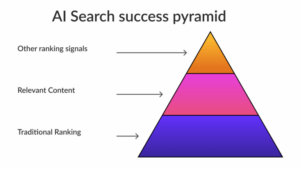
ai search success pyramid

Source: https://ziptie.dev/blog/seo-still-matters-for-ai-search-engines/

You will find more on the relationship between SEO and AISO in this article: What is the difference between regular SEO and AISO? And why do you need both?
The Statistical Trap: Percentages vs. Absolute Numbers

Scanning industry news, it is easy to fall for statistical traps. Headlines will tout triple-digit percentage growth in AI tools’ share of Search, which is true, yet the scale against the whole Search market is still small.

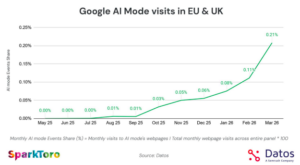
Take the State of Search report for Q1 2026: visits to Google’s AI Mode grew 162.5% between January and March 2026. Seen against all Google visits, AI Mode accounts for just 0.21% of the UK and European market.

google ai mode visits

Source: State of Search Q1 Report, 2026

Traditional search results, by contrast, are a fully mature and saturated market that holds steady but rests on an enormous base of nearly 9 billion queries a day. According to Statcounter data for May 2026, Google still holds a 90% share of the global Search market. Abandoning SEO budgets entirely in favor of work focused only on AI tools means cutting yourself off from a stable source of conversions.

Does this mean it is too early to invest extra in AI-based channels? Absolutely not. The shift is happening now, and the increases, though small in absolute terms, show high growth dynamics. As Rand Fishkin, a world-renowned SEO expert, commented in the report:

AI Mode grew faster in March than any month yet (in both regions). That suggests Google’s getting more aggressive about pushing it, and users are responding. I think we’re just at the start of a trend that could end in double digit percentages. 

Google is increasingly steering users toward AI Mode, but on the users’ side there is also growing interest in LLMs as a search tool. That is why you should start building AI visibility now, without giving up your SEO work.

The Bottom of the Funnel (BOFU) Still Belongs to Traditional SEO

According to a Senuto report that analyzed nearly 18 million phrases in the Polish market, AI Overviews in Google appeared for 24% of queries, though that number keeps rising. Crucially, AIO answers show up mainly for informational queries. They reach users at the early, top-of-funnel stage (TOFU). Building visibility and brand awareness at this stage matters a great deal, but it is not worth basing your strategy on AI channels alone.

For so-called money keywords, meaning purchase-intent phrases from the later funnel stages (MOFU and BOFU), Google still shows users mainly standard search results. That is why, for e-commerce businesses in particular, SEO and presence in organic search remain one of the key customer-acquisition channels.

senuto aio report

Source: Translated image from https://insight.senuto.com/aio-report/

Many transactional queries are indeed migrating to AI tools, but we see this more in the B2B sector, especially for products and services that demand more research, such as SaaS or the financial industry.

Evolution, Not Revolution: Why You Should Not Drop SEO for AI Optimization

Optimizing for AI tools is not a revolution that demands a complete change of approach and the abandonment of practices that already work. It is an evolution and an extension of SEO strategy, because solid foundations and a well-optimized site are essential for building AI visibility. AI tools draw on the pool of standard organic results to source information, so alongside AISO work focused on AI visibility, you also have to keep SEO and Google optimization in mind.

Data and reports show plainly that a strong correlation exists between SEO and AISO, and that wins in traditional SEO increase the chance of citations and mentions in AI tools. From the board’s perspective, maintaining solid SEO foundations combined with thoughtful optimization for AI tools (AISO) will effectively protect profits and let the company grow in both channels.

Sources:

An SEO and AISO Strategy for Your Company

Be visible everywhere your customers are waiting.

Get in touch!
Przemek Jaskierski
Przemek Jaskierski SEO Strategy Manager

Author
Damian Hliwa - Senior SEO & UX Specialist
Author
Damian Hliwa

Head of SEO

Over the several years of his career in SEO, Damian has gone through many positions. They start from internship, through team leader to head of SEO. During these years, his main specialization has been and still remains SEO and technical audits, but he is no stranger to linkbuilding or content campaigns. After hours, a filmmaker and photographer as a so-called one-man-army, a lover of good coffee brewed with all kinds of methods, Polish mountains and cycling.

Author
Damian Hliwa - Senior SEO & UX Specialist
Author
Damian Hliwa

Head of SEO

Over the several years of his career in SEO, Damian has gone through many positions. They start from internship, through team leader to head of SEO. During these years, his main specialization has been and still remains SEO and technical audits, but he is no stranger to linkbuilding or content campaigns. After hours, a filmmaker and photographer as a so-called one-man-army, a lover of good coffee brewed with all kinds of methods, Polish mountains and cycling.

FAQ

Will AI-based tools soon replace traditional search engines like Google?

Although search in AI tools is a growing trend, it still makes up a small share overall. According to the latest data for May 2026, Google holds a 90% share of the Search market. Building brand visibility in AI-generated answers now is certainly worthwhile, because the upward trend suggests that before long we could be talking about double-digit AI shares of the Search market.

Why is cutting the SEO budget in favor of AI a financial risk for a company?

By giving up traditional SEO, a company cuts itself off from a stable, mature market that generates billions of queries a day, handing a proven and profitable customer-acquisition channel to competitors. Investment in visibility across AI channels should run in parallel, not as a replacement.

Does SEO affect visibility in AI?

An analysis by ZipTie.dev points to a clear correlation between ranking first in traditional Google search results and the chance of being cited in AI Overviews or AI Mode. A site that ranks well in Google is a solid foundation for building AI visibility.