Author


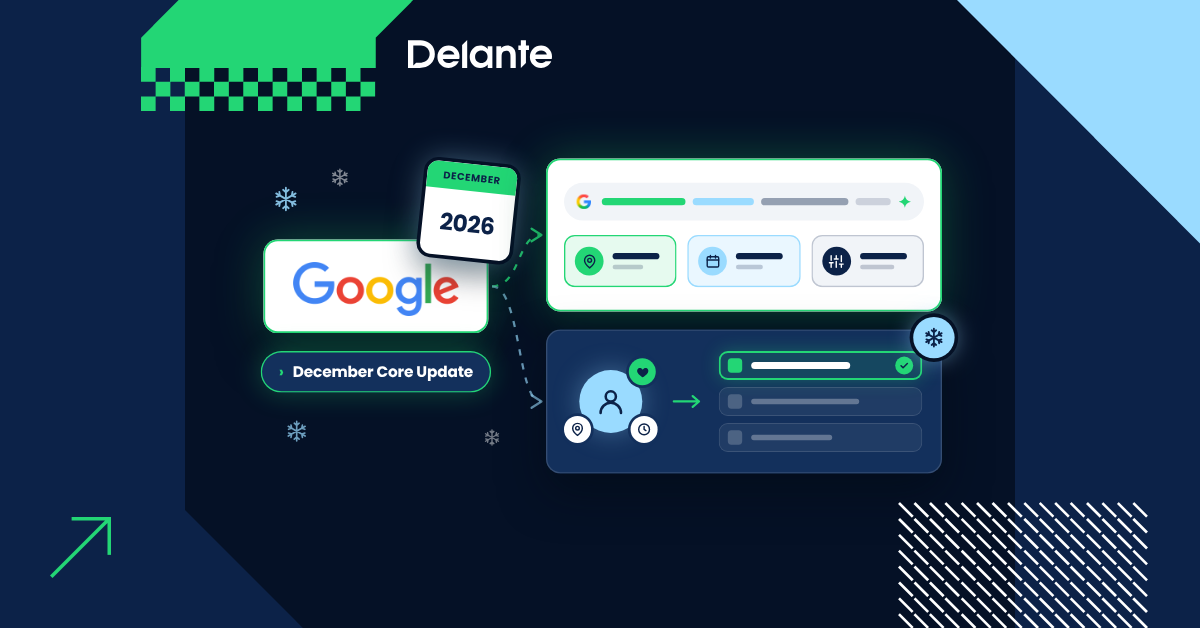
Google announced its December 2026 Core Update on November 24, just one hour after completing the November core update. This time, the company shared more details than usual: the upcoming update will improve how Google understands and ranks relevant content, particularly for longer and more complex search queries, while also refining personalized results for users who have personalization enabled. The update will affect Google Search worldwide, but the rollout has not started yet. Google plans to launch it in December, without specifying an exact date or duration.
For businesses and SEO professionals, the announcement raises two important questions: how will Google evaluate content that answers complex search queries, and what could stronger personalization mean for organic visibility?
| Detail | Confirmed information |
| Announcement date | November 24, 2026 |
| Announcement time | Approximately 10:03 AM EST |
| Expected rollout | December 2026 |
| Current status | Announced, not yet rolling out |
| Geographic coverage | Global |
| Languages | All languages where Google Search is available |
| Main focus | Content relevance, complex queries, personalization |
| Expected duration | Not announced |
Source: Google Search Status Dashboard, November 24, 2026.
The most important takeaways:
What should businesses do now? Review how well their most important pages address complex customer needs, preserve reliable performance data, and prepare to monitor December’s rollout once it begins. There is no reason to make sweeping SEO changes based on the announcement alone.
The timing of Google’s announcement is particularly unusual.
On November 24, 2026, Google confirmed that its November Core Update had finished rolling out. The update began on November 10 and lasted almost 14 days.
According to the official Google Search Status Dashboard, the November rollout ended at 6:03 AM PST (9:03 AM EST).
Approximately one hour later, Google published an announcement about the December Core Update. The company revealed that another broad ranking update was scheduled for the following month. This is notable because Google typically announces major core updates when the rollout begins. Here, the announcement provides advance notice of both timing and some of the areas the company intends to improve. However, one distinction is essential.
Google’s December 2026 Core Update has not started.
Any ranking changes currently associated with the November rollout should not automatically be attributed to the future December update.
For context, read our earlier coverage: Google November 2026 Core Update: What Businesses Should Know.
Google’s official announcement identifies two broad areas of improvement. The first concerns how Search understands and ranks relevant content, including content addressing longer and more complex questions. The second involves personalized search results. Unlike many core update announcements, which primarily describe broad improvements to search quality, this one gives businesses more specific areas to monitor. However, Google has not provided technical details about the algorithms or ranking signals being modified.
Google says the upcoming update will improve how its systems interpret complex questions and identify relevant content. This is particularly important because search behavior is becoming more conversational.
Users do not always search using short phrases such as:
“Best office coffee machine.”
They may instead ask:
“What’s the best automatic coffee machine for a 20-person office under $2,000, with low maintenance costs and easy cleaning?”
The second query contains several requirements.
A relevant result needs to address more than the general product category.
It may need to provide information about capacity, reliability, maintenance, pricing, and suitability for the intended use. Google has explicitly identified longer and more complex questions as one of the areas its ranking systems will improve. For businesses, this reinforces the importance of understanding the complete intent behind a search. However, it does not establish that longer pages, additional FAQs, or content written for conversational prompts will automatically receive better rankings.
Google has not announced a new content format or optimization requirement.
The update will also introduce broader improvements to how Google’s systems understand and rank relevant content. For SEO, this raises the importance of matching a page’s information with what users actually need. A product category page may rank for a broad keyword but still fail to answer important questions about suitability, compatibility, or purchasing conditions. Similarly, a service page may explain what a company offers without making it clear who the service is for, what problems it solves, or how customers can evaluate it. These gaps can reduce the usefulness of a page.
At Delante, we refer to a mismatch between a page’s content and the user’s needs as an Intent Gap.
Improving these areas is a sensible SEO practice regardless of the upcoming rollout. But it is important not to misrepresent Google’s announcement.
Google has not said that the December Core Update specifically targets pages with Intent Gaps or introduces a new intent-related ranking factor.
The practical takeaway is to review relevance and content usefulness, not to search for a supposed quick fix.
One of the most interesting parts of the announcement concerns personalization. Google states that the update will improve personalized search results for users who have opted into personalization. The company has not explained which underlying signals or mechanisms will change. It has also not specified which categories of searches will be most affected. Therefore, it would be premature to claim that browsing history, previous purchases, or particular user interactions are becoming more important ranking factors. What we do know is that Google has explicitly identified personalization as an area of improvement. This could make the interpretation of search rankings more challenging. Two users entering the same query may already see different search results depending on context and personalization settings. If Google’s upcoming changes alter personalized ranking behavior, standardized rank-tracking results may not fully reflect the experience of every individual searcher.
That is a potential measurement implication, not a confirmed outcome of the December update. For SEO teams, it reinforces the importance of evaluating actual search performance rather than relying exclusively on one keyword position.
International businesses are particularly interested in Google’s personalization announcement because their search performance already varies between markets. A retailer operating in the US, UK, Germany, and France may face different competitors, customer preferences, product availability, and search demand in each country. Personalization introduces another dimension to the search experience. However, localization and personalization should not be confused.
Localization concerns differences between markets, languages, and audiences.
Personalization concerns how Google may adapt results to an individual user’s context and enabled settings.
The December Core Update specifically identifies improvements for users with personalization turned on.
Google has not confirmed that the update introduces new international ranking rules.
Still, international companies should analyze performance at a more detailed level.
Useful segments include:
A global visibility score may conceal significant differences between individual markets.
For example, improved performance in the US could offset declining visibility in Germany when viewed in an aggregated report.
This is why international SEO requires market-specific analysis.
In our vidaXL international SEO case study, Delante describes how the project expanded from five markets to 16, with separate keyword priorities, competitor analysis, and market-specific execution.
This case study does not measure the impact of the December 2026 Core Update.
It illustrates why international SEO strategies cannot be evaluated through a single global ranking or traffic figure.
E-commerce websites could be particularly interested in Google’s focus on complex questions.
Product research often involves several requirements at once.
For example, customers may compare:
Product pages and category pages that communicate these details clearly may be better positioned to satisfy complex search intent.
However, Google has not announced that particular product attributes, comparison tables, or FAQ sections will receive preferential ranking treatment.
The practical recommendation is to provide useful information that supports informed purchasing decisions.
Retailers can use the announcement as an opportunity to assess whether important pages answer real customer questions.
For example:
| Page Type | What to Review |
| Product pages | Specifications, availability, compatibility, use cases |
| Category pages | Product differences, selection criteria, filtering |
| Buying guides | Comparisons, limitations, practical recommendations |
| Service pages | Scope, requirements, target customers, value |
| FAQs | Questions that are genuinely important to customers |
These improvements should be guided by customer needs and existing performance data.
There is no evidence that businesses need to create separate landing pages for every possible long-form search query.
Google has not confirmed a specific connection between the December 2026 Core Update and its AI-powered search features.
The company’s announcement refers to improvements in Search ranking systems.
The mention of longer, more complex questions is relevant to broader changes in search behavior, including conversational queries.
However, that does not make this a dedicated AI Mode update.
Google has not announced changes to:
Businesses should therefore avoid treating the update as evidence of changes in AI Search Optimization requirements.
Traditional SEO and AI Search Optimization remain related but distinct areas of measurement.
Organic search performance can be evaluated through Google Search Console, website analytics, and business results.
AI visibility requires additional monitoring of brand mentions, citations, recommendations, and relevant search experiences.
A change in one environment does not automatically establish a corresponding change in the other.
Google has not introduced new technical requirements or a special checklist for this rollout. Its existing guidance for core updates remains applicable. For businesses, the most useful approach is to prepare a reliable measurement framework.
November’s rollout ran from November 10 to November 24. December’s rollout has not yet started. The two periods should be documented separately. This will help businesses avoid attributing ranking movements to the wrong update.
Record the performance of important pages and queries.
Focus on clicks, impressions, average rankings, and conversions.
Because November’s rollout has only just ended, any immediate analysis should remain preliminary.
Google recommends waiting at least one full week after a core update finishes before conducting a detailed Search Console comparison.
Identify the questions customers ask when evaluating your products or services.
Look for content gaps, missing specifications, unclear explanations, and incomplete comparisons.
Improve pages when there is a genuine opportunity to make them more useful.
For global websites, prepare reporting by country, language, page group, and search intent.
This will help identify patterns once the December rollout begins.
Google has not revealed the detailed ranking mechanisms involved.
Mass rewriting content, deleting pages, or changing website structures solely because of the announcement is not justified.
Technical issues that affect users should still be addressed promptly.
Review how organic traffic contributes to qualified leads, transactions, and revenue.
This is particularly important during the holiday shopping season, when demand and user behavior can change quickly.
A traffic increase in December may reflect seasonal interest rather than the impact of a core update.
Likewise, a revenue decline may have causes unrelated to Google’s rankings.
The December rollout will take place during one of the busiest periods of the year for many online retailers.
That makes analysis more complicated.
In late November and December, search demand can be affected by Black Friday, Cyber Monday, holiday promotions, shipping deadlines, and changes in product availability.
If organic traffic increases, the cause may be higher search demand rather than improved rankings.
If conversions decline, the reason may be product availability, pricing, or competition rather than search visibility.
To avoid misleading conclusions, businesses should compare:
For more context, read our guide to combining SEO, SEM, and AI for the holiday shopping season.
The goal is to identify changes that are both meaningful and sustained.
Google has confirmed that the December 2026 Core Update is scheduled for December. However, it has not provided an exact date, time, or estimated rollout duration. The company is expected to publish further information through its Search Status Dashboard once deployment begins. After the rollout is complete, Google recommends waiting at least one full week before evaluating changes in Search Console. That analysis should compare an appropriate post-update period with a period before the update began. Because the rollout will take place during a seasonally active period for many businesses, additional adjustments may be necessary.
The December 2026 Core Update is notable for two reasons. First, Google announced it almost immediately after completing another major ranking update.
Second, it gave more information than usual about the planned improvements.
The update will focus on complex search queries, content relevance, and personalized results.
However, we still do not know which websites, industries, or search queries will experience the largest changes.
For SEO teams, the right response is preparation rather than speculation.
Review how well important pages satisfy user intent, establish reliable reporting, and monitor the rollout when it begins.
The key takeaway: Google’s December 2026 Core Update has been announced, but it is not live yet. Its real impact on rankings, organic traffic, and conversions can only be evaluated after the rollout.
Google’s search algorithms continue to evolve, making it essential to understand not only ranking changes but also their impact on business performance. At Delante, we analyze organic visibility across countries, search intents, and critical website sections. We combine technical SEO, content strategy, international search analysis, and conversion data to distinguish meaningful performance changes from temporary fluctuations.
Explore our international SEO experience or contact Delante to discuss your search strategy.