Google Assistant makes voice search a really powerful tool. It can schedule appointments, set clock alarms, or calculate your route home from work. It helps you find products to buy and gives you search results matching your location. This solution is predicted to become the most popular research method in 2025. How to optimize your website for voice search and stay on top of the game? Keep reading!
Based on the above-mentioned features, you can prepare an SEO strategy that will help youoptimize your page for voice search.
Let’s see how can you do it!
1. Improve Your Mobile Website Loading Time
Google voice search works on mobile devices. It’s natural that pages whose mobile versions load for hours won’t rank high.
Improving your mobile website loading time will always bring you benefits. However, in the case ofvoice search SEO, it’s particularly important.
Need help with improving your Core Web Vitals? Check our Core Web Vitals Audit and boost your ranking!
To check your website loading time, you can use tools like PageSpeed Insights, or GTMetrix. If you realize that your website doesn’t load fast, these tools will give you suggestions on what should be improved.
When considering the Core Web Vitals Update, this is even more vital.
If you see the above message, there is nothing you should worry about. Scroll down to see your total score and trends:
2. Take Care of Your Mobile UX
If your site isn’t transparent on mobile devices, users will abandon it quickly, even if Google Assistant ranks it first. User Experience for every type of SEO, and voice search isn’t different. What if you’re not sure whether your mobile UX is in a good shape?
Well, you could start by looking for common UX mistakes and eliminating them from your website. However, this is a surface approach. If you want in-depth information on improving your website’s mobile friendliness, we recommend a full UX audit, as it will provide you with a detailed list of problems and potential solutions to them.
3. Optimize Content for Featured Snippets
Featured snippets are the recommended Google answers. They are displayed directly in the search results. This is the so-called “position 0”, which can take the form of direct answers.
It doesn’t generate impressive traffic (although it increases brand recognition) because it limits the number of visits to the site. The user spends more time at the search engine level and is usually able to find the necessary answers there.
Nevertheless, the solution is very helpful for mobile device users. We’ve discussed On-SERP SEO some time ago. Check out our blog!
4. Use Natural Long Tail Phrases
Voice queries are speech. They sound natural, can be long, and colloquial. It’s important to remember that they often have the form of full sentences.
If you want to optimize your website for Google voice search, make sure that your texts include long tail phrases, questions, and answers.
Don’t trick your users with misleading titles without giving them the right answer. This will only increase your bounce rate and reader annoyance. As you can see on the screens below, answers to questions often include maps and graphics.
When optimizing your site, you need to take care of all the content, not just text.
Schema, or structured data, allows you to organize the information on your site. It makes your content more readable to Google. Thanks to it, your website can be displayed in the search results as featured snippets.
A large part of voice searches is local queries. They are sometimes constructed as “bakery near me”, “flower shop in Boston”, or “where to have breakfast in Jersey”.
Since Google voice search is mostly about questions, it’s a good idea to create the Frequently Asked Questions section on the website. Thanks to this, users will find information on topics they’re interested in.
A page with an extensive FAQ section will make it easier for you to communicate with users. Moreover, it’s a way to naturally optimize your page for many phrases constructed like questions.
Remember, you may also place FAQs at the end of your blog articles! (We really like this method at Delante . Maybe you’ve even reached our website thanks to it?)
8. Publish Blog Posts Suitable for Mobile Devices
According to Nielsen Norman Group, internet users prefer to watch, browse and scan content rather than read it.
What does it mean for you?
Complement your content with infographics, checklists, and summaries – all of which can show up in voice search. The content on your site must be structured to immediately give answers to the asked questions. Additionally:
Write transparently and understandably,
Build an understandable header structure,
Mark the most important information,
Mark quotes with the use of graphics.
Accept the fact that not many people will read the whole post (or even a short product description). Instead, they’ll scan the text to find the most important information.
This doesn’t mean that you shouldn’t work on longer posts. Everyone is looking for something different. The quality and readability of the text are the foundation required to gain the reader’s trust.
Users browse content based on the F model (in left-to-right reading cultures). They focus on content in the upper left corner, at the beginning of paragraphs, and on headers.
Even if you aren’t displayed in the first position in the voice search results, you can attract users to your site.
How?
By including an attractive CTA in your meta description. This element can do more than key phrases. A proper meta description indicates what can be found on the page, and tells users why a given search result is so important.
The Popularity of Google Voice Search in 2025
In the past, itw as predicted that half of all the queries would be voice searches by 2020. Additionally, WARC predicted that by 2025 72% of internet users around the world would browse the net on smartphones, tablets, or smartwatches, using voice search. Since it’s already 2025, we can now verify this data. What does it look like today?
Can Google Home Answer All Your Questions? The Phenomenon of Smart Speakers
Amazon Echo, Google Home, or Apple HomePod smart speakers are gaining increasing popularity. They can be easily used on an everyday basis and allow manufacturers to develop technologies like voice search.
There are already more than 200 million smart speakers in the world.
In 2022 their sales may surpass the sales of tablets (data from the Canalys report). Moreover, IDC data shows that Google Home devices constitute the fastest-growing smart home category in Europe.
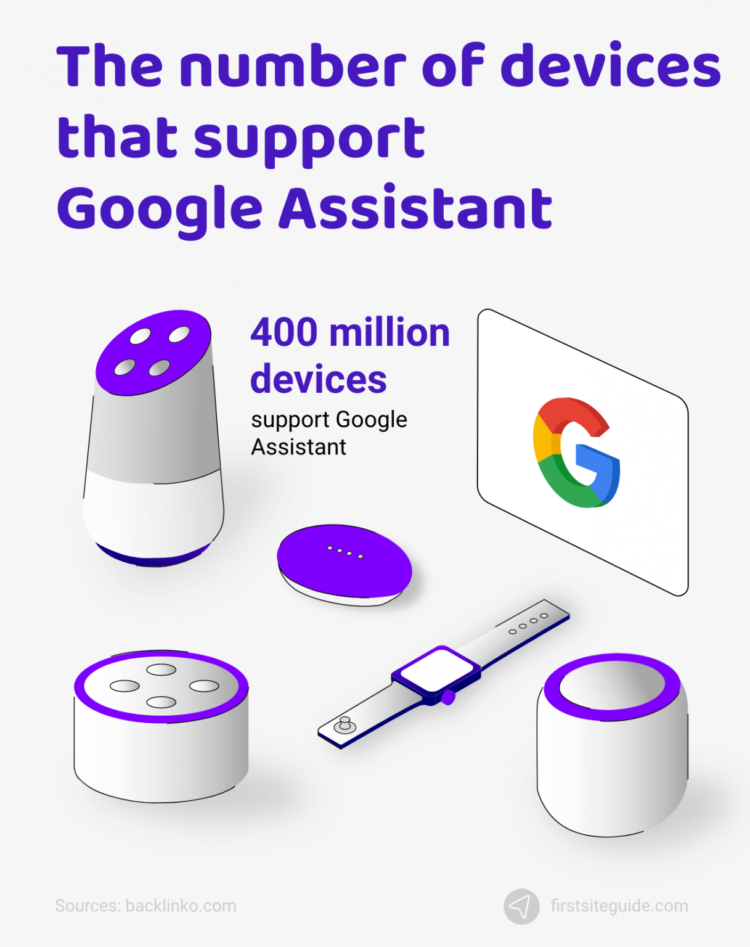
The language barrier disappears every year. Online voice assistants expand their polyglot skills and speak more and more languages. Today, there are more than 400 million devices that support voice search. Smart speakers aren’t an exception.
The convenient and innovative voice search is gaining increasing popularity. The number of people using voice assistants (such as Google Assistant) is growing rapidly. In 2020 it was already over 4 billion. Statista’s 2021 predictions indicate that this number is expected to double by 2024.
Naturally, we have to look at this data with a pinch of salt – it’s increasing partially due to households owning multiple voice assistant devices. Nevertheless, the number of voice assistant users is also rising, to the progress in this case is much slower. According to Statista, there are almost 150 million voice assistant users in the US only, which indicates a 2.5% increase in their number per year.
All this reshapes the way we use the internet and shows the direction of development for ecommerce companies and other businesses. It seems that voice search is the future of the online world and SEO.
Why Is Voice Search Important for SEO?
Voice search SEO brings various benefits, including:
Increased visibility in the search results on mobile devices,
Increased visibility in the local search results,
The possibility of being displayed in direct answers,
An increased number of natural long tail phrases the website is displayed for,
Increased accessibility for those with disabilities.
In practice, voice search is yet another SEO channel, so you have to utilize it for maximum effectiveness.
Are Users Scared to Buy Using Voice Search?
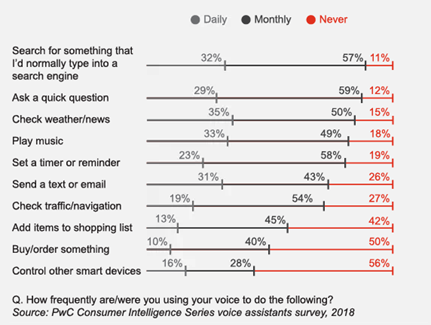
The PWC report revealed interesting facts concerning transactions made via voice search.
It turns out that when the study was conducted (in 2018), users were quite anxious to shop via voice search.
What do we mean by that?
People would willingly use voice search to order pizza on a Friday night, buy books, or other small household items. Interestingly, only 22% would purchase electronics and 3% would let the voice assistant purchase clothes.
What’s the future?
The predictions are promising. Some of them are already becoming reality.
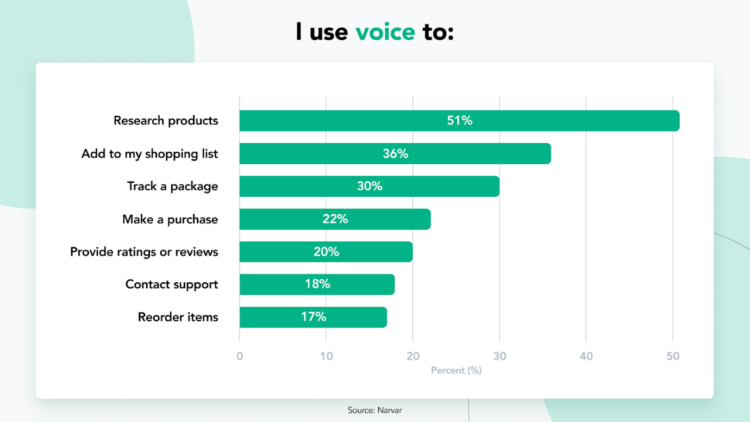
Voice search is becoming increasingly important for business. According to a report by Juniper Research, users still use voice search as a form of research and typically finalize transactions via devices like smartphones, tablets, or laptops. Sounds familiar, doesn’t it?
Not so long ago we described a similar situation with mobile devices and computers. The first ones were used for research, while the latter – for purchasing. Today, we are a step ahead and mobile devices are used to finalize transactions.
Voice search seems to be in the same spot as mobile devices a few years ago.
This is further strengthened by the latest data. According to Synup, we should experience a 20% increase in “research” keywords (e.g., those including “best”, “list”, “top”) in voice search this year. Plus, it still generated about $2 billion in sales in 2023, so while it is used mainly for research, it can also bring conversions and boost your revenue.
Why Is It Worth Investing in Voice Search Optimization in 2025?
Do you prefer hard data? Here are five points that will prove to you that voice search SEO is the future:
19% of smart speaker owners use them to shop online (Walkersands). As already mentioned, more and more people use speakers.
The value of e-commerce transactions made via voice assistants will reach more than $19 trillion by 2023. In 2021, that amount was $4.6 billion (Juniper Research).
57% of 18-24-year-olds say they’ll use voice search and voice assistants (PWC) even more. Currently, it’s mainly used by people aged 25-49.
32% of respondents use voice search instead of typing in queries into the search engine every day. Just 11% say they never do this (PWC). Half of the respondents buy something via an assistant at least once a month.
In 2020, 30% of all browser sessions took place without the use of a screen. In 2025, about 40% of web searches in the US are voice searches, and the number worldwide is about 27%, constantly increasing. (via Techjury)
How Does AI Impact Voice Search?
AI has a powerful impact on voice search – in principle, it makes it possible and more accurate. NLP models are currently used to interpret voice queries and provide relevant results. As we mentioned before, voice searches use much longer keywords – a standard query can even be 30-words-long. It is only thanks to AI that such queries work for the users, enabling them to search for information, products and services more naturally.
At the same time, we need to remember that most voice assistants in 2025 are already empowered by AI. They don’t only analyze queries and make relevant searches based on them, but also learn about the user themself. Take Siri for example – by default, it’s set to collect and analyze data about the user to provide them with personalized responses. So, the searches (and results) are interpreted in a specific context – the same query may prompt a different result from the assistant depending on the user.
Voice Search and SEO – The Takeaway
To sum up, a website optimized for voice search has:
Short loading time
Transparent mobile version
Content optimized for direct answers
Natural and long keyword phrases
Implemented structured data (schema)
Complete Google My Business listing
FAQ section
Blog articles adapted to mobile browsing
CTAs in the meta description
Ready to implement changes on your website? Contact us and let’s get it started!
Having completed English Studies with a translation specialty, he has discovered his marketing knack, joining Delante as an English copywriter. Ever since, he has developed a keen interest in content strategizing and effective communication, prioritizing clarity and logic in his texts and content plans. He’s also keen on accessible content and audio-description.
Having completed English Studies with a translation specialty, he has discovered his marketing knack, joining Delante as an English copywriter. Ever since, he has developed a keen interest in content strategizing and effective communication, prioritizing clarity and logic in his texts and content plans. He’s also keen on accessible content and audio-description.
FAQ
What is voice search?
Voice search is about using your voice to browse the internet. It’s done through voice assistants such as Google Assistant, Siri, Alexa or Cortana. It allows you to start a session in the browser without typing phrases and using the screen.
According to forecasts and statistics, voice search is not a temporary trend, but a solution that creates new ways of browsing the net.
How is voice search going to change SEO?
Voice search will primarily affect users’ queries and teach Google to understand people better.
Queries in the form of questions will affect voice search and keywords for which the website is displayed in the search results. Apart from that:
The search language will become more natural due to the increasing popularity of Google Assistant.
It’s possible that the word order in long tail phrases will be changed. Instead of “high heels red” we’ll have “red high heels”, whereas “cheap breakfast Boston” will be replaced by “where to eat cheap breakfast in Boston”.
Voice search will also significantly increase the importance of direct answers and local search.
How many people use voice search?
According to the 2021 data, more than 3 billion people already use voice search. It’s worth noting that the number of all internet users is estimated to reach 4.5 billion. Voice search users constitute almost ¾ of them (Statista).


 d-tags


 Loading...