
E-commerce in the Middle of Summer: How to Prepare Product Pages for GEO and Improve Their Readiness for the Sales Season

7min.

Comments:0

06 August 2026

E-commerce in the Middle of Summer: How to Prepare Product Pages for GEO and Improve Their Readiness for the Sales Season
The middle of summer is the right moment to optimize your product pages before the Q3 and Q4 shopping peak, while the sales pressure is still low. A good product page should describe the product precisely and in concrete terms, and stay easy to read for the user. Well thought out UX and proper optimization are the key to better product visibility in Google and AI tools, along with a chance for much higher conversion and fewer returns. Find out how to prepare your best selling products for the coming season with GEO and UX in mind.

7min.

Comments:0

06 August 2026

A summer product page audit: what is worth checking before the peak season

Even if you start optimizing right now, you will not manage to fix every product page. Here is the work plan: start by setting priorities. Focus first on optimizing:

  • Bestsellers,
  • Products with high seasonality falling in Q3 and Q4,
  • Products with heavy traffic but low conversion (a signal of high potential and possible quick wins),
  • Products with many variants (the highest risk that errors have crept in).

Once you have selected the products to optimize, review them against the checklist below:

  • Precise name (and H1 heading): an understandable name that includes the most important product feature and the specific variant, without artificially stuffing in keywords.
  • A description based on specifics: replace marketing generalities with hard data that directly helps the customer decide to buy.
  • A “who is this for” section: a clear paragraph indicating who the product is aimed at and what specific problems it solves.
  • A specification table: a transparent overview of the most important parameters (dimensions, material, intended use) matched to the requirements of the given industry.
  • High quality photos and video: image files (with completed ALT attributes) showing product details and the context of natural use.
  • Trouble free variant handling: automatic updates to the photo, price, availability and name immediately after a different option is selected (color or size, for example).
  • Full text reviews: publishing substantive reviews that answer real user concerns (how the sizing runs, durability over time), not just an average shown as stars.
  • Clear logistics rules: information about shipping costs, delivery times and the return policy, visible before the item is added to the cart.
  • Correct behavior on mobile devices: fast page loading and easy access to the buy button, photos and specification on smartphone screens.
  • Structured data (Schema): correctly implemented markup in the page code that matches exactly what the user sees (current price, availability and ratings).

Take a look at and download the full conversion rate optimization checklist prepared by Delante experts.
GEO in e-commerce: this is not about writing texts for AI

GEO, meaning optimization for every element of the Google ecosystem, means one thing in e-commerce: preparing your site and product data so that the brand and its products are understandable, credible and possible to show in generative search results (in AI Overviews or AI Mode, for example).

There is no single simple key that guarantees a presence in AI Overviews. GEO is a complex process in which the fundamentals of the SEO process matter, such as:

  • site indexability,
  • useful, original content,
  • clearly listed product data,
  • running a Google Merchant Center account,
  • care for the user experience.

On top of that, authority is especially important in GEO. In its generative answers Google chooses to show only the brands it considers trustworthy, and that element should be one of the basic components of a GEO strategy.

Instead of focusing on producing more paragraphs of text or another FAQ, work on building the digital authority of your brand and introduce e-PR activities. These elements will noticeably improve your brand authority in the eyes of Google, which becomes a solid foundation for further product page optimization.

Learn more about building brand authority: why your business needs authority in the eyes of AI.

Why does the product page matter more today than it used to?

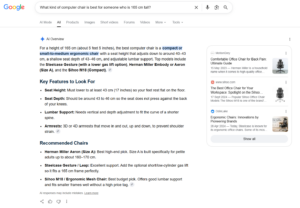
The way users search for products in Google has changed considerably. Being able to match a product to user intent more precisely means that people increasingly reach for longer queries. Instead of the keyword “office chair”, a user will ask “which chair for computer work suits a person who is 165 cm tall”, and Google will prepare a ready answer recommending a few matching models.

If your product page is not optimized and does not include the basic information about who the product suits, Google will not mention your product, and you will lose a potential customer at the research stage.

google aio results

Source: Google

A good product page optimized with GEO in mind has to include information that lets the user judge whether the product is right for them, whether it will meet expectations, and how it differs from competing models. This is exactly the kind of information Google uses to build its generative answers.

A good product page reduces purchase uncertainty

If Google recommended your product in its answer, that is already the first step toward success. At the next stage your product page still has to convince the user to buy. Keep in mind that when shopping online the customer cannot touch the product, check the material, judge the quality or try the clothing on. The product page should therefore create the desire to buy on one side, and help the customer limit the risk of a wrong decision on the other.

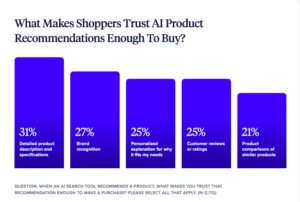
In this year’s report “Consumer Research 2026: What Makes Shopping Experience Matter?” Salsify shared the results of a survey in which respondents were asked what makes them ready to buy a product after AI recommends it. A detailed product description and its specification came first.

czynniki zaufania do produktu po rekomendacji ai

Source: Salsify Consumer Research Report 2026

This shows how much it matters to point to specific parameters on the product page rather than vague marketing phrases. So how do you turn empty wording into the language of specifics?

Marketing generalityA specific that helps make the decision
A very comfortable chairSeat depth and lumbar support adjustment for people working long hours.
High quality material100% linen of a specified weight; the fabric is not stretchy.
The perfect travel suitcaseDimensions within the cabin baggage limit and a separate laptop compartment.
An intensely moisturizing creamA formula for dry and dehydrated skin that supports the hydrolipid barrier.
A dress that is perfect for summerOpaque lining, adjustable straps, length from the armpit 102 cm.
A good marketing description can spark interest in a potential customer, but it is specific data that helps people decide. A well defined specification helps the user judge more quickly whether the product matches their requirements, and at the same time reduces the fear of having to return it and of being disappointed.

7 product page elements worth improving for GEO and conversion

Below we have put together a list of the 7 most important aspects worth paying attention to when optimizing a product page:

1. A well thought out product name plus high quality photos and videos

The product name should be precise enough to indicate what the product is, what its most important feature is, and which variant it is (where that matters). Taking the clothing industry as an example, instead of naming a product “Livia Dress”, it is better to choose the variant: “Livia Linen Midi Dress with Adjustable Straps, Beige”.

This is not about keyword stuffing, meaning unnaturally adding keywords to the product name, but about pointing out the most important information that lets the user and Google bots understand what the product is.

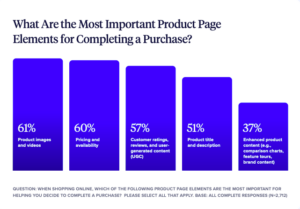
In the Salsify report mentioned above, users were also asked what the most important element convincing them to place an order is. The elements named most often (61%) were product photos and videos. When the user cannot see the product in person, visual materials become the basis for the decision.

elementy karty produktowej przekonujące do zakupu

Source: Salsify

Take care of high photo quality and also show examples of the product in use, because that may be the trigger that convinces the customer to buy.

2. A section titled “is this product for me?”

An answer to more elaborate user queries can come from an additional section in the product description whose purpose is to define who the product suits. A paragraph like this may turn out to be a practical differentiator against the competition, because not every business uses this solution yet.

What can a section like this look like? Taking a mattress as an example:

“The XYZ mattress is a good choice for side sleepers who are looking for a medium firm mattress and want to reduce the feeling of sinking in around the shoulders.”

This way you give the user specific information and address their needs, which can make the choice easier and effectively convince them to buy.

3. Parameters that help compare the product

A specification table is a must have on a product page, regardless of the industry. The user usually scans the page first, starting with the photos and then moving to the product data table. Presenting product features this way is the simplest and fastest to absorb, both for the user and for Google bots.

What should the specification table contain depending on the industry?

CategoryInformation that matters most for the decision
FashionMaterial, dimensions, cut, transparency, color, sizing guidance.
CosmeticsIngredients, intended use, how to apply, contraindications, combining with other ingredients.
FurnitureDimensions, load capacity, material, ergonomics, assembly, extra features.
ElectronicsCompatibility, parameters, battery, box contents, warranty.
Travel accessoriesWeight, dimensions, airline restrictions, material durability, interior organization of the bag or backpack.

Beyond the more technical parameters, the more “descriptive” points are also worth presenting in table form. You can add a few rows about who a given product variant is for, when it works well and so on. Think about the questions a potential customer may have about the product, and include that information in the table in a way that makes it sufficient to answer them.

4. Variants without the chaos

If the same product comes in different sizes, colors, materials or capacities, both the user and Google have to know unambiguously which variant they are currently looking at.

Variant related errors are among the most frequent challenges in e-commerce. What deserves particular attention when you review product pages with variants?

  • Make sure the variants have the right price and availability assigned.
  • Check all product variants to see whether the photos are correct.
  • Verify whether the product name changes after clicking a different color variant.
  • Check data consistency between the site and the products in Google Merchant Center.
  • Make sure the product page clearly communicates the other available product variants.

5. Reviews as proof, not decoration

According to the study “How Online Reviews Influence Sales” carried out by the Spiegel Research Center, showing reviews on a product page can increase conversion by as much as 270% (3). Collecting customer reviews and presenting them in full on the site (not only as graphically rendered stars) considerably increases user trust in the product they are viewing. More important than the average rating itself is the sense that the user can see a fuller picture of the product, learn how the sizing runs, whether the color matches the photos and whether the product itself does its job well.

If you are not using a system for collecting and displaying reviews on your site yet, it is high time to change that. You can also encourage customers to leave reviews by offering a discount as a thank you. Now is the best moment to do it, so that you can show more product ratings on the site in Q3 and Q4.

6. Shipping, returns and availability as part of the purchase decision

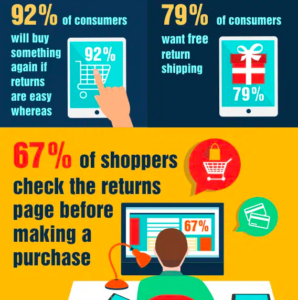
The available delivery methods and the return policy are key elements of the purchase decision for many customers. According to data from the Spiegel Research Center report, 79% of customers decide to buy only when free returns are possible, and 67% check the return policy page before making a purchase.

wpływ warunków dostawy i zwrotu na decyzję zakupową

Source: Spiegel Research Center

That is why you should communicate return and shipping terms clearly, along with the related costs, ideally before the user makes the purchase.

7. Product page optimization for SEO

From an SEO perspective, the following elements are worth optimizing or verifying:

  • Indexation: is the product page indexable by Google?
  • Title, H1: are these elements optimized for the right keywords?
  • Variants: are they split properly, do they have separate URLs?
  • Photos: are the file names appropriate, do they have completed ALT attributes?
  • Mobile: does the product page display well on mobile devices? Does it work fast?
  • Internal linking: does the product page include a section linking to other similar or complementary products within a set?
  • Structured data*: is it implemented? Does it match the content on the page?

*Schema (structured data) is not a guarantee of visibility in AI Overviews or AI Mode, but it helps Google understand your offer better and supports product presentation in search results, for example by displaying rating stars or the product price in a rich snippet.

Product Page Analysis

Increase your product sales with our help.

See the offer
Damian Hliwa
Damian Hliwa Head of SEO

Sources:

  1. https://www.salsify.com/thank-you/report/2026-consumer-research
  2. https://www.invespcro.com/blog/ecommerce-product-return-rate-statistics/
  3. https://spiegel.medill.northwestern.edu/wp-content/uploads/sites/2/2021/04/Spiegel_Online-Review_eBook_Jun2017_FINAL.pdf
Author
Damian Hliwa - Senior SEO & UX Specialist
Author
Damian Hliwa

Head of SEO

Over the several years of his career in SEO, Damian has gone through many positions. They start from internship, through team leader to head of SEO. During these years, his main specialization has been and still remains SEO and technical audits, but he is no stranger to linkbuilding or content campaigns. After hours, a filmmaker and photographer as a so-called one-man-army, a lover of good coffee brewed with all kinds of methods, Polish mountains and cycling.

Author
Damian Hliwa - Senior SEO & UX Specialist
Author
Damian Hliwa

Head of SEO

Over the several years of his career in SEO, Damian has gone through many positions. They start from internship, through team leader to head of SEO. During these years, his main specialization has been and still remains SEO and technical audits, but he is no stranger to linkbuilding or content campaigns. After hours, a filmmaker and photographer as a so-called one-man-army, a lover of good coffee brewed with all kinds of methods, Polish mountains and cycling.

FAQ

Why are marketing descriptions alone no longer enough on a product page?

The way customers search for products has changed. Instead of general phrases, they ask the search engine very precise questions about their specific needs. Marketing generalities only build interest, while specific data (dimensions, intended use, ingredients) genuinely helps people decide, and also increases the chance of appearing in a generative answer created by Google. Well described parameters reduce customer uncertainty and limit the risk of a poor purchase and a later return.

How do you correctly present a product that comes in many variants, such as colors or sizes?

The key is presenting the differences between variants clearly, both for the user and for Google bots. Selecting a specific variant on the page has to be unambiguous: the assigned price, availability status, product name and matching photo should all change automatically. It also matters that individual variants have separate URLs and stay 100% consistent with the product feed sent to Google Merchant Center.

Does implementing structured data (Schema) guarantee that a product will appear in AI Overviews?

No. Implementing Schema markup is not a pass that guarantees a presence in generative search results. Structured data does, however, help Google bots understand your offer much faster and more precisely, which forms the foundation for building visibility. It also supports the quality of product presentation in classic search results (rich snippets), for example by displaying the current product price or the average rating.